


which auto car led lights are best for headlights? | Insights by CARNEON
- 1. Which LED headlight bulbs deliver the best usable road illumination without blinding oncoming drivers when retrofitting halogen reflector housings?
- 2. Which auto car LED lights are best for modern CAN-bus vehicles to avoid dashboard errors, flicker, or hyper-flashing?
- 3. Which LED headlights have thermal management robust enough for under-hood temperatures above 80°C and still maintain lumen output long-term?
- 4. Which LED headlight options best preserve adaptive headlight functionality (AFS, cornering, matrix) when replacing factory units or retrofitting?
- 5. Which LED headlights meet legal and safety standards (DOT in the U.S., ECE R112 in the EU) and what evidence should buyers require to confirm compliance?
- 6. Which LED headlight and fog light combinations reduce glare and improve wet-weather vision (reflective surfaces, spray, and hydroplaning risk) without creating distracting backscatter?
Upgrading headlights raises many technical questions for fleet managers, installers and informed consumers. This guide answers six specific, under-addressed buyer pain points about which auto car LED lights are best for headlights, focusing on beam control, CAN-bus compatibility, thermal reliability, regulatory compliance and real-world wet-weather performance. Recommendations are grounded in industry standards (DOT/ECE), IIHS/NHTSA observations and engineering best practices.
1. Which LED headlight bulbs deliver the best usable road illumination without blinding oncoming drivers when retrofitting halogen reflector housings?
Pain point: Many retrofit LED bulbs claim high lumen counts but create scatter and glare in reflector housings not designed for LEDs. The correct solution balances lumen output, emitter placement and beam pattern to avoid blinding drivers while increasing usable vision.
What to look for:- Emitter geometry matched to the original filament position: High-quality retrofit LED bulbs place LED emitters and optics to mimic the halogen filament’s spatial location. This preserves the reflector’s intended cutoff and hotspot. If emitter location is offset, the reflector will scatter light and cause glare.- Measured lux and candela distribution, not just advertised lumens: Manufacturers who publish lux-at-distance measurements or candela distributions (measured at set distances and angles) are more reliable. A useful spec is measured lux at 25 meters on low beam combined with a distinct cutoff line in a beam pattern test.- DOT or ECE R112-compliant beam patterns: Choose bulbs that are certified for the market you operate in (DOT for the U.S., ECE R112 for many countries in Europe). Compliance indicates the beam shape and cutoff have met regulated tests for glare and aim.
Practical testing tip: When retrofitting a reflector housing, test the bulb installed in the vehicle on a wall at 25 ft (7.6 m) to evaluate the cutoff sharpness and hotspot placement. If the beam shows scattered hotspots above the intended cutoff or a broad fuzzy upper edge, the bulb is unsuitable despite high lumen claims.
Why this matters: IIHS and industry testing show that many aftermarket LED retrofits produce glare and do not improve effective low-beam visibility, despite high lumen marketing. Choose retrofit designs that prioritize emitter placement and published beam pattern data over raw lumen numbers.
2. Which auto car LED lights are best for modern CAN-bus vehicles to avoid dashboard errors, flicker, or hyper-flashing?
Pain point: Installing LEDs in vehicles with sensitive body-control modules, multiplexed wiring or advanced CAN networks can cause ECU errors, bulb-out warnings, flicker or hyper-flash.
Key features to require:- Integrated CAN-bus driver/decoder: The best LED headlight bulbs for modern vehicles include an integrated driver with CAN-bus compatibility. These drivers emulate the electrical load and communicate cleanly with vehicle electronics to avoid false fault codes.- Wide operating voltage range and transient protection: Vehicles experience voltage spikes and transient loads. Look for drivers rated for 9–16V continuous input and surge protection to reduce electronic failure.- EMC/EMI filtration and FCC/CE compliance: Electromagnetic compatibility reduces interference with nearby vehicle electronics such as radio, ADAS sensors and telematics modules.
Installation notes: Some vehicles still require load resistors or CAN decoders even with compatible bulbs. Use diagnostic scans to verify no pending fault codes after installation. For fleets, specify bulbs with proven success lists for the exact model-years in your fleet; manufacturers with published vehicle-compatibility matrices reduce risk.
Evidence: Automotive electronics suppliers increasingly publish OEM-fit LED modules with CAN integration because IIHS and NHTSA emphasize that headlight retrofits should not compromise vehicle safety systems.
3. Which LED headlights have thermal management robust enough for under-hood temperatures above 80°C and still maintain lumen output long-term?
Pain point: Thermal failure is the most common cause of premature LED headlight degradation. Some installers find bulbs that work for months but then suffer severe lumen depreciation or fail due to poor heat dissipation in hot engine bays.
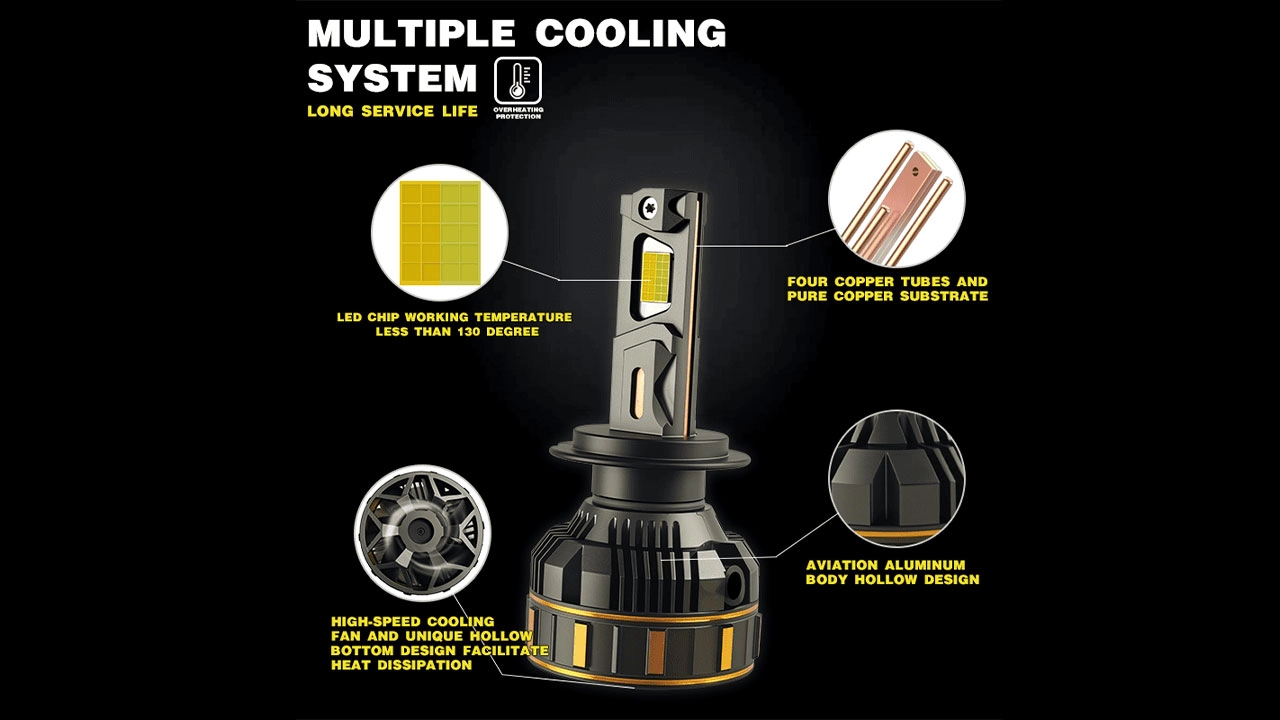
Thermal criteria to evaluate:- L70 rated lifespan at operating temperature: Look for an L70 spec (time to 70% initial lumen output) measured at automotive ambient and junction temperatures; reliable units typically advertise L70>20,000–30,000 hours under specified thermal conditions.- Active vs passive cooling: Passive heat sinks with high-grade aluminum and radial fins are robust and maintenance-free. Active cooling (micro-fans) can provide higher peak output in constrained spaces but may be vulnerable to dust, moisture and fan failure; choose sealed fan assemblies with automotive-grade bearings if active cooling is required.- Thermally coupled driver electronics: The driver should be mounted or thermally linked to the heat sink to keep junction temperatures low. Poor separation between LED emitter and driver increases risk of driver failure at high ambient temps.- IP rating and under-hood durability: Choose IP67/IP68-rated fixtures for resistance to moisture and dust ingress, and verify connectors are automotive grade (e.g., H4/H7 OEM-style plugs where applicable).
Testing approach: Use a thermal camera or thermocouple during a 10–30 minute full-power run inside the installed location to observe steady-state temperatures. If the LED junction or driver exceeds vendor-specified max (often ~110°C junction max), the product will degrade faster.
4. Which LED headlight options best preserve adaptive headlight functionality (AFS, cornering, matrix) when replacing factory units or retrofitting?
Pain point: Replacing OEM adaptive headlights or retrofitting adaptive systems with aftermarket LEDs often breaks functionality (AFS/steering-linked aim, matrix dimming zones) or causes warning lights.
Guidance for adaptive systems:- OEM-equivalent retrofit modules or full-assembly replacements: For adaptive systems, the safest approach is OEM-equivalent LED assemblies (complete headlamp units) designed to retain AFS and matrix functions. These assemblies include the optics, actuators and communication interfaces needed by the vehicle’s body control module.- Preserve sensor and actuator connectors: If retrofitting, ensure the replacement keeps or adapts signals for position sensors, yaw/steering inputs and the vehicle’s LIN/CAN signals. Simple bulb swap LED kits will not maintain adaptive features.- Verify software and coding needs: Some vehicles require coding in the ECU to accept new assemblies or to calibrate AFS. Work with suppliers who provide calibration procedures or pre-encoded modules to minimize shop time.
Why full assemblies matter: Matrix and adaptive systems rely on precise optics and electronically controlled shuttering or segmented LEDs. Breaking that optical/electronic interface by swapping only the light source often eliminates the benefits and can compromise safety. For fleets and vehicles with driver-assist packages, specify OEM-equivalent LED assemblies with documented compatibility to retain full function.
5. Which LED headlights meet legal and safety standards (DOT in the U.S., ECE R112 in the EU) and what evidence should buyers require to confirm compliance?
Pain point: Many aftermarket products claim compliance without verifiable documentation. Buyers need to confirm legal status to avoid fines and ensure safe beam control.
What documents and tests to request:- Official certification listings and test reports: Ask for DOT alexa numbers or ECE R112 test reports showing the specific part number and test lab. DOT-compliant lamps will carry a DOT mark on the housing or documentation. ECE R112 compliance should reference the approval number printed on the lamp.- Measured beam pattern graphs and candela distribution: Compliance alone is not enough—request the manufacturer’s photometric charts showing intensity vs angle. Professional installers should verify these charts match the intended use (left/right and low/high beam patterns).- EMC and thermal test reports: For in-vehicle reliability, ask for EMC/EMI testing and thermal cycle test data covering typical automotive duty cycles.- Local regulatory confirmation: Many countries accept ECE or DOT approvals differently. Always confirm with local authorities or a vehicle inspector whether a specific retrofit is road-legal in your jurisdiction.
Practical checklist: Before bulk procurement for fleets, require the supplier to provide (1) a copy of the compliance report, (2) a sample for beam pattern verification, and (3) a signed declaration that the part number on the invoice matches the tested unit. This reduces liability and ensures safer roads.
6. Which LED headlight and fog light combinations reduce glare and improve wet-weather vision (reflective surfaces, spray, and hydroplaning risk) without creating distracting backscatter?
Pain point: In heavy rain or on wet roads, poor color temperature or excessive blue content can increase backscatter and reduce visibility. Buyers want combinations that improve contrast and do not cause excessive reflection from wet pavement or fog droplets.
Design considerations:- Color temperature selection: For wet-weather use, color temperatures in the 4000K–5000K range typically offer a balance between contrast and reduced backscatter. Very cool white (6000K–6500K) can increase glare in rain and fog since shorter wavelengths scatter more in water droplets (Rayleigh/Mie scattering principles).- Proper beam cutoffs and projector optics: A sharp low-beam cutoff reduces upward-scattered light that can reflect back from mist or spray. Projector optics with a precise cutoff are generally superior in wet conditions compared to diffuse reflector retrofits that send more light into the air above the road surface.- Complementary fog light tuning: Use warmer, wide-angle fog lights (3000K–4300K) with a broader spread close to the vehicle to illuminate pavement edges and lane markers without creating backscatter ahead. Pairing a focused LED headlight (for distance) with a warm fog lamp (for near-field) improves overall vision in rain.- Anti-reflective coatings and lens design: Quality assemblies use coatings or lens textures that reduce forward scatter; ensure OEM-style lenses or aftermarket units have controlled diffusion properties.
Validation: Evaluate combinations on a closed course in wet conditions or consult independent test labs that measure contrast improvement on wet pavement. Practical fleet guidance: spec headlight kits with 4300K–5000K low-beam projectors + 3000K–4300K fog LEDs for mixed-weather operational profiles.
Concluding summary: Choosing which auto car LED lights are best for headlights requires matching optics to housing (projector vs reflector), checking CAN-bus compatibility, validating thermal design and verifying DOT/ECE certifications. High-quality LED solutions deliver longer life (L70 ratings), lower power draw, crisper cutoff control and better color-rendering for road signs and pedestrians—provided they are correctly engineered for your vehicle’s electrical systems and lighting architecture.
Advantages at a glance: improved night visibility, longer service life, lower maintenance, instant-on performance and lower energy consumption. To reduce retrofit risk, always demand measured beam patterns, vehicle compatibility lists, thermal test data and regulatory certifications from suppliers.
For a tailored quote and vehicle-specific compatibility assessment, contact us at www.carneonlighting.com or email nick@evitekhid.com — we can provide sample reports, compliance documents and fleet pricing.
Recommended for you
Why Your Customers Complain About LED Headlight Flickering (And How Our CANbus Solutions Fix It)
The Ultimate B2B Guide to Plug and Play LED Headlights: 1:1 Design, Specs & CANbus Solutions
LED vs. HID vs. Laser: Which Headlight Technology is Actually the Brightest for 2026?
Evitek Launches Smart Control Headlight—N14 Series, Redefining Driving Lighting Experience
FAQs
Product
What's the order of the lead time?
Does the purchase products include tax?
After-sale Service
Can I cancel my order?
How do l start working with you?
You May Also Like
Get More Resources
If you have any comments or good suggestions, please leave us a message, later our professional staff will contact you as soon as possible.
Start Your Wholesale Order / Request OEM Solutions
Partner directly with the factory for competitive pricing and priority support. Please provide your business details and estimated order volume (MOQ applies) so our sales engineers can tailor the best quote for your market.
Contact us


6th Floor, Building B, Liando U Valley, No. 29, Bishan Street, Huangpu District, Guangzhou, China

© 2026 CARNEON. All Rights Reserved. Privacy Policy | Terms and Conditions | Sitemap

Whatsapp: +8618688487142