


LED Headlight Troubleshooting for Auto Parts Distributors: Installation & Compatibility Workflow
- Quick Answer
- Key Takeaways
- Use a Five-Step Distributor LED Headlight Troubleshooting Framework
- Step 1 — Identify
- Step 2 — Classify
- Step 3 — Check
- Step 4 — Escalate
- Step 5 — Record
- Why Does Socket Fit Not Guarantee Full Vehicle Compatibility?
- What Information Should a Distributor Collect Before Troubleshooting?
- Use a Five-Category Troubleshooting Decision Matrix
- How Should Distributors Handle Common LED Headlight Troubleshooting Scenarios?
- The LED Headlight Does Not Turn On
- The LED Flickers or Triggers a Dashboard Warning
- Other Troubleshooting Scenarios
- Follow a Distributor Troubleshooting Decision Tree
- What Should Distributors Do When the Same Application Produces Repeated Complaints?
- Review the Application Assignment
- Review Technical Documentation
- Check the Product Revision
- Avoid Conclusions Based on a Single Case
- Record the Final Outcome
- What Should Be Included in a Supplier Escalation Package?
- Distributor Troubleshooting Readiness Checklist
- Frequently Asked Questions
- Conclusion
- Need Help Reviewing a Specific LED Headlight Application?
Quick Answer
Do not replace or escalate an LED headlight immediately after a complaint. First identify the exact vehicle and installed product, classify the issue as physical, electrical, optical, thermal, or installation related, and complete the relevant first-line checks. Document the result before deciding the next action. Escalate unresolved repeatable problems with structured evidence, and review fitment records when the same application generates repeated complaints.
Key Takeaways
- Socket fit does not confirm complete vehicle compatibility.
- Every case should start with exact vehicle, product, installation, and symptom information.
- Classify the complaint before replacing components or assuming a product defect.
- Escalate unresolved repeatable problems with structured evidence.
- Repeated application issues should feed back into fitment records and technical documentation.
Use a Five-Step Distributor LED Headlight Troubleshooting Framework
Identify → Classify → Check → Escalate → Record
This five-step framework is the main troubleshooting process. The decision matrix helps classify the issue, while the decision tree helps determine the next action.
Step 1 — Identify
Confirm the exact application before diagnosing the complaint. Collect:
- vehicle market or region;
- model year;
- make and model;
- relevant trim or headlamp configuration;
- original bulb type;
- installed LED product;
- adapter, driver, or additional interface where applicable.
A socket number alone is not enough to define the complete vehicle application.
Step 2 — Classify
Place the complaint into one or more first-pass categories:
- physical fitment;
- electrical compatibility;
- optical compatibility;
- thermal;
- installation.
The purpose is not to prove the root cause immediately. Classification determines what should be checked first.
Step 3 — Check
Complete only the checks relevant to the category:
- Physical: socket, adapter, mounting position, housing clearance.
- Electrical: connector, installed configuration, vehicle electrical behavior.
- Optical: bulb seating, orientation, headlamp type.
- Thermal: cooling clearance, fan obstruction, enclosure conditions.
- Installation: connector, cable routing, seating, cap, gasket, or seal condition.
Step 4 — Escalate
Prepare technical escalation when:
- the exact application is known;
- the installed product is known;
- the relevant first-line checks have been completed;
- the issue remains unresolved or repeatable.
Escalation should be based on evidence, not only on the statement that a bulb “does not work.”
Step 5 — Record
Preserve the outcome of the case. Record:
- original symptom;
- issue category;
- checks completed;
- corrective action;
- final status;
- whether fitment or installation information needs updating.
If the available evidence cannot distinguish between installation, vehicle compatibility, and product behavior, record the case as unresolved rather than forcing a root-cause conclusion.
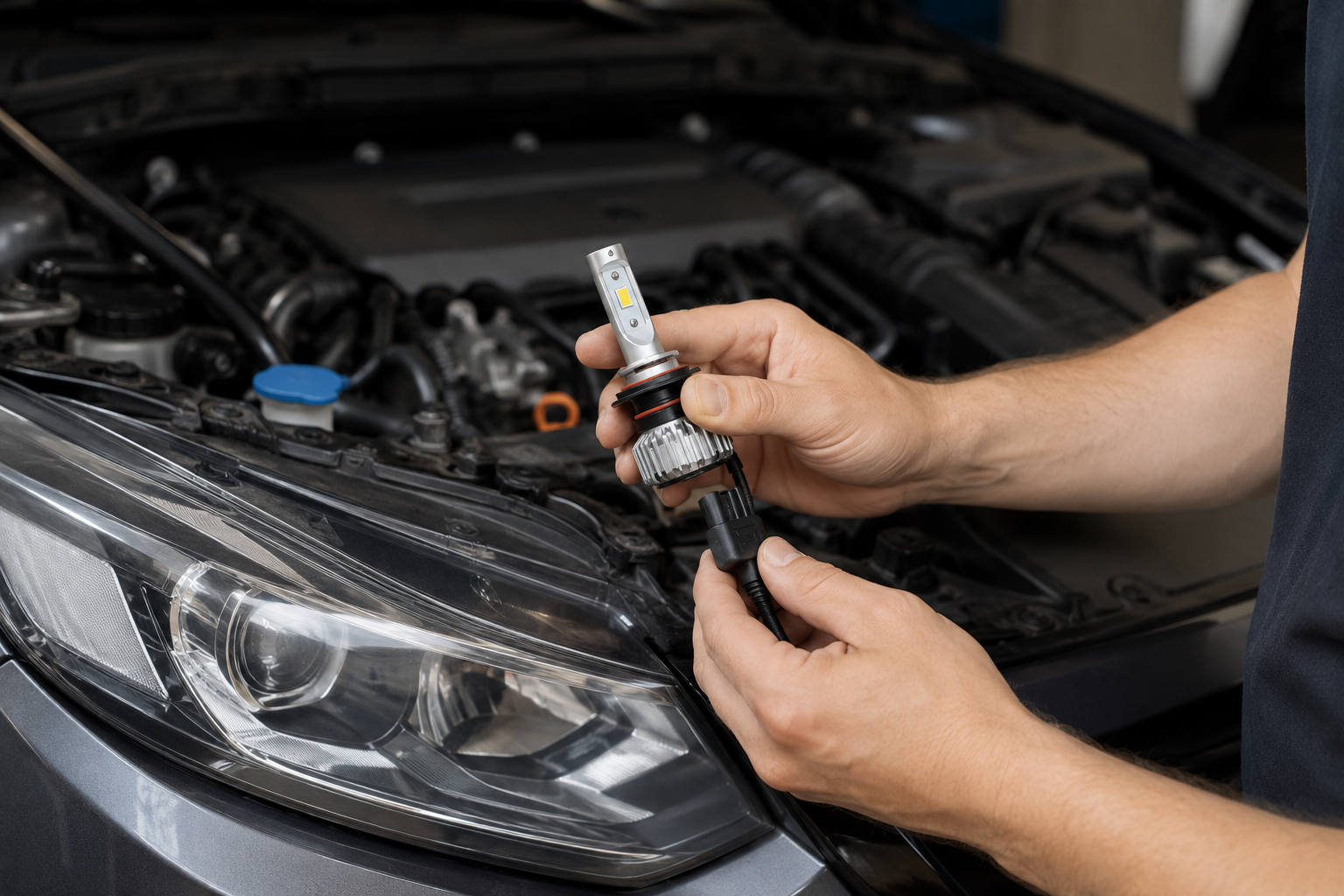
Five-step LED headlight troubleshooting workflow for auto parts distributors.
Why Does Socket Fit Not Guarantee Full Vehicle Compatibility?
LED headlight bulb fitment begins with the bulb base, but it does not end there. A replacement LED bulb may mount correctly while the complete installation still has compatibility problems related to housing clearance, electrical behavior, optical geometry, cooling, sealing, or installation configuration.
Socket fit answers whether the bulb can mount. Full compatibility asks whether the complete vehicle-headlamp system can operate correctly with that installed configuration.
For a detailed pre-installation review, distributors can use the vehicle compatibility checklist for LED conversion kits. This article focuses on what to do after a compatibility or installation problem has already appeared.
For U.S.-market applications, distributors should also review the applicable requirements in FMVSS No. 108 — Lamps, Reflective Devices, and Associated Equipment and 49 CFR Part 564 — Replaceable Light Source and Sealed Beam Headlamp Information.
For markets applying UNECE vehicle regulations, distributors should review the applicable current requirements under UN Regulation No. 149 — Road Illumination Devices. Market-specific compliance or homologation requirements should be confirmed for the exact product and destination market.
What Information Should a Distributor Collect Before Troubleshooting?
A support case should not begin with only “the light flickers” or “the bulb does not fit.” A useful technical case needs enough information for another person to understand the application and reproduce the reasoning.
| Field | Information to Collect | Why It Matters |
|---|---|---|
| Vehicle | Market, year, make, model | Identifies the application |
| Headlamp | Type and original bulb | Defines the original lighting system |
| LED product | Exact product/version if available | Identifies the installed item |
| Added components | Adapter, driver, interface | Reveals installation variables |
| Symptom | Exact abnormal behavior | Determines the diagnostic category |
| Timing | Startup, intermittent, after warm-up | Helps narrow possible causes |
| Evidence | Photos and warning details | Supports technical review |
| Previous actions | Checks already completed | Prevents duplicate work |
Useful installation evidence may include photos of:
- bulb seating;
- mounting collar or adapter;
- rear housing clearance;
- connector;
- driver;
- cable routing;
- dust-cap or enclosure closure.
Use a Five-Category Troubleshooting Decision Matrix
| Category | Typical Symptoms | First Check | Evidence | Escalate When | Distributor Action |
|---|---|---|---|---|---|
| Physical fitment | Bulb will not seat; cap will not close | Socket, adapter, housing clearance | Installation photos | Correct application still interferes physically | Review application fit |
| Electrical compatibility | No startup, flicker, warning | Connection and vehicle electrical behavior | Vehicle and symptom record | Issue remains repeatable after relevant checks | Escalate for technical review |
| Optical compatibility | Glare, weak or uneven beam | Seating, orientation, headlamp type | Beam and installation evidence | Correct installation still gives abnormal beam behavior | Review application suitability |
| Thermal | Instability or shutdown after running | Cooling clearance and enclosure | Operating-time evidence | Problem repeats under appropriate installation conditions | Escalate for technical review |
| Installation | Loose connection or sealing problem | Connector, seating, routing, seals | Installation photos | Corrected installation does not resolve the issue | Correct, retest, then reclassify if needed |
This matrix is a first-line triage tool. It does not by itself prove a product defect or confirm complete vehicle compatibility.
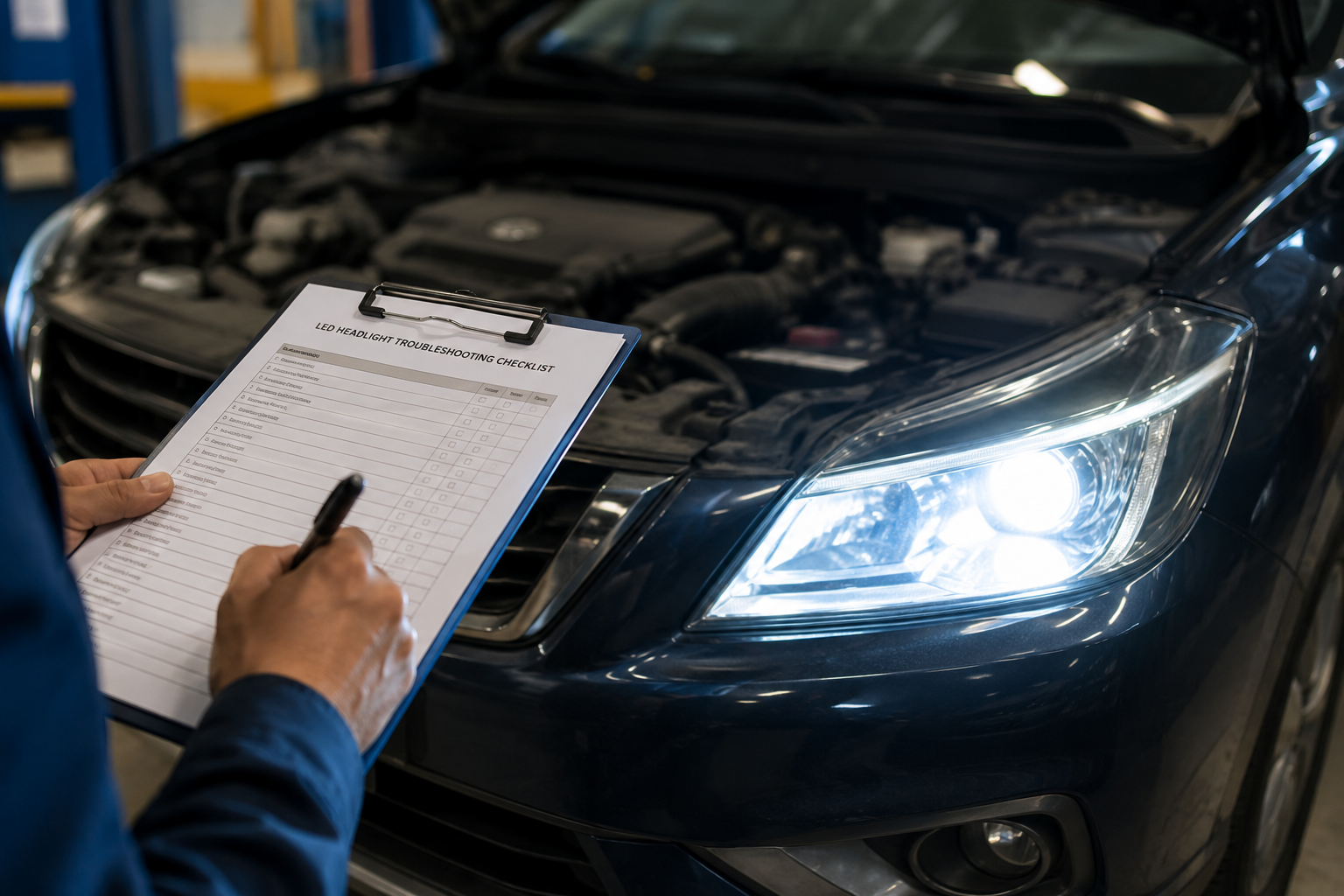
Five-category diagnostic model for LED headlight installation and compatibility issues.
How Should Distributors Handle Common LED Headlight Troubleshooting Scenarios?
The LED Headlight Does Not Turn On
A no-start condition can come from several sources. First check:
- connector condition;
- installed product configuration;
- adapter or external driver;
- polarity where relevant;
- obvious installation problems;
- vehicle-side electrical behavior.
Escalate when: the relevant installation and vehicle-side checks have been completed but the failure remains repeatable.
The LED Flickers or Triggers a Dashboard Warning
LED headlight flickering problems should not automatically be labeled as one universal “CAN bus issue.” Possible factors may include:
- bulb monitoring;
- PWM-related behavior;
- electrical load behavior;
- connector instability;
- added interface components;
- CAN-related control conditions where applicable;
- product-side electrical behavior.
Do not assume that a decoder or interface is a universal solution.
Escalate when: the exact vehicle application, product, additional components, and symptom behavior are documented and the problem remains repeatable.
Other Troubleshooting Scenarios
| Symptom | First Area to Check | Escalate When |
|---|---|---|
| Dust cap cannot close | Housing clearance, adapter, rear components | Correct application still cannot be installed correctly |
| Uneven beam | Seating, orientation, headlamp type | Correct installation still produces abnormal beam behavior |
| Excessive glare | Optical positioning and headlamp configuration | Relevant installation checks do not resolve the result |
| Shutdown after warm-up | Cooling, enclosure, thermal conditions | Instability repeats under appropriate installation conditions |
| Intermittent operation | Connection, electrical behavior, thermal conditions | Issue remains repeatable |
| Moisture after installation | Cap, gasket, routing, enclosure | Correct enclosure condition does not resolve the issue |
For detailed installation considerations, refer to the LED headlight installation tips.
For technical background on headlamp glare factors, technical teams can also review the SAE technical paper “Headlamp Parameters and Glare”.
Follow a Distributor Troubleshooting Decision Tree
Complaint received
Is the exact vehicle application known?
- No: collect vehicle and headlamp information.
- Yes: continue.
Is the installed LED product and configuration known?
- No: identify the product, adapter, driver, and additional interface.
- Yes: continue.
Classify the issue:
- Physical
- Electrical
- Optical
- Thermal
- Installation
Is an installation issue identifiable?
- Yes: correct it, retest, and document the result.
- No: continue with the relevant compatibility checks.
Does the problem remain repeatable?
- No: document the resolution.
- Yes: prepare a supplier technical escalation package.
Has the same application produced repeated complaints?
- No: record the individual case according to the distributor's own process.
- Yes: review the fitment record, vehicle variation, product revision, and technical documentation.
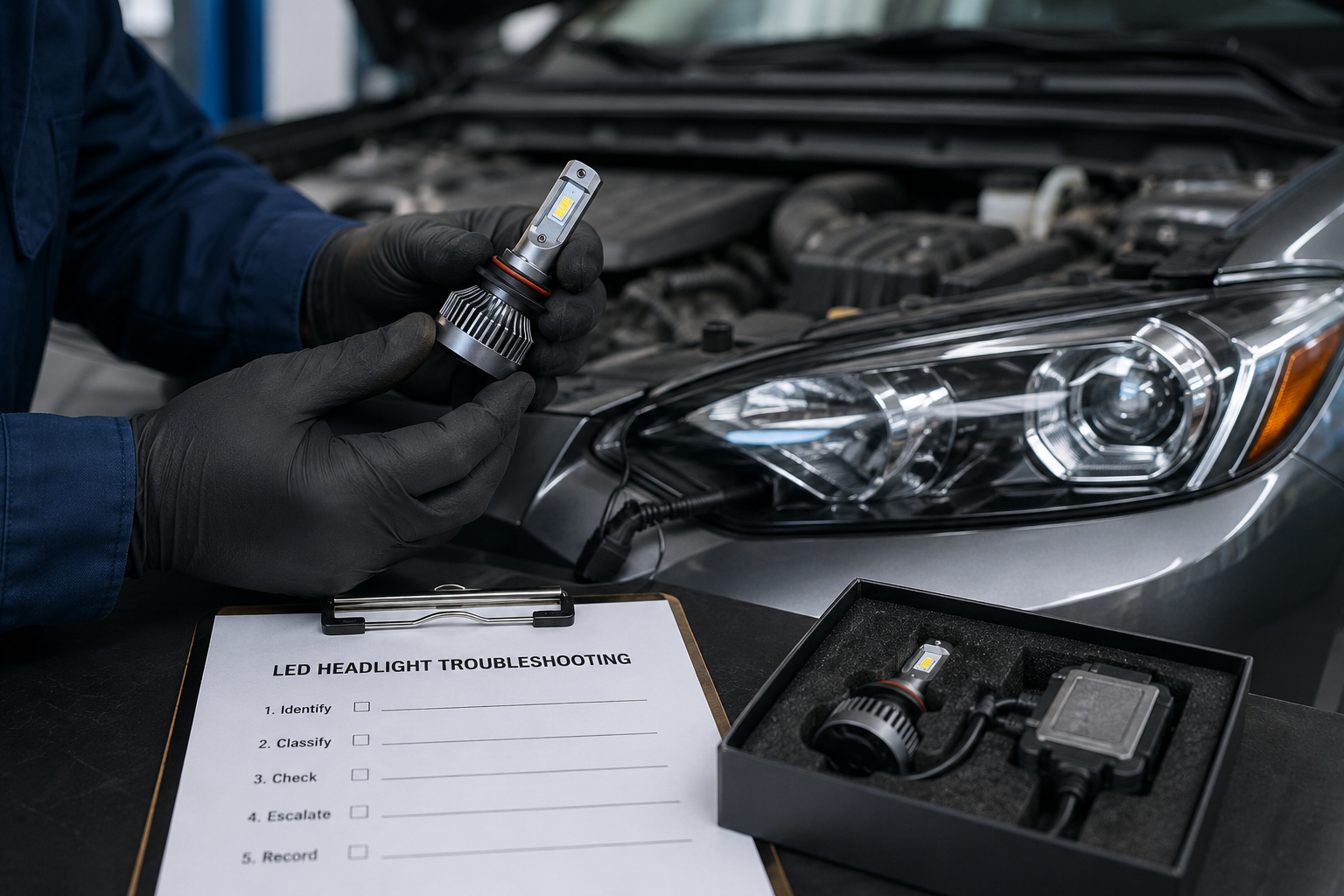
Distributor decision tree for troubleshooting LED headlight installation and compatibility complaints.
What Should Distributors Do When the Same Application Produces Repeated Complaints?
Repeated complaints should not automatically be treated as unrelated individual cases. They should trigger a review of the underlying application information.
Review the Application Assignment
- vehicle market;
- model year;
- headlamp variant;
- original bulb;
- assigned LED product;
- adapter requirement.
Review Technical Documentation
Determine whether the repeated issue reveals missing or outdated:
- installation notes;
- compatibility notes;
- adapter requirements;
- known application limitations.
Check the Product Revision
Fitment information should remain linked to the product version actually reviewed. If relevant dimensions, drivers, adapters, mounting structures, or cable configurations change, previous fitment information may need review.
Avoid Conclusions Based on a Single Case
Do not automatically expand compatibility coverage because one installation succeeded. Likewise, do not automatically remove an application after a single complaint. Fitment decisions should consider the exact vehicle configuration, product version, repeated evidence, and documented root cause.
Record the Final Outcome
| Field | Purpose |
|---|---|
| Application | Identifies the affected vehicle configuration |
| Product/version | Links the issue to the actual product |
| Original symptom | Preserves the complaint |
| Root-cause category | Physical, electrical, optical, thermal, installation, or unresolved |
| Corrective action | Records what changed |
| Status | Resolved, conditional, review required, or unresolved |
| Documentation update | Identifies whether fitment notes or instructions should change |
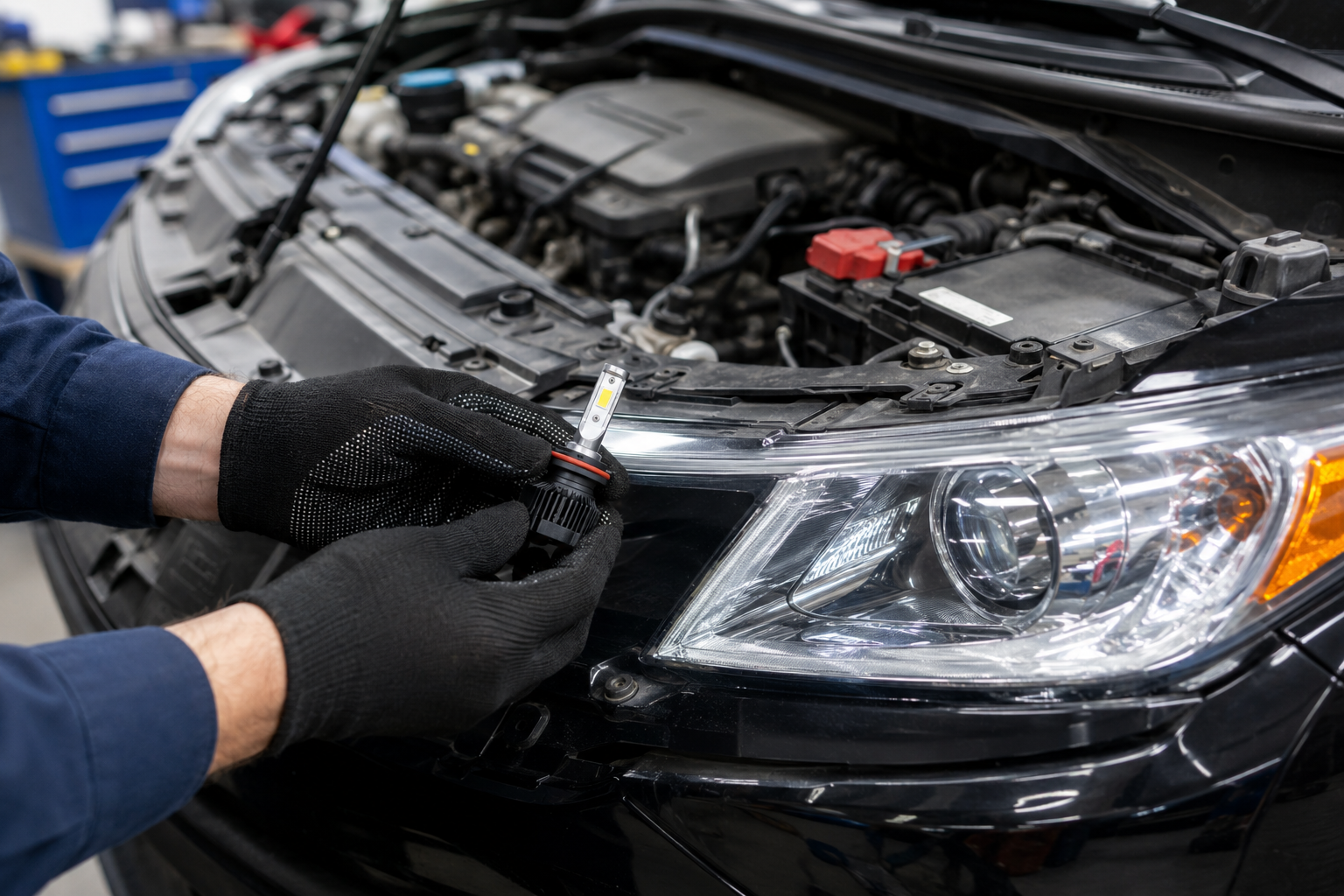
Fitment feedback loop for repeated LED headlight compatibility complaints.
What Should Be Included in a Supplier Escalation Package?
The objective is not to prove a defect before escalation. The objective is to provide enough structured evidence for technical review.
A useful package can include:
- market or region;
- year;
- make and model;
- headlamp configuration;
- original bulb;
- installed LED product/version;
- adapter or interface information;
- installation photos;
- exact symptom;
- timing;
- dashboard warning information where relevant;
- troubleshooting completed;
- result after each relevant check.
Distributor Troubleshooting Readiness Checklist
A repeatable troubleshooting process requires both internal discipline and usable supplier information.
| Distributor Should Have | Supplier Information to Confirm |
|---|---|
| Standard technical case intake | Current fitment information |
| Product/version identification | Adapter requirements |
| Complaint classification method | Electrical compatibility considerations |
| Case history and final status | Current installation instructions |
| Defined escalation preparation | Technical escalation requirements |
For a broader supplier capability review, see how to audit a car LED headlight bulb manufacturer. The purpose of this checklist is troubleshooting readiness, not a complete supplier audit.
Frequently Asked Questions
Why can an LED headlight fit the socket but still be incompatible with a vehicle?
Socket fit confirms only the mounting base. Full compatibility can also depend on housing clearance, vehicle electrical behavior, optical geometry, cooling conditions, sealing, and the exact headlamp configuration.
What information should a distributor collect before troubleshooting an LED headlight problem?
Collect the vehicle market, year, make, model, headlamp configuration, original bulb, installed LED product, added adapters or interfaces, exact symptom, relevant photos, and checks already completed.
Why can LED headlights flicker or trigger dashboard warnings?
Possible factors include bulb monitoring, PWM-related behavior, electrical load behavior, connection problems, added interfaces, CAN-related control conditions where applicable, or product-side electrical behavior. The exact application should be reviewed before deciding the cause.
How can a distributor distinguish an installation issue from a possible product problem?
Confirm the exact application, installed configuration, mounting, connectors, adapters, electrical behavior, optical position, and cooling conditions where relevant. If the issue remains repeatable after the applicable checks, document the evidence and escalate it for technical review.
When should an LED headlight problem be escalated to the supplier?
Escalate when the exact application and installed product are known, the relevant first-line checks are complete, and the issue remains unresolved or repeatable.
What information should a distributor send to an LED headlight supplier for technical review?
Send the vehicle and headlamp information, installed product/version, adapter or interface details, installation photos, exact symptom, timing, warning details where relevant, and a record of the checks already completed.
Conclusion
For distributors, LED headlight troubleshooting is not simply about deciding whether a bulb is “good” or “bad.”
The goal is to identify the exact application, classify the issue, complete the relevant checks, document the evidence, make the correct next decision, and preserve the result so the same problem is easier to prevent in future orders.
Need Help Reviewing a Specific LED Headlight Application?
Before contacting CARNEON about an application or technical issue, prepare:
- target market or region;
- vehicle year;
- make and model;
- headlamp configuration;
- original bulb type;
- intended or installed LED product;
- adapter or interface information where applicable;
- observed issue or installation constraint;
- relevant photos.
Product-specific compatibility and commercial terms should be confirmed for the exact project.
Recommended for you
LED Headlight Bulb Sizes & Applications: A B2B Market Sourcing and Fitment Guide
How to Launch a Private Label Automotive LED Lighting Brand: An OEM/ODM Roadmap for Distributors

The Technical Guide to Identifying High-Performance LED Headlight Bulbs (2026 Edition)

The Ultimate B2B Guide to Sourcing Automotive LED Headlights: From Factory Verification to Technical Auditing (2026 Edition)
You May Also Like



Get More Resources
If you have any comments or good suggestions, please leave us a message, later our professional staff will contact you as soon as possible.
Start Your Wholesale Order / Request OEM Solutions
Partner directly with the factory for competitive pricing and priority support. Please provide your business details and estimated order volume (MOQ applies) so our sales engineers can tailor the best quote for your market.
Contact us


6th Floor, Building B, Liando U Valley, No. 29, Bishan Street, Huangpu District, Guangzhou, China

© 2026 CARNEON. All Rights Reserved. Privacy Policy | Terms and Conditions | Sitemap

Whatsapp: +8618688487142