


Why Do LED Headlight Bulbs Need a Cooling Fan?
Why Do LED Headlight Bulbs Need a Cooling Fan?
Quick Answer
LED headlight bulbs need a cooling fan when their heat sink cannot shed junction heat adequately through passive airflow. The fan drives air across the heat sink; it does not cool the LED chip directly. Compare thermal load, rear clearance, electrical compatibility, fan noise, and environmental exposure. Project support should verify these points, since final selection depends on vehicle conditions and testing.
How Project Support Works
The supplied company profile does not document specific cooling-fan engineering, OEM/ODM, customization, or quality-control capabilities, so none should be assumed. For a sourcing inquiry, request documented fan type, rated voltage and current, dimensions, operating-temperature range, and applicable product test records.
Before placing a bulk order, confirm bulb base and vehicle fitment, available rear-cover clearance, intended market, target quantity, and required validation. MOQ, lead time, testing scope, and quotation must be confirmed per project; request written confirmation rather than relying on a general product description.
Discuss Cooling-Fan Fitment for Your LED Headlight Project
Share the target market, vehicle make, model and year, bulb base, rear dust-cap clearance, system voltage, expected order quantity, and operating conditions. These details can frame a discussion about compatible fan or fanless architectures and sample-evaluation steps; final fit and thermal performance should be checked in the intended housing. Send your project details to www.carneonlighting.com or nick@evitekhid.com to discuss a suitable evaluation path.
Cooling Fan FAQs
Why do some LED headlight bulbs need active cooling fans?
LEDs convert some electrical input into heat, and that heat must be conducted away from the LED package and dissipated. In a compact bulb, a passive heat sink may not have enough surface area or airflow to keep temperatures within the product’s specified operating range. A fan moves air over the heat sink to support heat transfer. It does not directly cool the LED chip, and a fan is not necessary in every design: a sufficiently sized passive heat sink may work where space and airflow allow. Compare thermal performance in the intended housing, not only on an open bench, because the vehicle’s dust cap and nearby components can restrict airflow.
Can a fanless LED headlight bulb run cooler?
It can, depending on the design and installation. A fanless bulb avoids fan-motor heat and moving parts, but that alone does not mean it runs cooler. Its heat sink must transfer and release the LED’s heat effectively, and the bulb needs adequate clearance and airflow. A compact passive design fitted inside a restricted headlamp housing may retain more heat than a well-designed fan-cooled model. Compare manufacturer thermal data under comparable conditions, including the same operating power and an enclosed or representative housing. Do not judge cooling solely by whether the bulb has a fan or by touching the exterior; the heat sink’s surface temperature does not directly establish the LED junction temperature.
What happens when an LED headlight cooling fan fails?
A failed or obstructed fan reduces airflow across the heat sink. Depending on the bulb’s thermal design and driver, the result may be rising component temperatures, reduced light output, intermittent operation, accelerated degradation, or a protective shutdown. Responses differ by product, so a fan failure does not produce one universal symptom. Check for debris, a loose connector, damaged wiring, unusual noise, or a fan that does not start, following safe vehicle-service procedures. Do not assume that a bulb still lighting is operating within its intended temperature range. If the fan is not replaceable or the cause is unclear, stop using the bulb and seek product-specific service guidance.
Can a cooling fan fit behind the factory dust cap?
Only if the bulb, fan, wiring, and any driver have enough room behind the cap without pressing against the housing or blocking the fan intake and exhaust. Check the available depth and diameter, the position of the connector, and whether the cap can close and seal as intended. A fan that spins in an open-air test may be starved of airflow once enclosed. Avoid cutting or leaving off a dust cap without confirming the vehicle maker’s service guidance; doing so can expose the headlamp to moisture and contamination. Confirm fitment on the exact headlamp assembly, because bulb-base compatibility alone does not prove adequate cooling clearance.
How do I diagnose LED headlight flicker from overheating?
Note when the flicker begins and whether it changes as the bulb warms up. Heat-related problems may emerge after a period of operation, especially if a fan is stalled or airflow is blocked, but timing alone is not proof. Flicker can also result from unstable supply voltage, poor connections, an incompatible driver, or vehicle lighting electronics. Inspect connectors and fan operation, then check supply voltage and the bulb’s specified operating conditions using appropriate service procedures. Compare the behavior with a known-compatible bulb or test setup where practical. If the fault persists, have the vehicle circuit and bulb evaluated rather than replacing the fan based on flicker alone.
Does a faster cooling fan improve headlight brightness?
Not necessarily. Brightness depends on the LED output, driver current, optical alignment, and headlamp design; increasing fan speed does not directly increase the light produced. More airflow may help control temperature if the existing cooling system is inadequate, but the benefit depends on heat-sink design and air movement through the housing. A faster fan can also add noise, draw more electrical current, or introduce vibration. Compare measured thermal behavior and light output under the same operating conditions, and follow the product’s rated electrical and thermal specifications. Do not modify fan speed or drive current without validation, since excess heat or electrical stress may shorten component life.
Recommended for you
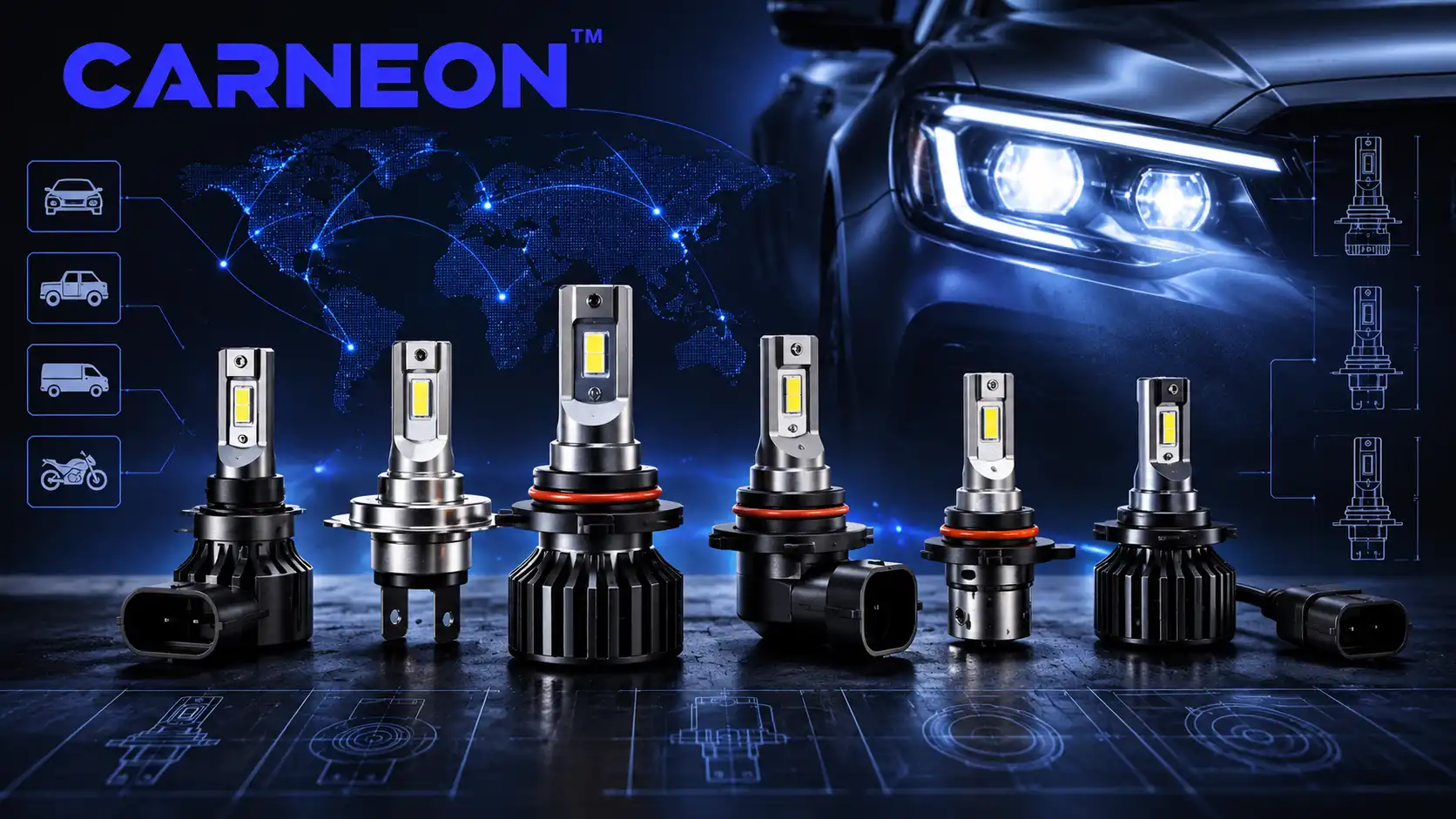
LED Headlight Bulb Sizes & Applications: A B2B Market Sourcing and Fitment Guide
How to Launch a Private Label Automotive LED Lighting Brand: An OEM/ODM Roadmap for Distributors
LED Headlight Troubleshooting for Auto Parts Distributors: Installation & Compatibility Workflow

The Technical Guide to Identifying High-Performance LED Headlight Bulbs (2026 Edition)
You May Also Like


Get More Resources
If you have any comments or good suggestions, please leave us a message, later our professional staff will contact you as soon as possible.
Start Your Wholesale Order / Request OEM Solutions
Partner directly with the factory for competitive pricing and priority support. Please provide your business details and estimated order volume (MOQ applies) so our sales engineers can tailor the best quote for your market.
Contact us


6th Floor, Building B, Liando U Valley, No. 29, Bishan Street, Huangpu District, Guangzhou, China

© 2026 CARNEON. All Rights Reserved. Privacy Policy | Terms and Conditions | Sitemap

Whatsapp: +8618688487142