


Why Do H7 LED Headlight Bulbs Need Cooling Fans?
Why Do H7 LED Headlight Bulbs Need Cooling Fans?
Quick Answer
Cooling fans help move heat away from the LED emitter and driver inside a compact h7 led headlight bulb. Lower operating temperatures can support more stable light output and reduce thermal stress, but fan selection depends on airflow, noise, dust protection, bulb clearance, and electrical compatibility. Final solutions depend on vehicle fitment, testing, and site conditions.
How Supports Projects
Project discussions can be organized around the cooling architecture, available space behind the headlamp, input voltage, driver arrangement, fan noise tolerance, and environmental exposure. These parameters help distinguish a suitable active-cooling design from a passive or hybrid alternative without assuming that one configuration fits every vehicle.
Before requesting a quotation, buyers should confirm the target vehicle list, socket and dust-cap constraints, required light source position, operating environment, validation method, and expected order volume. MOQ, lead time, testing scope, and quotation must be confirmed for each project because product configuration and commercial terms depend on the requested specification.
Discuss Your H7 LED Cooling Requirements
Share the target market, vehicle models, H7 socket details, available rear clearance, voltage range, environmental conditions, noise expectations, and target order volume. These details allow suitable cooling options, sample steps, fitment checks, and validation requirements to be discussed. Visit www.carneonlighting.com or email nick@evitekhid.com to discuss your project requirements.
Frequently Asked Questions
Why does an H7 LED bulb require active cooling?
An LED converts only part of its electrical input into visible light; the remaining energy becomes heat. That heat is concentrated near the LED junction, a small area that can become difficult to cool inside an H7 retrofit housing. A fan increases air movement across the heat sink, helping transfer heat into the surrounding air. This can reduce thermal throttling, color shift, and accelerated component aging. Active cooling is not automatically required for every design: a sufficiently large passive heat sink, lower drive current, or carefully engineered hybrid system may provide adequate thermal control. Buyers should assess measured operating temperature and output stability rather than judging a bulb by fan presence alone.
Can a cooling fan affect H7 headlight bulb lifespan?
It can influence service life indirectly by controlling temperature at the LED board, driver, and nearby components. Excessive heat may accelerate degradation of phosphor materials, solder joints, capacitors, and electronic semiconductors. However, a fan is a mechanical component with its own wear, bearing, contamination, and electrical risks. A poorly selected fan can introduce vibration or stop moving enough air after dust accumulation. The relevant comparison is the complete thermal design: heat-sink area, airflow path, fan duty cycle, driver efficiency, LED drive current, and measured temperature during extended operation. Buyers should request thermal test conditions and operating results rather than treating a cooling fan as proof of longer life.
What happens when an H7 LED fan stops working?
Heat usually accumulates more quickly because the compact heat sink loses forced airflow. The bulb may reduce output through driver protection, experience visible brightness variation, or continue operating while its internal temperature rises. Continued operation at excessive temperature can shorten the life of the LED package and driver. The result depends on the product’s thermal mass, ambient temperature, drive current, and whether a temperature-protection circuit is present. Vehicle owners should not assume that a failed fan is harmless simply because the lamp still illuminates. A practical evaluation includes fan-start behavior, abnormal-noise checks, thermal shutdown behavior, and inspection of the rear housing for restricted airflow.
Are fanless H7 LED bulbs safer for dusty headlights?
Not necessarily. A fanless design avoids drawing air through a moving mechanism, but it still needs a heat path from the LED board to the outside environment. If the passive heat sink is undersized or blocked by the dust cap, internal temperature can rise substantially. A fan-cooled design may perform well when its airflow path is protected and the fan is rated for the operating environment. Dust exposure, moisture, engine-bay temperature, and installation orientation should be evaluated together. The correct question is whether the complete assembly maintains acceptable LED and driver temperatures under realistic contamination and enclosure conditions, not whether passive cooling is automatically safer.
How should buyers compare cooling fans in H7 retrofit bulbs?
Fan size alone is a weak purchasing criterion. Compare the airflow path, heat-sink geometry, rated voltage, starting behavior, noise, vibration, bearing construction, contamination tolerance, and available clearance behind the headlamp. Also confirm how the fan is controlled: continuous operation, temperature-based control, or driver-linked operation can produce different acoustic and thermal results. Testing should include extended operation at the intended voltage, hot ambient conditions, restricted rear clearance, and repeated start-stop cycles. The bulb must also preserve the correct LED emitter position relative to the H7 filament reference, because excellent thermal performance cannot compensate for poor beam geometry or glare.
Does fan speed change H7 LED beam performance?
Fan speed does not directly define beam geometry; emitter placement, optical design, shield interaction, and bulb alignment determine how the headlamp forms its beam. Fan speed can affect performance indirectly if inadequate airflow causes the driver to reduce current or the LED temperature to change output and color. Excessive speed may also increase noise or vibration without producing useful additional cooling when the heat sink or airflow path is the limiting factor. Buyers should evaluate beam pattern and thermal stability separately. A proper assessment includes photometric testing, road-legal fitment review where applicable, and temperature measurements after the lamp reaches a stable operating condition.
Recommended for you
LED Headlight Bulb Sizes & Applications: A B2B Market Sourcing and Fitment Guide
How to Launch a Private Label Automotive LED Lighting Brand: An OEM/ODM Roadmap for Distributors
LED Headlight Troubleshooting for Auto Parts Distributors: Installation & Compatibility Workflow

The Technical Guide to Identifying High-Performance LED Headlight Bulbs (2026 Edition)
You May Also Like


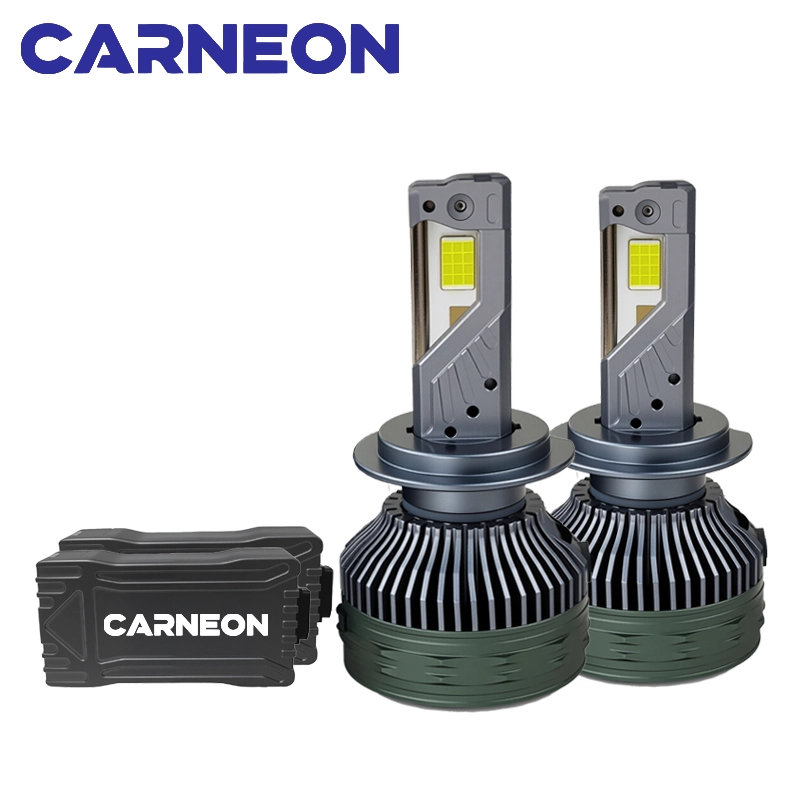

Get More Resources
If you have any comments or good suggestions, please leave us a message, later our professional staff will contact you as soon as possible.
Start Your Wholesale Order / Request OEM Solutions
Partner directly with the factory for competitive pricing and priority support. Please provide your business details and estimated order volume (MOQ applies) so our sales engineers can tailor the best quote for your market.
Contact us


6th Floor, Building B, Liando U Valley, No. 29, Bishan Street, Huangpu District, Guangzhou, China

© 2026 CARNEON. All Rights Reserved. Privacy Policy | Terms and Conditions | Sitemap

Whatsapp: +8618688487142