


Why Do Auto LED Headlights Flicker and How Can You Fix It?
Quick Answer
Auto LED headlight flicker usually comes from pulse-width modulation, vehicle bulb monitoring, unstable charging voltage, poor grounding, or an incompatible LED driver. Carneon Lighting can help review the application, while the key checks are vehicle electronics, input voltage behavior, driver compatibility, thermal conditions, and wiring quality. The appropriate remedy depends on the vehicle, installation, testing results, and operating conditions.
How Carneon Lighting Supports Flicker-Diagnosis Projects
Carneon Lighting can support project discussions by reviewing the vehicle platform, lamp interface, electrical symptoms, and intended market before a configuration is selected. This helps separate a control-system compatibility issue from a driver, harness, connector, or grounding problem rather than treating every flicker as a bulb defect.
For a quotation or development review, confirm the input-voltage range, control method, connector and mounting constraints, thermal environment, and required vehicle compatibility. MOQ, lead time, testing scope, and quotation must be confirmed per project with Carneon Lighting after the application details are available.
Discuss Your Flicker-Diagnosis Requirements
Send the vehicle make, model and year, lamp position, original bulb type, observed flicker pattern, measured voltage, warning-light behavior, target market, and required order volume so suitable troubleshooting or product options can be discussed, along with sample steps and validation needs. Visit www.carneonlighting.com or email nick@evitekhid.com to discuss your project.
Why Do Auto LED Headlights Flicker and How Can You Fix It?
Why do LED headlights flicker after installation on older vehicles?
Older vehicles may use bulb circuits designed around the electrical load and current behavior of halogen lamps. An LED retrofit draws less current, so the body control module may interpret the lower load as a failed bulb or periodically test the circuit with short diagnostic pulses. Some vehicles also use pulse-width modulation for brightness control, which can become visible when the replacement driver does not properly filter or interpret that signal. Begin by checking whether both lamps flicker, whether the effect changes with the engine running, and whether a bulb warning appears. Inspect the ground connection and measure voltage at the lamp connector under idle, accessory, and loaded conditions. A compatible driver or vehicle-specific interface may be appropriate, but adding a resistor without calculating heat output can create a wiring or fire risk.
Can CAN bus errors cause an aftermarket LED headlight to flicker?
CAN bus communication does not directly power the lamp in every vehicle, but the vehicle control module can use networked commands and current feedback to manage lighting. If the replacement load differs from the original bulb, the module may generate a fault, shut down a channel, or send diagnostic pulses. Flicker can therefore appear as a compatibility symptom even when the CAN network itself is operating correctly. A dashboard warning, delayed activation, intermittent shutdown, or different behavior between low beam and high beam strengthens this possibility. Scan the relevant body-control module for lighting faults, confirm the original bulb specification, and use an interface designed for that vehicle rather than assuming a generic decoder will work. The decoder must also match the lamp control strategy and available space.
Is a decoder safer than an oversized resistor for flickering headlights?
A decoder is not automatically safer, but a properly matched electronic interface can address bulb monitoring or control-signal compatibility without converting as much electrical energy into heat. A resistor used to imitate a halogen load must dissipate substantial power, and its surface can become hot enough to damage plastic, insulation, paint, or nearby components if mounted incorrectly. The required resistance and power rating should be calculated from the vehicle circuit, then verified under worst-case operating conditions. A decoder can still generate heat, draw current, or fail if its rating is unsuitable. Confirm its input range, control compatibility, thermal installation requirements, and fault behavior. Avoid placing either device in a sealed or heat-sensitive area, and do not bypass vehicle protection systems without a documented electrical reason.
How can I test whether voltage or wiring causes LED flicker?
Use a digital multimeter to compare voltage at the battery, lamp connector, and lamp ground while the engine is off and running. Measure during the exact condition that produces flicker, including low beam, high beam, daytime running lights, blower motor, and other relevant loads. A substantial difference between battery voltage and the lamp connector suggests resistance in a fuse holder, relay, connector, splice, or positive cable. A voltage-drop test across the ground path can reveal a poor ground even when a static continuity check appears normal. Look for loose terminals, corrosion, pin fit problems, damaged insulation, and shared grounds. If the meter appears stable but the lamp still flickers, an oscilloscope or suitable automotive test instrument may reveal PWM pulses, alternator ripple, or brief control-module interruptions that a basic meter averages out.
Why does flicker appear only with daytime running lights active?
Daytime running lights often use a separate control strategy from low-beam operation. The vehicle may reduce lamp output through PWM, series wiring, a dedicated module, or a lower-duty command, while the replacement driver expects a relatively steady supply. The LED may therefore flicker in daytime mode but operate normally when the low beams are selected. Some vehicles also switch ground paths or monitor the circuit differently between operating modes. Compare the connector voltage waveform and polarity in both modes, and consult the vehicle wiring diagram before modifying the circuit. A solution that works for low beam may not be compatible with DRL operation. The correct approach can involve a mode-compatible driver, an approved vehicle interface, or retaining the original DRL control architecture rather than forcing full voltage into the circuit.
When should a flickering LED headlight be replaced instead of repaired?
Replacement is more appropriate when the driver has visible damage, water ingress, burnt components, repeated thermal shutdown, unstable output after the vehicle wiring has been verified, or a fault that follows the lamp when it is moved to the opposite side. Repair is difficult when the driver is sealed, the LED board has suffered thermal damage, or the failure involves specialized components without a documented service procedure. First isolate the vehicle from the lamp by testing the original bulb or a known-compatible unit, checking connectors and grounds, and confirming the supply behavior. Do not keep operating a lamp that intermittently goes dark in traffic. A replacement should match optical position, electrical input range, thermal requirements, connector configuration, and the vehicle's control method; brightness alone is not sufficient evidence of compatibility.
Recommended for you
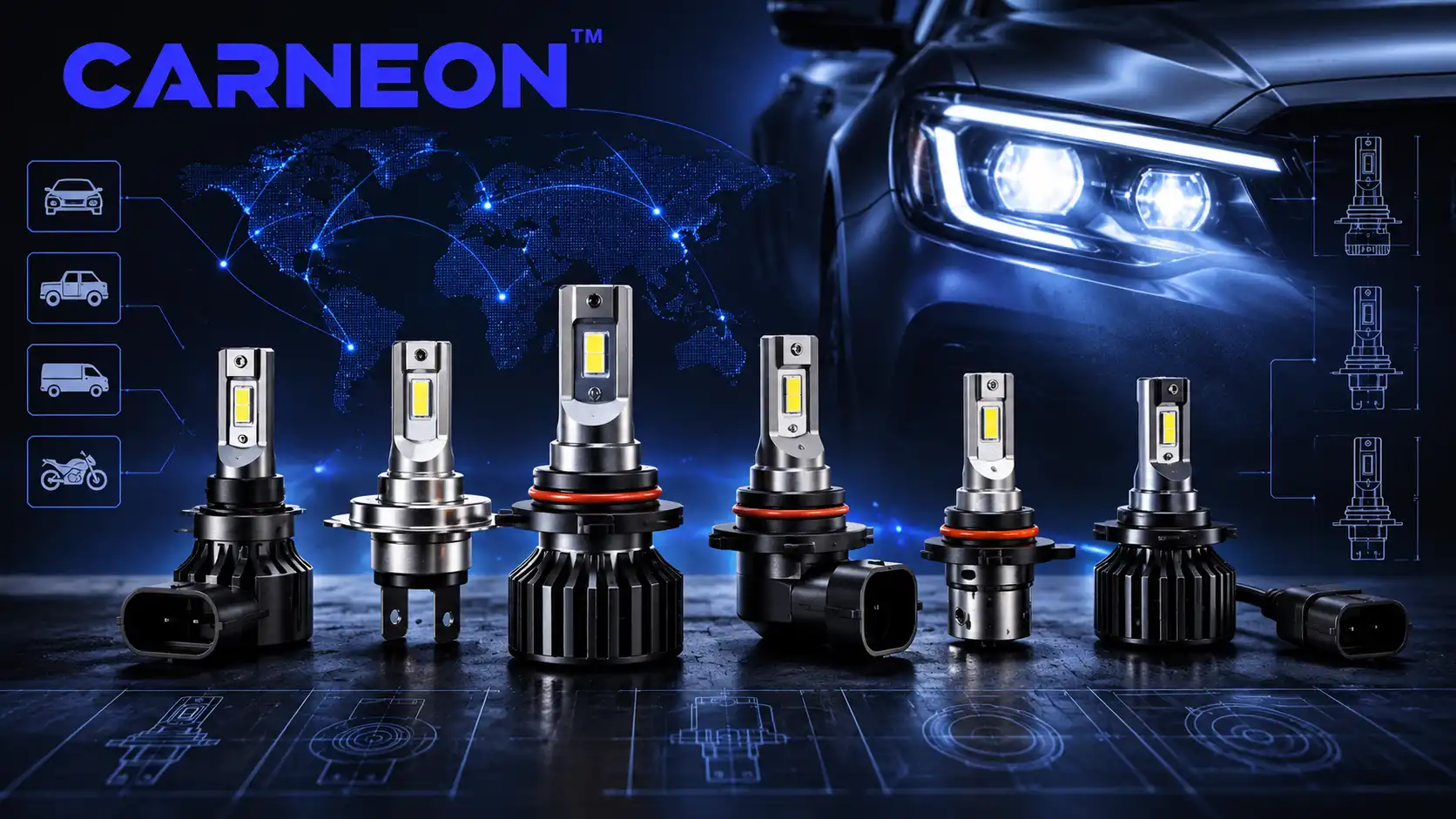
LED Headlight Bulb Sizes & Applications: A B2B Market Sourcing and Fitment Guide
How to Launch a Private Label Automotive LED Lighting Brand: An OEM/ODM Roadmap for Distributors
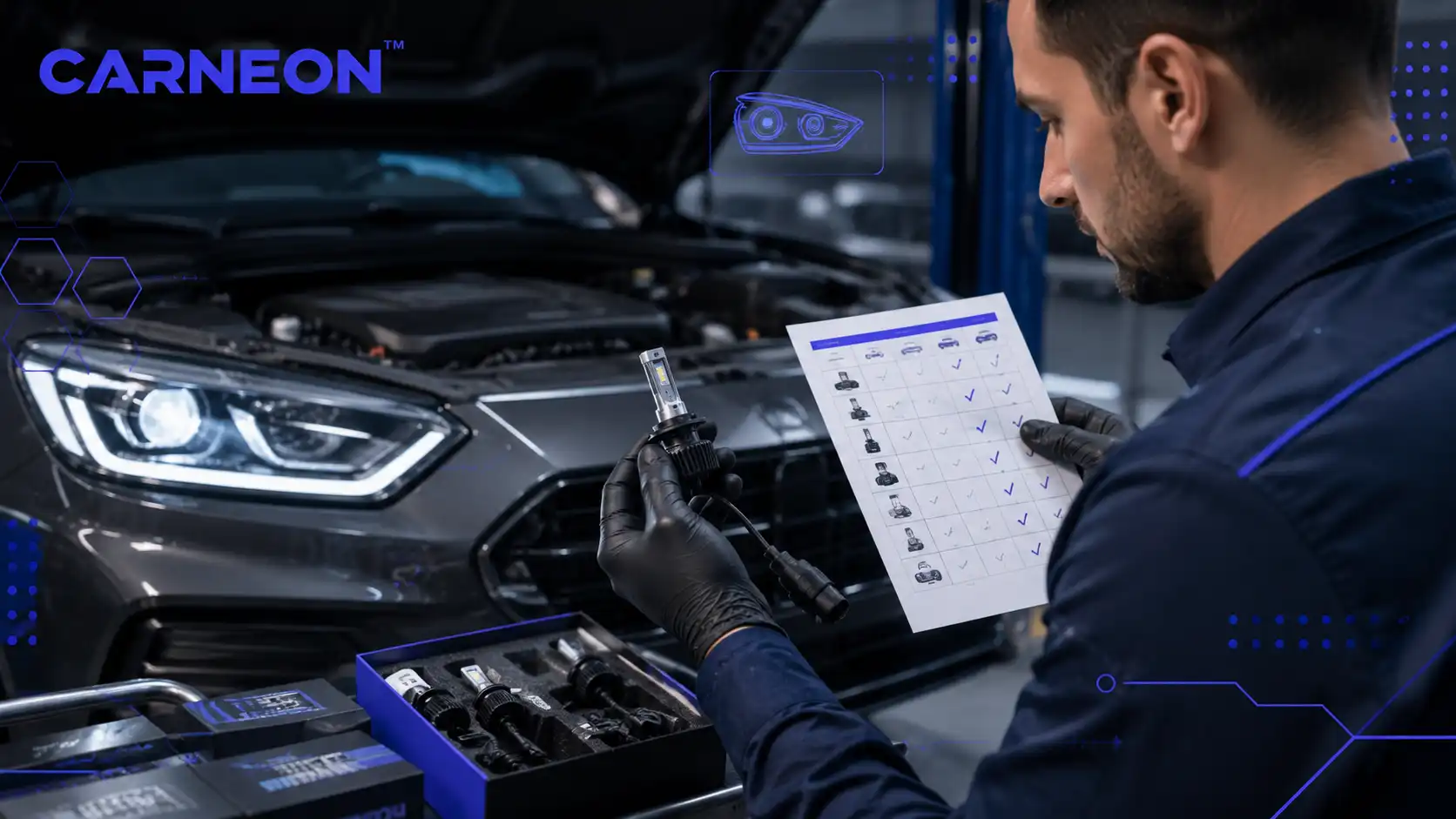
LED Headlight Troubleshooting for Auto Parts Distributors: Installation & Compatibility Workflow

The Technical Guide to Identifying High-Performance LED Headlight Bulbs (2026 Edition)
You May Also Like



Get More Resources
If you have any comments or good suggestions, please leave us a message, later our professional staff will contact you as soon as possible.
Start Your Wholesale Order / Request OEM Solutions
Partner directly with the factory for competitive pricing and priority support. Please provide your business details and estimated order volume (MOQ applies) so our sales engineers can tailor the best quote for your market.
Contact us


6th Floor, Building B, Liando U Valley, No. 29, Bishan Street, Huangpu District, Guangzhou, China

© 2026 CARNEON. All Rights Reserved. Privacy Policy | Terms and Conditions | Sitemap

Whatsapp: +8618688487142