


Why Are LED Headlights for Cars Better Than Halogen Lights?
Quick Answer
LED headlights for cars are generally more efficient, longer-lasting, quicker to activate, and easier to package than halogen lights. The right choice depends on beam pattern, optical compatibility, thermal control, electrical integration, and regulatory requirements. Supplier support can help compare suitable options, but final solutions depend on the vehicle, testing, and operating conditions.
How Carneon Lighting Supports Projects
The supplied company brief does not document specific manufacturing, OEM, ODM, laboratory, or certification capabilities for Carneon Lighting. Buyers should therefore request verifiable information before approving a program, including product drawings, LED and driver specifications, thermal-management details, beam-pattern data, and vehicle-fitment records.
For a sourcing discussion, confirm the target vehicle applications, lamp housing, connector and CAN-bus requirements, intended market, compliance pathway, sample process, and quality documentation. MOQ, lead time, testing scope, and quotation must be confirmed for each project rather than assumed from a general product listing.
Discuss Your Automotive LED Headlight Requirements
Provide the vehicle make, model and year, target market, original bulb or lamp type, housing dimensions, connector details, intended beam function, and expected order volume so suitable options and sample steps can be assessed. Send your project details through www.carneonlighting.com or nick@evitekhid.com.
Frequently Asked Questions
Why do LED headlights consume less power than halogen bulbs?
A halogen lamp creates light by heating a tungsten filament until it glows. An LED uses semiconductor junctions to generate light without heating a filament, so less electrical energy can be converted into unwanted heat for a comparable lighting task. The actual saving depends on the LED package, driver efficiency, optical losses, and required output. A lower wattage rating alone does not prove better road illumination; photometric measurements and the complete lamp design are more meaningful for procurement decisions.
Can LED replacement bulbs improve brightness without causing dangerous glare?
They can improve usable illumination only when the LED light-emitting area, orientation, and position reproduce the original halogen filament closely enough for the reflector or projector optics. If the emitting geometry is incorrect, extra raw lumens may create scattered foreground light and glare instead of a stronger compliant beam. Buyers should request low-beam and high-beam photometry, cutoff evaluation, and vehicle-specific testing. In the United States, Federal Motor Vehicle Safety Standard No. 108 governs many lighting requirements, while other markets follow their own approval frameworks.
What determines compatibility when fitting LEDs into halogen headlamps?
Compatibility involves more than the bulb base. The buyer must verify mechanical clearance, connector type, polarity, driver location, heat-sink space, dust-cap sealing, electromagnetic behavior, CAN-bus monitoring, and the optical relationship between the LED source and the original filament location. Some vehicles report a failed bulb because the replacement draws less current; an electronic solution may be needed, but added components can create heat or reliability concerns. A test fit and beam check should precede a bulk order.
Do LED headlights last longer in real automotive operating conditions?
LEDs have no tungsten filament to evaporate or break from vibration, so their service potential can exceed that of halogen bulbs. Their life is strongly affected by junction temperature, driver quality, voltage transients, moisture, vibration, and heat trapped inside the lamp housing. Manufacturers may describe lumen maintenance rather than a simple failure date. Buyers should examine thermal test conditions, current control, ingress protection where relevant, vibration results, and the warranty terms instead of treating a claimed LED lifespan as universal.
How does color temperature affect visibility and driver comfort?
Color temperature describes the apparent color of light, not its total brightness or beam quality. A higher correlated color temperature may appear whiter or bluer, but it does not automatically improve seeing distance and can increase perceived glare or visual discomfort in rain, fog, or snow. Road performance depends on spectrum, intensity distribution, contrast, and the optical system. Selection should follow the target market's rules and measured photometry rather than relying on appearance in a showroom or product photograph.
What testing should buyers request for automotive LED headlight upgrades?
Request dimensional and connector checks, electrical-load and transient testing, thermal measurements, vibration and moisture assessments, electromagnetic-compatibility evidence where applicable, and photometric evaluation in the intended lamp housing. The beam test should examine cutoff, hot spot, foreground light, glare, and left-right consistency for the relevant traffic side. Confirm which standard or approval route applies in the destination market. A sample evaluated in the actual vehicle is more informative than a universal claim based only on LED chip wattage or advertised lumens.
Recommended for you
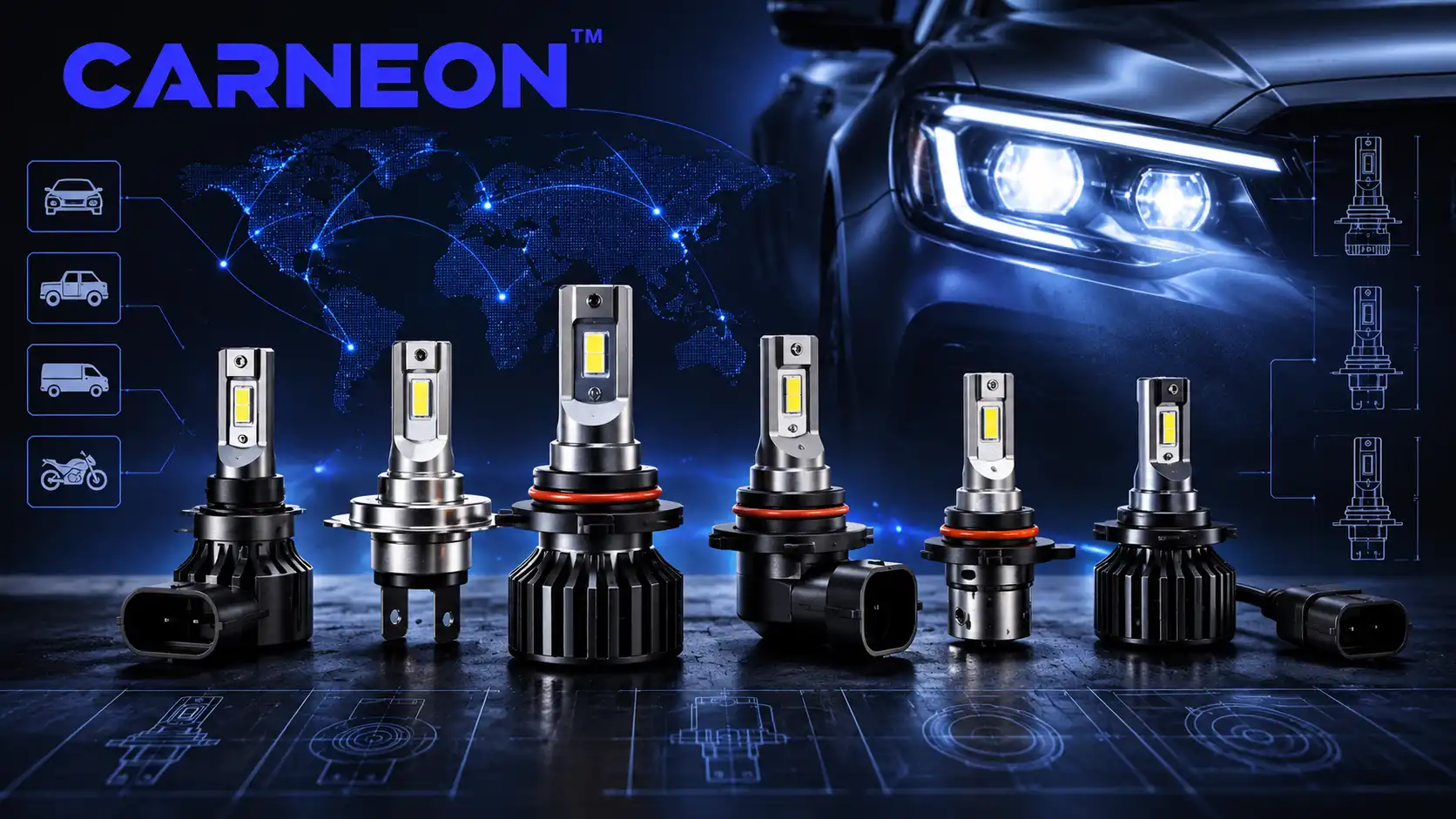
LED Headlight Bulb Sizes & Applications: A B2B Market Sourcing and Fitment Guide
How to Launch a Private Label Automotive LED Lighting Brand: An OEM/ODM Roadmap for Distributors
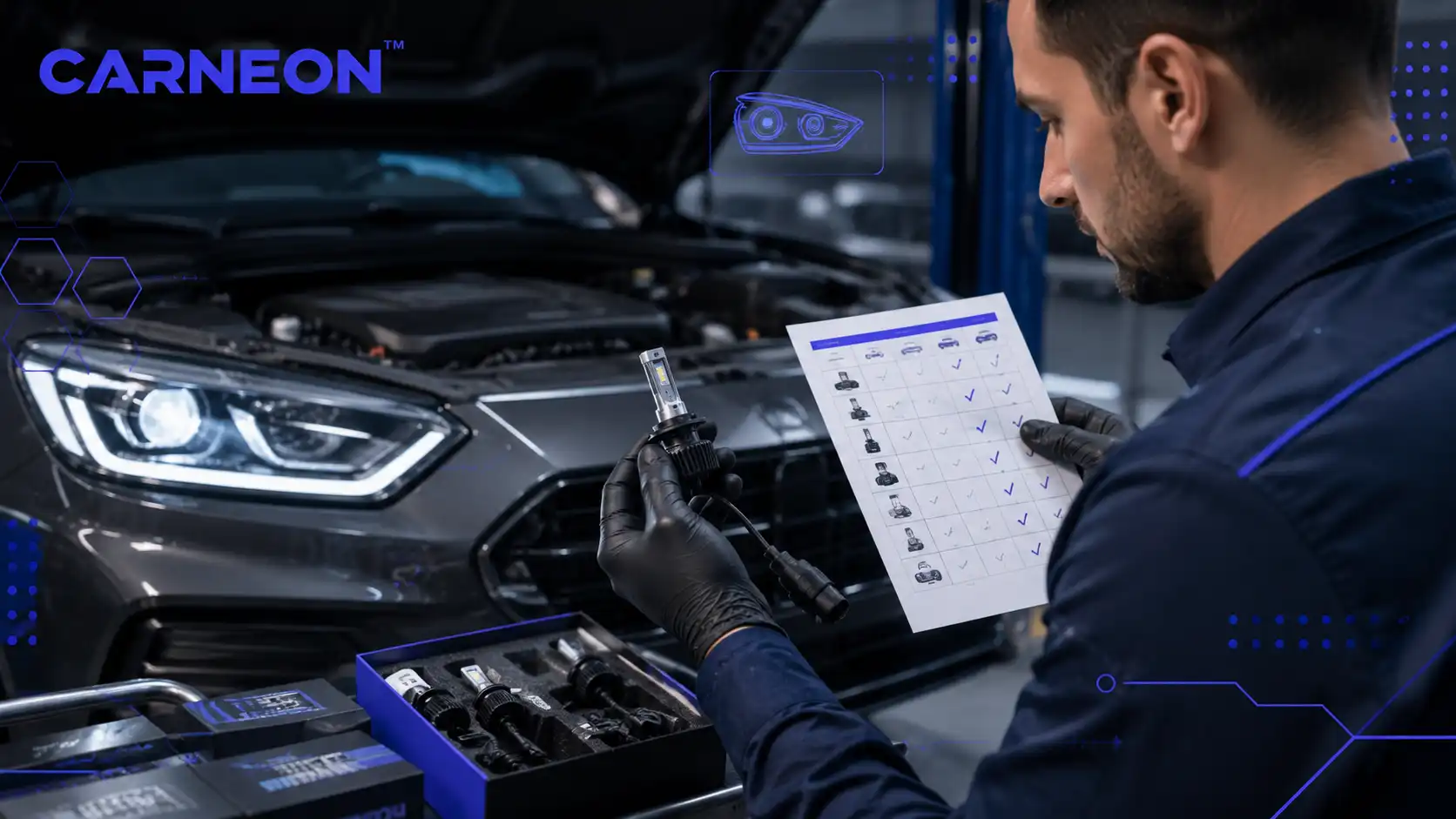
LED Headlight Troubleshooting for Auto Parts Distributors: Installation & Compatibility Workflow

The Technical Guide to Identifying High-Performance LED Headlight Bulbs (2026 Edition)
You May Also Like


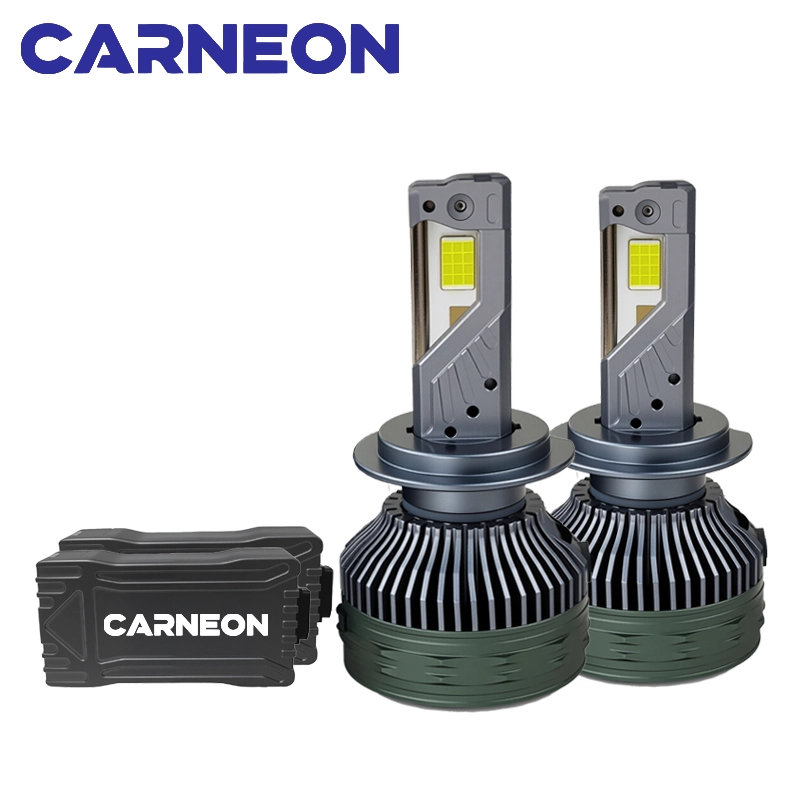

Get More Resources
If you have any comments or good suggestions, please leave us a message, later our professional staff will contact you as soon as possible.
Start Your Wholesale Order / Request OEM Solutions
Partner directly with the factory for competitive pricing and priority support. Please provide your business details and estimated order volume (MOQ applies) so our sales engineers can tailor the best quote for your market.
Contact us


6th Floor, Building B, Liando U Valley, No. 29, Bishan Street, Huangpu District, Guangzhou, China

© 2026 CARNEON. All Rights Reserved. Privacy Policy | Terms and Conditions | Sitemap

Whatsapp: +8618688487142