


How to verify quality of an auto LED headlight manufacturer? | Insights by CARNEON
- 1. How can I independently verify a manufacturer's photometric performance when I don't have lab access?
- 2. What exact compliance and certification documents should I ask for to confirm DOT/FMVSS, ECE or regional legal compliance?
- 3. How do I evaluate a manufacturer's thermal management claims and predict lumen depreciation in real-world use?
- 4. Which production quality control processes must a professional buyer insist on (burn‑in, AQL, traceability), and what acceptance criteria are realistic?
- 5. How do I assess real-world durability for vibration, moisture ingress, corrosion and EMI (salt‑spray, vibration, IP, EMC)?
- 6. What are the top documentary or factory audit red flags that indicate an LED headlight supplier is low quality or risky?
1. How can I independently verify a manufacturer's photometric performance when I don't have lab access?
Why it matters: Incorrect beam pattern or inflated lumen claims are the most common causes of poor on-road performance and legal non-compliance. Photometric performance determines glare, cutoff, and usable illumination.
Step-by-step verification you can do and what to request:
- Ask for an accredited photometric report from an ISO/IEC 17025 lab or recognized test house (examples: SGS, Intertek, Bureau Veritas). The report should include an integrating-sphere total luminous flux (lumens) and a goniophotometer candela distribution (cd at angles) or a full photometric file (IES/LM-63 or EULUMDAT).
- Check the photometric plot for a distinct, legal cutoff (for low-beam) and the claimed beam pattern for your market (DOT/FMVS108 in the U.S. or ECE/E‑mark for Europe). The report must list measurement standards used (e.g., SAE J1383 / FMVSS 108 references or ECE test method).
- If you lack lab tools, perform a pragmatic field check with the sample lamp: mount at vehicle height against a vertical wall at a known distance (commonly 7.5 m / 25 ft used by many installers). Use a lux meter to measure peak lux and verify the visual cutoff line and hotspot position. Compare the measured lux reduction vs. manufacturer's claimed lumen/lux figures (understanding this is an approximation).
- Require the IES/LM file from the manufacturer and open it in free viewers (e.g., AGi32 trial, Photopia viewer). This allows you to simulate beam pattern and validate candela points without specialized hardware.
- Red flags: No goniophotometer data, only marketing lumen numbers without test reports, or photometric reports from non‑accredited houses.
2. What exact compliance and certification documents should I ask for to confirm DOT/FMVSS, ECE or regional legal compliance?
Why it matters: Legal compliance varies by market. Installing non‑compliant headlights can lead to fines, failures in inspections, and liability exposure.
Documents to request:
- For the U.S.: Evidence of compliance with FMVSS 108 requirements and DOT marking where applicable. Ask for official test reports showing the product meets required photometric limits and referencing the FMVSS/SAE test procedures used.
- For EU/other regions: Request the applicable E‑mark (ECE) certificate or test report. The product should display the correct E‑mark code for the lamp function and market.
- Ask to see third‑party lab test reports that explicitly state the normative standard used (e.g., SAE, DOT test method, or the specific ECE regulation number). Reports should be dated, stamped and traceable to the tested sample serial number.
- In addition request EMC/EMI test reports (CISPR 25 or equivalent) and environmental tests used for compliance in automotive applications.
- Red flags: Generic CE markings only (CE is not an automotive compliance substitute), certificates without a lab stamp or with unverifiable report numbers, or certificates for different product models than the ones you plan to buy.
3. How do I evaluate a manufacturer's thermal management claims and predict lumen depreciation in real-world use?
Why it matters: LED lifetime and consistent luminous output depend primarily on thermal design. Poor heat dissipation reduces light output and causes premature failure.
What to ask for and how to evaluate:
- Request a detailed thermal test report showing junction temperature (Tj) vs. time and board or substrate temperatures under continuous operation at rated current. The report should state the test ambient temperature and cooling conditions.
- Check if the manufacturer provides an L70 or L50 lifetime estimate with the test method described (e.g., accelerated HTOL testing). High‑quality automotive LEDs typically produce lifetime data in tens of thousands of hours; ensure the claim is backed by test data rather than marketing text.
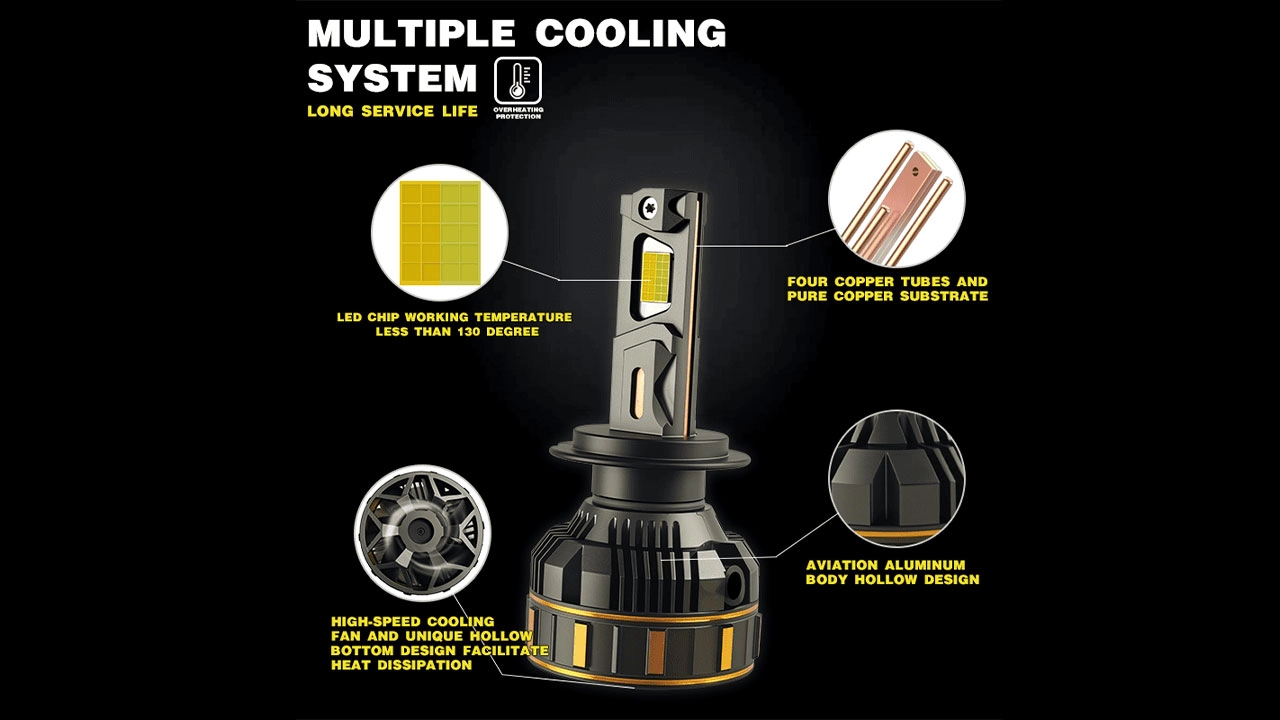
- Inspect the product architecture: aluminum housings, direct thermal paths (heat pipes, copper-core MCPCBs), and whether it uses passive (large heatsink) or active cooling (fans). For sealed housings (IP67/68) ensure thermal paths don’t rely solely on convective cooling that won’t work when sealed.
- Ask for actual in-house thermal images (IR thermography) taken after a burn‑in period and for the case‑to‑ambient (Tc‑Ta) thermal resistance figure (°C/W) if available. Lower °C/W is better.
- Home check: after 10–30 minutes of operation, carefully feel the housing (not the LED emitter). Excessive heat at the driver housing or plastic lens indicates inadequate heat sinking.
- Red flags: No thermal data, claims of long life without L70 data, or sealed designs with small heatsinks and no clear thermal path.
4. Which production quality control processes must a professional buyer insist on (burn‑in, AQL, traceability), and what acceptance criteria are realistic?
Why it matters: Consistent production quality prevents high field failure rates and warranty costs.
Processes and acceptance criteria to require:
- Quality management certifications: IATF 16949 (preferred for automotive OEM suppliers) or ISO 9001. Ask for scope pages showing lighting/headlamp production rather than generic site certificates.
- Burn‑in / aging: 100% or statistically sampled burn‑in for 8–24 hours at rated current and elevated temperature. The supplier should list burn‑in parameters and failure rate during this process.
- AQL sampling plans: For critical defects insist on tighter AQL levels (e.g., AQL ≤1.5 for critical/major defects). Inspect incoming material inspection (IQC) for LEDs and drivers, and outgoing quality control (OQC) reports including measured lumens and color binning distribution.
- Component traceability: BOM traceability with batch numbers for LED chips, drivers, and lenses. Traceability enables root cause analysis for failures and is standard in reputable suppliers.
- Routine production tests: 100% electrical test (function), visual inspection for solder joints and alignment, and sample-based photometric checks per lot. Check if they archive test data tied to production lot numbers.
- Red flags: Factory that refuses to share QA stats, no burn‑in, no traceability or only verbal assurances without documentation.
5. How do I assess real-world durability for vibration, moisture ingress, corrosion and EMI (salt‑spray, vibration, IP, EMC)?
Why it matters: Automotive environments expose headlights to mechanical shock, road salt, water, and electromagnetic disturbances. Passing environmental tests predicts field reliability.
Tests and documentation to demand:
- Vibration and shock: Ask for reports showing compliance to automotive vibration profiles and mechanical shock tests. Look for test standards cited (e.g., OEM PV390/IEC 60068 family equivalents) and acceleration profiles with test duration.
- Ingress protection (IP): Request IP67/IP68 test reports for sealed lamps including test parameters (immersion depth/time). Ensure lens/house sealing methods (gaskets, adhesive) are described.
- Corrosion: Salt spray (fog) testing reports showing durations and evaluation criteria. For coastal or salted-road use, extended salt-spray performance matters for connector and housing corrosion resistance.
- EMC/EMI: Request CISPR 25 (or equivalent) conducted and radiated emissions and immunity reports to confirm the driver and lamp meet vehicle electromagnetic compatibility requirements.
- Connector and harness durability: Request mating cycle data for connectors, and verify over‑molding or sealed connector designs are used for high‑moisture exposure.
- Red flags: Missing EMC reports, only IP claims without tests, or no vibration/shock testing for an automotive‑grade product.
6. What are the top documentary or factory audit red flags that indicate an LED headlight supplier is low quality or risky?
Why it matters: Spotting early warning signs saves time and warranty money; suppliers sometimes falsify paperwork or present non‑reproducible lab reports.
List of red flags and how to verify:
- Unverifiable certificates: Report numbers that cannot be confirmed with the issuing lab, expired accreditation, or lab logos that don’t match the lab’s public database. Always verify ISO/IEC 17025 and IATF/ISO certificates on the registrar’s website.
- No traceability: If the supplier cannot provide component batch records for LEDs and drivers or refuses to tie test reports to serial/sample numbers, treat this as a major risk.
- Inconsistent test conditions: Photometric reports missing ambient temperature, current, or measuring distance—these omissions invalidate comparisons. Ask for full test parameters.
- Factory evasiveness: Refusal to allow third‑party factory audits or provide production line photos, process flow diagrams, or OEE/CPK data suggests problems in production discipline.
- Unrealistic warranty terms: Extremely short warranty or none at all, or warranty terms that exclude all real failure modes, indicate lack of confidence in product quality.
- Low BOM transparency: Refusal to disclose LED chip brand, driver vendor, optical supplier, or lens material—good suppliers will share relevant technical info under an NDA.
Mitigations: Use third‑party factory audits (SGS/Bureau Veritas), request sample lots for independent testing at an ISO/IEC 17025 lab, and negotiate staged payments tied to acceptance criteria and warranty provisions.
Concluding paragraph — Advantages of buying from a fully verified LED headlight manufacturer
Working with a verified automotive LED headlight manufacturer that provides accredited photometric reports, FMVSS/ECE compliance evidence, robust thermal data, documented burn‑in/AQL processes and environmental/EMC testing reduces legal risk, minimizes field failures and warranty exposure, and ensures predictable performance and long life. Traceability and IATF/ISO processes enable rapid root‑cause analysis and continuous improvement, delivering lower total cost of ownership and higher fleet uptime.
For a technical quote, sample testing or to schedule a factory audit, contact us: www.carneonlighting.com | nick@evitekhid.com
Recommended for you
Why Your Customers Complain About LED Headlight Flickering (And How Our CANbus Solutions Fix It)
The Ultimate B2B Guide to Plug and Play LED Headlights: 1:1 Design, Specs & CANbus Solutions
LED vs. HID vs. Laser: Which Headlight Technology is Actually the Brightest for 2026?
Evitek Launches Smart Control Headlight—N14 Series, Redefining Driving Lighting Experience
FAQs
After-sale Service
How do l start working with you?
Product
Does the purchase products include tax?
Customized Service
Do you provide OEM/ODM service?
Brand
How can I contact CARNEON for inquiries or orders?
You can reach CARNEON via email, phone, or website contact form. Our team provides support for brand customers, OEM/ODM partners, and distributors globally.
You May Also Like
Get More Resources
If you have any comments or good suggestions, please leave us a message, later our professional staff will contact you as soon as possible.
Start Your Wholesale Order / Request OEM Solutions
Partner directly with the factory for competitive pricing and priority support. Please provide your business details and estimated order volume (MOQ applies) so our sales engineers can tailor the best quote for your market.
Contact us


6th Floor, Building B, Liando U Valley, No. 29, Bishan Street, Huangpu District, Guangzhou, China

© 2026 CARNEON. All Rights Reserved. Privacy Policy | Terms and Conditions | Sitemap

Whatsapp: +8618688487142