


can i replace halogen bulbs with plug and play led headlights? | Insights by CARNEON
- 1) Can I replace halogen bulbs with plug-and-play LED headlights in reflector (sealed) housings without creating glare or poor beam pattern?
- 2) Will plug-and-play LED bulbs trigger bulb-out warnings or CAN-bus errors, and how do I fix them?
- 3) Do plug-and-play LED headlight bulbs require extra cooling space, and will fans fit inside tight factory housings?
- 4) Are plug-and-play LED replacements street legal (DOT/ECE), and how can I verify approval for my country?
- 5) How does lumen and lux output of plug-and-play LED bulbs compare to halogen in real-world beam pattern and road visibility?
- 6) What are common failure modes for plug-and-play LED headlights after installation and how do I get a warranty claim accepted?
- Concluding summary: Advantages of replacing halogen bulbs with plug-and-play LED headlights
1) Can I replace halogen bulbs with plug-and-play LED headlights in reflector (sealed) housings without creating glare or poor beam pattern?
Short answer: Maybe — but you must confirm chip position and optical design match the halogen filament location, and verify aim after installation.
Why this matters: Halogen filaments are a single, small linear light source positioned precisely inside the bulb. Factory reflector and projector housings are engineered around that light source position to create a controlled cutoff and focused beam. Most plug-and-play LED bulbs place LED chips where the filament used to be, but some low-cost designs put chips too far forward/back or use multiple emitters at different angles. That changes the reflector's interaction with the light and causes scattered light and glare.
What to check before buying:
- Bulb type and chip placement: Choose plug-and-play LED bulbs that explicitly state the LED chips are arranged to mimic the filament’s optical center for your bulb code (H1, H4, H7, H11, 9005/9006, etc.). High Quality manufacturers publish cross-section photos and measured beam graphs.
- Housing type: Reflector (sealed) housings are less forgiving than projector housings. Many installers report acceptable results in projectors; reflectors need a close match in chip position.
- Beam measurements: Look for independent lux/beam pattern tests (measured at 10–25 m) rather than lumen-only claims.
Installation and verification steps:
- Install on a flat surface, level the vehicle, and set the headlight aim using a wall at 7.6 m (25 ft) or per OEM spec. Many installers use the 25 ft wall method to check cutoff.
- Check for asymmetrical cut-off and bright hot spots above the legal horizontal line — these indicate mismatch and potential glare.
- If glare occurs, either return the kit or fit a purpose-built retrofit projector or a lamp specifically designed for your housing.
Practical outcome: Good-quality plug-and-play LED bulbs that mimic filament position can work in many housings. Cheap universal LEDs often fail the beam pattern test and cause glare or poor forward visibility. For safe, legal, and repeatable results in reflector housings, a headlight module designed for retrofit or a sealed LED unit is the safer choice.
2) Will plug-and-play LED bulbs trigger bulb-out warnings or CAN-bus errors, and how do I fix them?
Short answer: Yes — many vehicles report errors or flicker due to lower current draw and different impedance. Fixes include CAN-bus decoders, load resistors, or purpose-built CAN-compatible LED drivers.
Why CAN-bus sees an issue: Modern vehicles monitor headlight circuits for current draw; halogen bulbs draw significant current. LEDs draw much less current and present different electrical characteristics (lower resistance, sometimes rapid PWM from internal drivers). The vehicle interprets this as an open circuit and throws warnings, hyperflash, or flicker.
Solutions (ordered from preferred to last-resort):
- Buy CAN-bus compatible LED kits: Many manufacturers now include a decoder or driver tuned to the car’s system and flagged as “CANbus” or “Error Free.” These are the easiest solution for plug-and-play installs.
- Use OEM-style LED drivers: Replace inline drivers with ones that emulate the halogen load and provide stable DC output.
- Install load resistors: Resistive loads replicate halogen current draw and stop warnings. Downsides: they waste power as heat, require mounting and proper waterproofing, and are vehicle-specific. Not ideal for low-power conversions.
- Professional reprogramming: Some vehicles (especially High Quality European cars) allow the BCM to be reprogrammed to accept LED loads; this requires dealer tools or an aftermarket coder.
Notes on EMI and radio interference: Cheap decoders or resistors can create EMI that interferes with radio reception or vehicle sensors. Choose components with EMI suppression and IP67-rated housings where possible.
3) Do plug-and-play LED headlight bulbs require extra cooling space, and will fans fit inside tight factory housings?
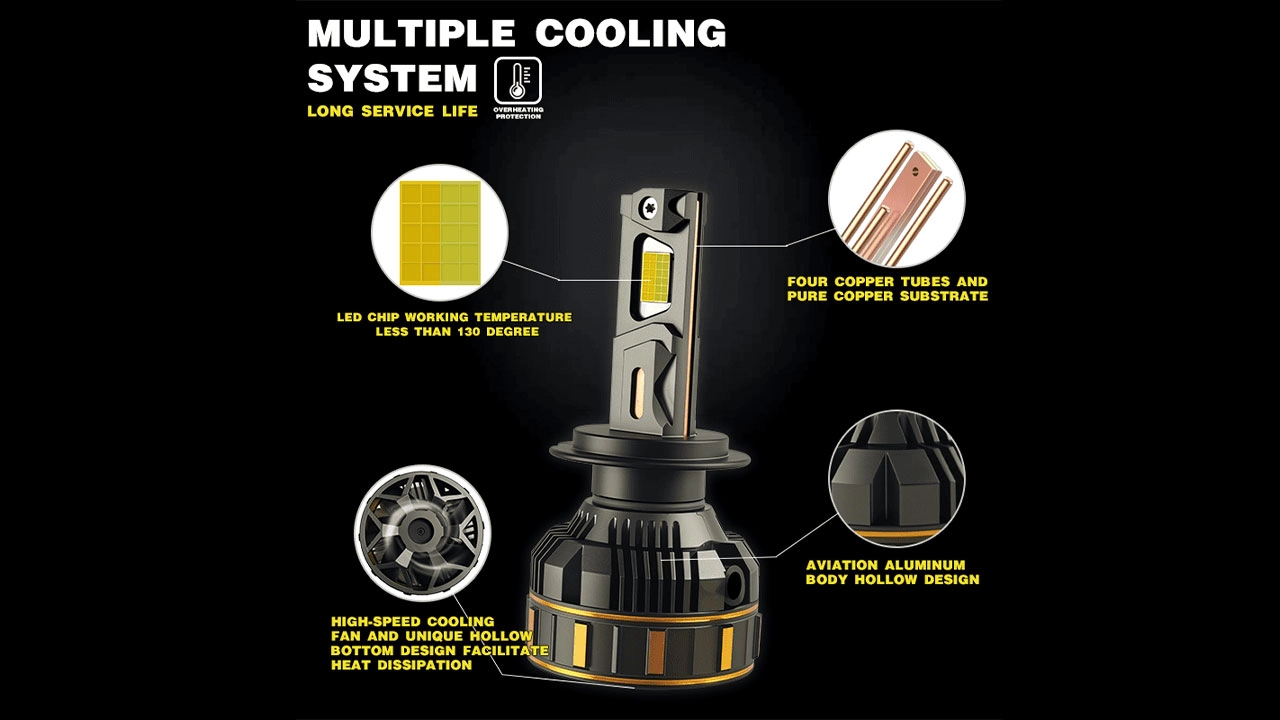
Short answer: Yes — thermal management matters. Many plug-and-play LEDs use either active (fan) or passive (large heatsink) cooling, and you must check rear-cavity clearance and sealing.
Thermal basics: LEDs are semiconductors — they produce heat at the base. Excess junction temperature reduces light output, colour stability, and lifetime. Manufacturers lower junction temperature with heatsinks, thermal pads, and fans. Real-world LED headlight lifespan (with good thermal management) commonly ranges from ~30,000 to 50,000 hours; halogen bulbs last roughly 500–1,000 hours.
What to measure and check:
- Rear clearance: Many plug-and-play LED bulbs need 20–40 mm (0.8–1.6 in) of rear clearance for a heat sink or fan. Some vehicles (especially those with dust covers or limited space) do not have room. Measure behind the OEM bulb before ordering.
- Fan vs passive: Fans are compact and give better cooling in constrained spaces but can fail mechanically (fan lifespan). Passive fins are more reliable long-term but need more clearance and rely on airflow.
- Sealing and dust covers: If your vehicle has a rubber dust cap or weather seal, it may need trimming or a different adapter. Ensure any modification preserves water and dust ingress protection (IP rating).
Installation tips:
- Check for movement under full steering lock and suspension travel; confirm no contact with housing.
- If a fan cannot fit, choose a low-profile, high-performance passive design or a sealed LED retrofit unit built as a direct housing replacement.
4) Are plug-and-play LED replacements street legal (DOT/ECE), and how can I verify approval for my country?
Short answer: Not always. Street legality depends on certification and jurisdiction. In the U.S., bulbs must meet FMVSS 108 / DOT requirements; in Europe, UNECE/EC type-approval (E-mark) is required for retrofit bulbs.
What to look for:
- U.S. market: Look for DOT or FMVSS 108 compliance. Many aftermarket “plug-and-play” LED bulbs are not DOT-approved for on-road use when used as simple bulb replacements in housings designed for halogen bulbs.
- Europe and other UNECE countries: Look for an E-mark and the applicable regulation citation (installation vs. lamp unit approval). Aftermarket LED bulbs often lack proper type approval and are only legal when part of a certified headlamp assembly.
How to verify:
- Manufacturer documentation: Check for a DOT stamp or E-mark on the product label and the technical datasheet. Genuine certification will include a regulation number and approval code.
- Independent testing: Reputable brands publish third-party test results (beam pattern, lux plots, EMC tests).
- Local enforcement: Some jurisdictions allow retrofits only if the entire headlamp is replaced with an approved LED unit; others permit LED bulbs if they meet the approval mark. Check local vehicle inspection rules.
Practical guidance: If you need guaranteed street legality, buy a properly certified LED headlamp assembly or bulbs explicitly approved for retrofit use in your market. Using non-certified plug-and-play bulbs risks failing inspection and creating unsafe glare for other road users.
5) How does lumen and lux output of plug-and-play LED bulbs compare to halogen in real-world beam pattern and road visibility?
Short answer: Lumen claims alone don't equate to usable road illumination. Lux and measured beam pattern at driving distances are the reliable metrics to compare performance.
Important distinctions:
- Lumens measure total light emitted in all directions. A high lumen number can be meaningless if light is scattered.
- Lux measures illuminance (lumens per square meter) on a target surface and correlates to how well the road ahead is lit at a certain distance.
What to expect:
- Halogen baseline: Typical halogen bulbs (H7/H4 class) produce a focused beam with predictable lux distribution that OEM housings are designed around.
- Plug-and-play LEDs: Good kits can significantly increase lux on the road centerline and improve peripheral illumination if the chip position and optics match the halogen filament location. Beware of inflated lumen claims and no lux data.
How to validate performance before purchase/installation:
- Look for independent lux tests at standard distances (10–25 m). Trusted reviewers and labs measure the lux on the cutoff and centerline; use those for comparison.
- Check beam pattern images (ideally taken in a dark room with the same camera settings) showing cutoff sharpness and hot spot location.
- Manufacturer data should include CRI (colour rendering), correlated colour temperature (CCT — many drivers prefer 4000–6000K), and sustained lumen output after 30 minutes of operation (thermal stabilization test).
Practical suggestion: If your priority is usable visibility at speed (highway driving), prioritize lux and beam graph data over lumen marketing numbers, and select kits from manufacturers that publish measured beam patterns for your bulb/housing combination.
6) What are common failure modes for plug-and-play LED headlights after installation and how do I get a warranty claim accepted?
Common failure modes:
- Thermal failure: Overheating due to poor heatsinking, insufficient rear clearance, or clogged cooling leading to rapid lumen drop and premature chip failure.
- Driver/electronics failure: Internal driver/PCB or solder joint failures caused by voltage spikes, poor EMI suppression, or water ingress.
- Mechanical failures: Fan failure (if active cooling), broken fins, or connector fatigue from vibration.
- Electrical compatibility-related failures: CAN-bus voltage spikes, incorrect polarity, or backfeed from vehicle circuits.
How to reduce risk before and during installation:
- Buy from reputable manufacturers with transparent specifications and independent test data (IP rating, EMC, operating temperature range, sustained lumen output).
- Ensure correct fitment: Verify clearance, secure connectors, and preserve vehicle seals.
- Confirm electrical compatibility: Use CANbus kits or load resistors if recommended, and test for flicker and error codes immediately after installation.
How to prepare for warranty claims:
- Keep purchase documentation (invoice, photos of packaging showing part numbers and approval marks).
- Photograph the installed product (clear shots of seals, wiring, and clearance) and document fitment and aim checks.
- Record the vehicle model, VIN, and installation date — many manufacturers require this for cross-checking known vehicle compatibility lists.
- If failure occurs, capture diagnostic evidence: voltage at the plug, error codes, and photos of failed components (corrosion, water ingress, burn marks).
- Contact the seller/manufacturer with the above documentation and ask for an RMA or warranty form. Reputable brands will offer repair, replacement, or proof-of-failure testing.
Warranty expectations: High-quality manufacturers commonly offer 2–5 year warranties for headlights; cheeky one-year warranties on low-cost products often lead to poor post-sale support. Seek a seller with a clear return policy, technical support, and a replacement procedure.
Concluding summary: Advantages of replacing halogen bulbs with plug-and-play LED headlights
When done correctly, converting from halogen to plug-and-play LED headlights brings meaningful advantages: higher luminous efficacy (more usable light per watt), longer service life (commonly 30,000–50,000 hours for quality LED modules versus ~500–1,000 hours for halogen), lower vehicle electrical load, instant start and stable colour temperature, and often better beam uniformity when the LED chip placement matches the halogen filament position. However, benefits rely on correct product selection (CAN-bus compatibility, proper chip placement for your housing), certified units for street legality, and adequate thermal management to ensure reliability.
As LED headlight specialists at Car Neon Lighting, we can evaluate your vehicle, recommend DOT/ECE-approved LED solutions or complete retrofit assemblies, and provide installation guidance. Contact us for a quote at www.carneonlighting.com or email nick@evitekhid.com to get a certified, vehicle-specific recommendation.
Recommended for you
Why Your Customers Complain About LED Headlight Flickering (And How Our CANbus Solutions Fix It)
The Ultimate B2B Guide to Plug and Play LED Headlights: 1:1 Design, Specs & CANbus Solutions
LED vs. HID vs. Laser: Which Headlight Technology is Actually the Brightest for 2026?
Evitek Launches Smart Control Headlight—N14 Series, Redefining Driving Lighting Experience
FAQs
Company
How many employees in Evitek?
Brand
What products does CARNEON offer?
High-quality LED headlight bulbs with stable output from 25W to 75W, designed for real-road performance and durability.
E1
What is the lead time?
Mass production takes 15-20 days; samples take 5-10 days.
After-sale Service
Do you provide installation or user manuals?
You May Also Like
Get More Resources
If you have any comments or good suggestions, please leave us a message, later our professional staff will contact you as soon as possible.
Start Your Wholesale Order / Request OEM Solutions
Partner directly with the factory for competitive pricing and priority support. Please provide your business details and estimated order volume (MOQ applies) so our sales engineers can tailor the best quote for your market.
Contact us


6th Floor, Building B, Liando U Valley, No. 29, Bishan Street, Huangpu District, Guangzhou, China

© 2026 CARNEON. All Rights Reserved. Privacy Policy | Terms and Conditions | Sitemap

Whatsapp: +8618688487142