


plug and play led headlight | Insights by CARNEON
- 1. Can I install a plug and play LED headlight on vehicles with adaptive high beam, auto-leveling, or headlight washers without disabling those features?
- 2. How can I avoid glare and a poor cutoff when using a plug and play LED headlight in reflector housings?
- 3. My plug and play LED headlights cause CANbus errors, flicker or hyper-flash—what are the root causes and how do I fix them without cutting wires?
- 4. How do I evaluate the true brightness and longevity of a plug and play LED headlight—are lumen claims reliable?
- 5. Will a plug and play LED headlight overheat inside sealed housings or cause body-control issues because of thermal stress?
- 6. Are plug and play LED headlights street-legal and likely to pass inspection in the US and EU?
- Conclusion: Why choose a certified plug and play LED headlight?
Plug and Play LED Headlight: 6 Deep Answers Every Buyer Needs
When searching for a plug and play led headlight, beginners face specific technical and legal pain points that generic product pages don’t resolve. Below are six long-tail, outcome-focused questions buyers actually need answered, with in-depth, practical guidance based on industry standards (FMVSS 108/DOT, ECE R regs), LED testing (LM-80/TM-21) and automotive EMC guidance (CISPR25/ISO 7637).
1. Can I install a plug and play LED headlight on vehicles with adaptive high beam, auto-leveling, or headlight washers without disabling those features?
Short answer: Sometimes — but it depends on the vehicle’s control architecture, the LED driver’s CANbus compatibility, and whether the LED unit preserves OEM signalling and electrical load characteristics.
Details and checklist:
- Understand the vehicle’s architecture: Many modern cars (Audi, BMW, Mercedes, Volkswagen, Ford, etc.) use a body control module or advanced lighting control unit that monitors bulb type, resistance, and PWM signals. If the aftermarket plug and play LED headlight changes the electrical signature, the system may throw errors, disable adaptive functions, or flag faults in diagnostic logs.
- Look for CANbus-aware LED drivers: High-quality plug and play LED headlight kits intended for modern vehicles include CANbus-compatible drivers or dedicated decoders that emulate OEM bulb load and error-free communication. Verify the manufacturer explicitly states compatibility with adaptive/high-beam assist and lists tested vehicle models.
- Coding vs hardware: Some vehicles require OBD re-coding after converting to LED to tell the module a compliant LED is present. This is a safer approach than brute-force load resistors because it preserves module diagnostics. If you’re uncomfortable with coding, choose a kit that’s explicitly advertised as compatible with your exact model and model-year.
- OEM-level retrofits: For cars with camera-based adaptive systems, the most reliable approach is OEM or purpose-built retrofit modules that are designed to maintain communication and calibration with the vehicle’s sensors. Consumer plug-and-play bulbs can work in many cases, but they’re higher risk on advanced systems.
- Reflector housings were designed for halogen filaments placed at a precise focal point. LED emitters behave differently unless the LED module reproduces the halogen filament’s axial position and effective beam source size.
- Poorly designed plug and play bulbs often scatter light, creating upward glare for oncoming drivers even if claimed lumen output is high.
- Filament equivalence: Manufacturers that specify a 1:1 filament position or show CAD alignment with H4/H7/9005/9006 filaments are more reliable for reflector housings.
- Beam pattern proof: Look for measured beam diagrams or lux maps (e.g., lux at 10m) and a clear cutoff illustration. Lumen numbers alone are insufficient; industry best practice is to publish lux at fixed distance and beam pattern graphs.
- Projector vs reflector: Projector housings with proper optics usually handle LED bulbs better. If your vehicle uses sealed reflectors, choose a kit explicitly optimized for reflector housings or select a projector retrofit.
- Aim and alignment: After installation, always check headlight aim using a wall or workshop alignment tool to ensure the cutoff meets local regulations and avoids blinding oncoming drivers.
- Electrical load mismatch: LED drivers draw far less current than halogen bulbs; some vehicles detect a low load as a burned-out lamp and trigger a fault or hyper-flash.
- EMC/EMI interference: Poorly filtered drivers can generate noise that interferes with multiplexed communication on the vehicle network.
- PWM incompatibility: OEM lamp monitoring may expect a particular PWM signature; aftermarket drivers with different PWM behavior can be misinterpreted.
- Use a CANbus-compatible LED driver: Replace the LED kit with one whose driver explicitly supports your vehicle’s load monitoring and PWM behavior.
- Add a CANbus decoder module: These plug between the bulb and socket and emulate the required load and communication handshake. They are plug-and-play for many models and avoid splicing into OEM wiring. Choose decoders rated for automotive temperature and vibration.
- OBD re-coding: For many European cars, the correct fix is to change the lamp configuration via the vehicle’s diagnostic interface (e.g., VCDS, ISTA). This tells the BCM that LEDs are installed and suppresses false errors—this is reversible and preserves diagnostics.
- Avoid resistors when unnecessary: Load resistors can stop hyper-flash but add heat and drain current; if you can achieve compatibility with a decoder or updated driver, that is preferable.
- System vs chip lumens: Many suppliers quote LED chip manufacturer lumens (ideal chip output) which ignores losses in optics, drivers, and thermal throttling. Instead, prioritize system lumens or, better, lux measurements at 10 meters with a published beam map.
- Lux is more meaningful: For headlamps, lux at a given distance and the beam distribution determine usable visibility and compliance. Look for photos or tables showing cutoff performance and lux at standard distances (typically 10m).
- LM-80 & TM-21: These are industry test standards for LED lumen depreciation and life prediction. Reliable manufacturers will provide LM-80 test data and an estimate using TM-21 projections (e.g., L70 > 30,000–50,000 hours). If none is available, question the longevity claims.
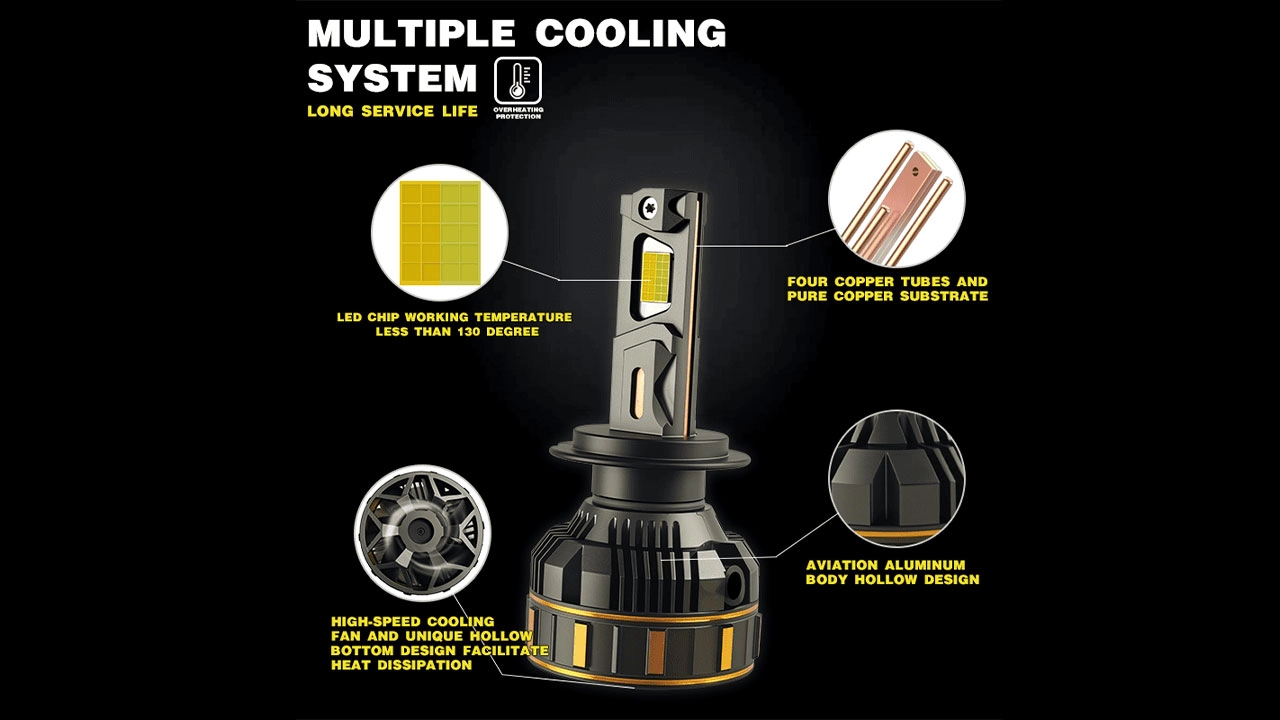
- Thermal management and duty cycle: Heat kills LED output. Check whether the product uses active cooling (fan) or passive cooling (heatsink). Active systems may offer higher peak output but add mechanical parts; passive systems are quieter and can be more reliable if designed properly.
- Warranty and real-world track record: A meaningful warranty (2–5 years) and documented real-world reviews or independent bench tests are strong indicators of trustworthy brightness and lifetime claims.
- Active vs passive cooling: Fan-cooled drivers need airflow and space behind the headlamp. In tightly packed engine bays or sealed housings, fans can be obstructed or draw hot air, reducing performance. Passive heatsinks rely on surface area and conduction and can perform better in confined spaces if designed correctly.
- Heat and optics: Excessive temperature can cause lumen depreciation, color shift, and premature driver failure. Good LED kits incorporate thermal cut-off or current throttling to prevent catastrophic failure but that can reduce brightness under high ambient temps.
- Housing pressure and seals: Some sealed projector or reflector housings have limited volumetric clearance. If the aftermarket LED assembly extends too far rearwards or disrupts the seal, you risk moisture ingress. Look for IP67/IP68-rated LED modules and connectors to reduce this risk.
- Body-control impacts: Overheating or driver noise can trigger error codes or cause the BCM to limit lighting functions. Use products tested for automotive temperature ranges (typically -40°C to +105°C) and specify over/under-voltage protection.
- Measure or check the free space behind your headlamp. Compare to the LED kit’s required clearance and cooling method.
- Check IP rating and stated operating temperature range. Prefer IP67/IP68 for water and dust resistance in automotive environments.
- Choose a supplier who publishes thermal images, cooling strategy, and long-term lumen maintenance testing.
- US: Look for DOT compliance markings and documentation referencing FMVSS 108 conformance. Note: DOT marking alone is helpful but not an absolute guarantee; some products bear markings without formal certification.
- EU/UK: ECE regulations differ for LEDs. ECE R112 historically covered headlamp performance; newer ECE regulations like R128 relate to LED modules and adaptive systems. Legal LED retrofit in EU markets often requires E-mark certification and proper installation per R48.
- Local inspection: Even if a bulb is certified, enforcement varies. Some vehicle inspections focus on beam cutoff and aim rather than certification labels. Ensure proper alignment and beam pattern to pass visual inspections.
- Projector vs reflector legal nuance: In many jurisdictions, LED retrofits are more defensible in projector housings because they can be aligned to produce the correct beam pattern. Reflector retrofits carry higher legal risk unless the LED is explicitly certified for that housing.
Actionable recommendation: Before purchase, ask the supplier to confirm model-year compatibility and CANbus or OBD coding requirements. Keep a record (screenshot/email) that the kit supports your model. If in doubt, use an OEM or validated retrofit solution to avoid deactivating safety features or voiding warranties.
2. How can I avoid glare and a poor cutoff when using a plug and play LED headlight in reflector housings?
Short answer: Match filament position and optical footprint; validate beam pattern with lux/ANSI measurements rather than trusting raw lumen claims.
Why this matters:
What to verify:
Practical test: If possible, ask the vendor for an in-person demo or sample lux map. Reputable suppliers commonly publish beam shots and measured results rather than only chip lumens.
3. My plug and play LED headlights cause CANbus errors, flicker or hyper-flash—what are the root causes and how do I fix them without cutting wires?
Root causes:
Non-destructive fixes (no cutting wires):
Technical notes: Look for LED products that state compliance with automotive EMC standards (CISPR25) and transient protection (ISO 7637). These reduce the risk of intermittent faults and radio interference.
4. How do I evaluate the true brightness and longevity of a plug and play LED headlight—are lumen claims reliable?
Short answer: Treat raw lumen claims skeptically. Use test data (lux at distance), thermal specs, and industry-standard LED lifetime reports (LM-80/TM-21) as the reliable indicators.
Key evaluation points:
Practical numbers to expect: High-quality plug and play LED headlight bulbs typically provide 2,000–6,000 lumens per bulb in real-system measurements (4,000–12,000 lm per pair) depending on optical efficiency. However, prioritize lux/beam pattern and manufacturer LM-80/TM-21 data over raw lumen marketing.
5. Will a plug and play LED headlight overheat inside sealed housings or cause body-control issues because of thermal stress?
Short answer: It can, unless thermal management and space/clearance are verified for your specific headlamp housing.
Thermal considerations:
How to verify before purchase:
6. Are plug and play LED headlights street-legal and likely to pass inspection in the US and EU?
Short answer: Maybe — legality depends on region and whether the unit is certified to the relevant regulatory standard (DOT/FMVSS108 in the US; ECE R112/R128 and installation regs R48 in many countries). Many aftermarket plug and play units are not street-legal despite marketing claims.
What to check for legal compliance:
Practical advice: Verify the vendor’s compliance documents and request a copy of certification. If you live in a strict jurisdiction, consider using LED conversion modules explicitly certified for retrofit in your region or get an OEM retrofit kit to avoid inspection issues.
Conclusion: Why choose a certified plug and play LED headlight?
When selected and installed correctly, a certified plug and play led headlight delivers several clear advantages: improved night visibility with cooler color temperatures (typically 4300K–6000K for road use), longer service life (many products claim L70 in the 30k–50k hour range based on LM-80/TM-21), lower power draw, and instant-on performance. The real benefits come from choosing units with validated beam patterns (lux maps), proper CANbus compatibility, robust thermal design (IP67/IP68 and automotive temperature ratings), and recognized compliance with DOT or ECE regulations.
Before you buy, insist on model-year verified compatibility, ask for LM-80/TM-21 and EMC (CISPR25/ISO 7637) documentation, and confirm return/warranty terms. For vehicles with adaptive lighting, seek OEM-grade or proven retrofit solutions to avoid disabling safety systems.
For a personalized recommendation or a quote tailored to your vehicle model, contact us at www.carneonlighting.com or email nick@evitekhid.com.
Recommended for you
Why Your Customers Complain About LED Headlight Flickering (And How Our CANbus Solutions Fix It)
The Ultimate B2B Guide to Plug and Play LED Headlights: 1:1 Design, Specs & CANbus Solutions
LED vs. HID vs. Laser: Which Headlight Technology is Actually the Brightest for 2026?
Evitek Launches Smart Control Headlight—N14 Series, Redefining Driving Lighting Experience
FAQs
Brand
What makes CARNEON headlights reliable?
Triple-copper heat conduction system, rigorous testing, stable power output, and real-world vehicle testing ensure reliability.
Product
Are your products compliant with EU/US safety
What's the difference Evitek products and others?
After-sale Service
Can I cancel my order?
You May Also Like
Get More Resources
If you have any comments or good suggestions, please leave us a message, later our professional staff will contact you as soon as possible.
Start Your Wholesale Order / Request OEM Solutions
Partner directly with the factory for competitive pricing and priority support. Please provide your business details and estimated order volume (MOQ applies) so our sales engineers can tailor the best quote for your market.
Contact us


6th Floor, Building B, Liando U Valley, No. 29, Bishan Street, Huangpu District, Guangzhou, China

© 2026 CARNEON. All Rights Reserved. Privacy Policy | Terms and Conditions | Sitemap

Whatsapp: +8618688487142