


What is the lifespan of quality LED headlight bulbs? | Insights by CARNEON
- 1) For a daily commuter who drives 12,000–15,000 miles per year, how many years will quality LED headlight bulbs actually last?
- 2) How much does junction temperature and thermal management reduce LED headlight lifespan — can you quantify it?
- 3) Are advertised 30k–50k hour lifespans meaningful if the driver electronics or cooling fan often fail earlier?
- 4) How can I verify a supplier’s lifespan claims before buying — what test reports should I demand?
- 5) Which real-world factors (voltage spikes, alternator noise, moisture, vibration) shorten LED headlight life most, and how can I mitigate them?
- 6) If my LED headlight becomes dim or shifts color, is it end-of-life or can it be repaired — how to diagnose?
As LED headlight specialists at Carneon Lighting, we frequently see buyer confusion about advertised lifespans (30,000–50,000 hours) versus what drivers actually experience. Below are six focused, long-tail questions frequently asked by beginners — each answered with engineering-backed detail, test-data guidance, and purchase checklists you can use today. Semantic topics covered include LED headlight lifespan, lumen maintenance (L70), LM-80/TM-21, junction temperature, thermal management, IP ratings, driver MTBF, and vehicle electrical protection.
1) For a daily commuter who drives 12,000–15,000 miles per year, how many years will quality LED headlight bulbs actually last?
Advertised lifespans such as 30,000–50,000 hours are chip-level or optimal-system predictions (usually L70 projections). To translate hours into calendar years for a real driver, you must estimate annual headlight-on hours rather than miles. Practical ranges:
- Typical night-driving hours: 300–700 hours/year for an average commuter (varies by region and commute time).
- If you use headlights 500 hours/year, a 30,000-hour L70 LED chip implies a theoretical 60 years of use (30,000 / 500 = 60 years). A 50,000-hour chip would be 100 years. These raw numbers show why chip-level hours can be misleading.
Why the discrepancy? The L70 metric measures lumen depreciation to 70% under controlled conditions; it does not account for real failure modes that commonly end operation earlier: driver electronics, cooling fans or passive thermal interfaces, water ingress, wiring and connector corrosion, or road vibration. In real-world road use, high-quality integrated LED headlight assemblies typically last 6–15 years before replacement, while lower-quality retrofits often fail in 1–4 years because of poor thermal design or weak drivers.
Practical recommendation: evaluate both the chip L70 rating and system-level reliability: request LM-80/TM-21 data for the LED chip plus driver MTBF, IP rating, vibration test reports, and fan life (if active cooled). For commuter usage, choose products whose driver and cooling components are rated for at least 20,000–50,000 hours and that carry multi-year warranties.
2) How much does junction temperature and thermal management reduce LED headlight lifespan — can you quantify it?
Junction temperature (Tj) is the single biggest predictor of lumen maintenance and lifetime for LEDs. The physics: higher Tj accelerates phosphor degradation and semiconductor wear mechanisms. Manufacturers and lighting engineers commonly use the following rule-of-thumb: many semiconductor failure processes accelerate with temperature, roughly doubling rate for each ~10°C rise (an Arrhenius-type approximation). In lumen-maintenance terms, higher sustained Tj reduces the L70 lifetime projection issued under controlled TM-21 extrapolation.
Concrete implications:
- If a chip has L70=50,000 hours at a given controlled Tj (e.g., 85°C test condition), operating it routinely at a junction temperature 10–20°C higher will materially shorten that L70 projection. Exact factor depends on phosphor chemistry and package design, but engineers use an acceleration factor in life-testing to estimate decline.
- Poor thermal paths — thin heatsinks, inadequate airflow, or blocked radiator fins — can raise package temperature by 20–40°C compared to a well-designed assembly, shaving decades off the implied lifetime.
What to check on product datasheets:
- LM-80 test conditions and reported temperatures (often 85°C). Ask what Tj the TM-21 L70 projection is based on.
- Thermal resistance (RθJC or RθJA) for the LED package and system-level thermal dissipation details.
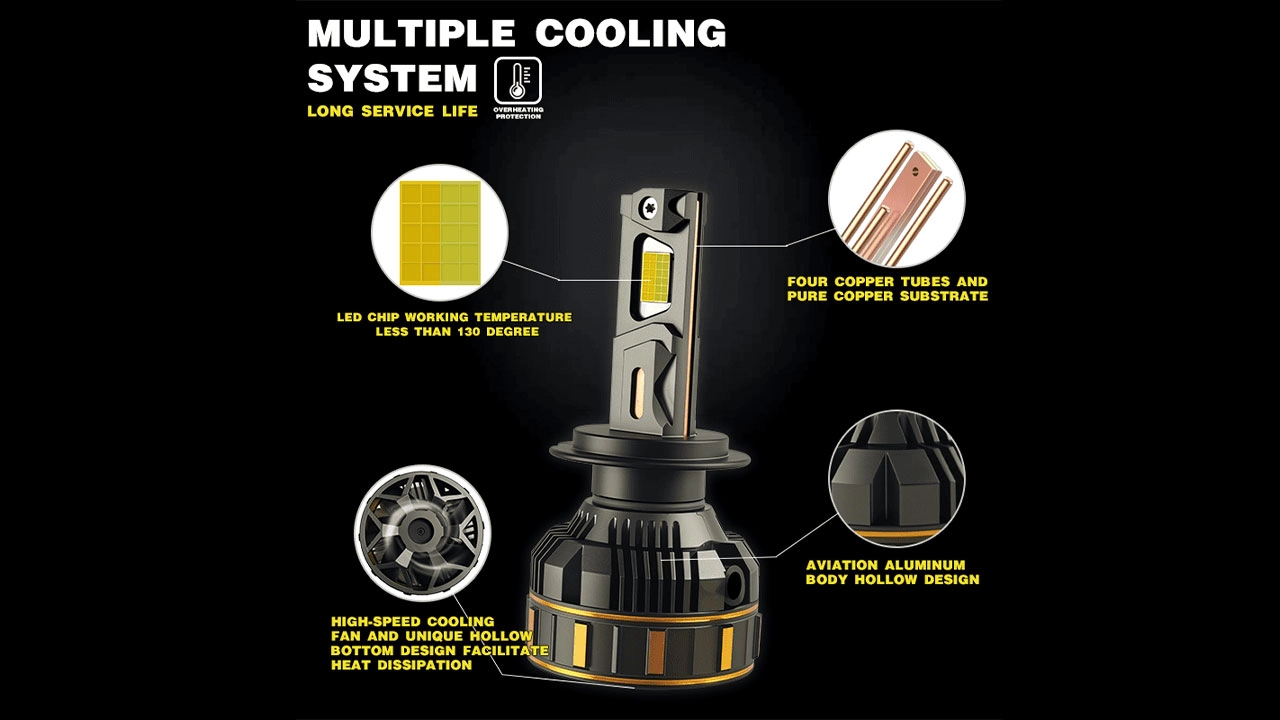
- Cooling strategy: passive heatsink mass, fins and conductive paths, or active cooling with fan specs (fan MTBF and rated hours).
Practical mitigation: select LED headlight units with robust passive heatsinks (preferred for vibration-free, maintenance-free designs) or high-quality fans rated 30,000+ hours continuous. Ensure the product maintains junction temperatures within the manufacturer’s LM-80 test envelope under your vehicle’s under-hood ambient temperatures.
3) Are advertised 30k–50k hour lifespans meaningful if the driver electronics or cooling fan often fail earlier?
Short answer: No — chip-level longevity is necessary but not sufficient. The system reliability of a finished LED headlight depends on four subsystems: LED chips, optical assembly, thermal management, and electronics (driver and wiring). Many failures originate in the driver or moving parts:
- Driver electronics: Poorly designed drivers are sensitive to input voltage transients, heat, and vibration. A driver rated for MTBF (mean time between failures) of 20,000–50,000 hours or higher is necessary to approach chip-level lifetimes. Look for stated MTBF, and ask for accelerated stress test reports.
- Active cooling fans: Small axial fans used in many retrofit bulbs often have bearing lives of 10,000–30,000 hours depending on bearing type and duty cycle. Fans are a common early failure point; passive designs avoid this risk.
- Seals and connectors: Water ingress and corrosion cause intermittent faults and early failures. IP67/IP68 ratings and conformal-coated electronics extend service life.
Checklist before purchase:
- Request LM-80/TM-21 for the LED chip and a driver MTBF report (or failure-rate data).
- If the product uses a fan, request fan model and manufacturer MTBF or choose fanless passive designs for long-term reliability.
- Check for IP67/IP68 sealing, vibration (ISO 16750 or equivalent) and EMC (R10 or manufacturer test) compliance to ensure durability in the vehicle environment.
4) How can I verify a supplier’s lifespan claims before buying — what test reports should I demand?
Trust but verify. Reputable suppliers will provide documentation that connects chip-level life testing to system-level performance. Ask for these documents and test results:
- LM-80 reports for the LED chips — shows luminous flux and color over 6,000–10,000 hours under controlled conditions.
- TM-21 life projections — shows how LM-80 data was extrapolated to L70, L80, etc., with the assumption and projection method.
- Driver MTBF and thermal cycling / soak test reports — details on driver component selection, surge protection and predicted lifespan under automotive temperature ranges.
- Photometric reports (IES files) showing initial candela distribution and measured lumen output.
- Environmental tests: IP67/IP68 sealing certificate, salt spray / corrosion reports, vibration tests (ISO 16750 or equivalent), and EMC/R10 test results if used in CAN-bus vehicles.
- Factory production QA: sample burn-in procedures, failure rates during QA, and warranty terms (length and coverage details).
If a supplier refuses to provide LM-80/TM-21, driver MTBF, or basic environmental test reports, treat advertised lifespans as marketing claims. For fleet purchases, require third-party lab verification (photometric and life testing) as part of procurement.
5) Which real-world factors (voltage spikes, alternator noise, moisture, vibration) shorten LED headlight life most, and how can I mitigate them?
Real-world automotive environments stress LED systems in ways bench tests sometimes ignore. Major threats and mitigations:
- Voltage transients and spikes: Alternator load dumps, jump-start events and load-switching cause high-voltage spikes. Mitigation: choose drivers with robust surge protection (transient voltage suppressors, TVS diodes, input capacitors) and an input range rated for 9–16V or wider for heavy-duty vehicles.
- Electromagnetic interference (EMI): Poor drivers can cause or succumb to EMI. Mitigation: EMC-tested drivers (R10 or equivalent), filtered inputs, and conformal-coated PCBs.
- Moisture and condensation: Water ingress causes shorting and corrosion. Mitigation: IP67/68 sealed housings, silicone gaskets, breathers/vent designs that prevent condensation, and potting of electronics when possible.
- Vibration and mechanical shock: Solder joint fatigue and PCB cracking shorten life. Mitigation: ruggedized PCB mounting, shock-absorbing potting, and vibration testing (ISO 16750-3 style protocol).
- Road grime and blocked cooling fins: Reduced thermal dissipation increases junction temp. Mitigation: accessible, serviceable heatsink areas or self-cleaning fin designs and location choices that avoid direct mud accumulation.
Buying tip: Request specific protection features and test certificates from the supplier. For harsh or off-road use, prefer sealed, passive-cooled fixtures with wide input voltage tolerance and demonstrable vibration testing.
6) If my LED headlight becomes dim or shifts color, is it end-of-life or can it be repaired — how to diagnose?
Dimming and color shift are two different failure signatures with different root causes and remedies:
- Gradual dimming (lumen depreciation): Typically indicates lumen maintenance decline — expected over many thousands of hours. Confirm by measuring output with a lux meter; compare to known-good unit or IES file at distance. If within expected TM-21 projection, replacement is the long-term fix.
- Sudden dimming or flicker: Often driver/electronics or power supply issue. Diagnose by checking DC forward current and voltage at the bulb plug. If current is unstable or driver output is absent, the driver likely failed — drivers on many retrofit bulbs are replaceable.
- Color shift toward purple/blue or yellow: Can indicate phosphor degradation, overheating, or partial LED chip failure. Inspect for water ingress, melted optic coatings, or signs of excessive heat (discolored heatsink). If the driver board has failed components, replacement may restore color if chips are intact.
- Intermittent failure only when hot: Thermal-related driver or solder-joint failure. After a cool-down, unit works again — again pointing to thermal stress and poor soldering or component placement.
Diagnostic steps:
- Visually inspect for condensation, broken seals, or damage.
- Measure input voltage and driver output current with a multimeter under operating conditions.
- Swap the unit with a known-good bulb to isolate vehicle wiring/ECU/CAN-bus issues.
- Contact supplier with symptom photos and test readings; if under warranty, request repair/replacement rather than DIY fixes that void coverage.
Many field failures are repairable at component level (driver replacement, fan replacement) if the supplier offers spare drivers or a service plan. For sealed integrated units, replacement is usually required.
Closing summary
Quality LED headlight bulbs offer real advantages: higher luminous efficacy, stable beam control, faster turn-on, and lower long-term operating cost when the entire system (chips, driver, thermal management and sealing) is engineered for automotive conditions. However, don’t rely on chip-hour numbers alone. Verify LM-80/TM-21 data, driver MTBF, IP and vibration certification, and cooling design. Prefer passive-cooled, sealed units for long-term reliability in daily-commute and fleet applications. For harsh or off-road conditions, insist on wide input voltage range, surge protection and independent lab test reports.
For a customized quote, specification sheet review, or to request our LM-80/TM-21 and driver MTBF documentation, contact us at www.carneonlighting.com or email nick@evitekhid.com — we’ll provide test reports and a competitive quote tailored to your vehicle application.
Recommended for you
Why Your Customers Complain About LED Headlight Flickering (And How Our CANbus Solutions Fix It)
The Ultimate B2B Guide to Plug and Play LED Headlights: 1:1 Design, Specs & CANbus Solutions
LED vs. HID vs. Laser: Which Headlight Technology is Actually the Brightest for 2026?
Evitek Launches Smart Control Headlight—N14 Series, Redefining Driving Lighting Experience
FAQs
Company
What's Evitek's main products for factory?
When is Evitek founded?
Product
What's the order of the lead time?
Are your products compliant with EU/US safety
You May Also Like
Get More Resources
If you have any comments or good suggestions, please leave us a message, later our professional staff will contact you as soon as possible.
Start Your Wholesale Order / Request OEM Solutions
Partner directly with the factory for competitive pricing and priority support. Please provide your business details and estimated order volume (MOQ applies) so our sales engineers can tailor the best quote for your market.
Contact us


6th Floor, Building B, Liando U Valley, No. 29, Bishan Street, Huangpu District, Guangzhou, China

© 2026 CARNEON. All Rights Reserved. Privacy Policy | Terms and Conditions | Sitemap

Whatsapp: +8618688487142