


What is the lifespan of quality LED headlight bulbs? | Insights by CARNEON
- 1) How long will high-quality plug-and-play LED headlight bulbs last on a daily-driven car in hot climates (above 40°C)?
- 2) What causes early failure in LED headlight bulbs within the first 1,000–5,000 hours, and how can I diagnose it?
- 3) If a quality LED headlight shows reduced brightness after 10,000 hours, is it the LED chips or the driver, and can it be repaired?
- 4) How does constant on/off cycling (city driving, intermittent use) affect the lifespan of LED headlights compared to continuous highway use?
- 5) Do aftermarket retrofit LED bulbs achieve OEM-rated 30,000–50,000 hours in real-world conditions, and what features in a product predict actual longevity?
- 6) What warranty and verification standards (e.g., L70, IES LM-80, DOT/ECE) should buyers require to ensure the advertised lifespan of LED headlight bulbs is reliable?
1) How long will high-quality plug-and-play LED headlight bulbs last on a daily-driven car in hot climates (above 40°C)?
High-quality LED headlight bulbs are commonly rated by manufacturers using the L70 metric (hours until the LED emits 70% of initial lumens). Industry-accepted lifespans for quality automotive LED modules and bulbs typically range between 30,000 and 50,000 hours L70 under controlled test conditions. However, in hot climates (ambient >40°C) real-world life is often shorter for retrofit plug-and-play units unless their thermal management is properly engineered.
Why temperature matters:
- Junction temperature: LED chip lifetime is strongly controlled by junction temperature (Tj). Every 10°C rise in Tj can accelerate lumen depreciation and failure mechanisms.
- Driver electronics: LED drivers and capacitors are temperature-sensitive—electrolytic capacitors in lower-cost drivers can fail after a few thousand hours at elevated temperatures.
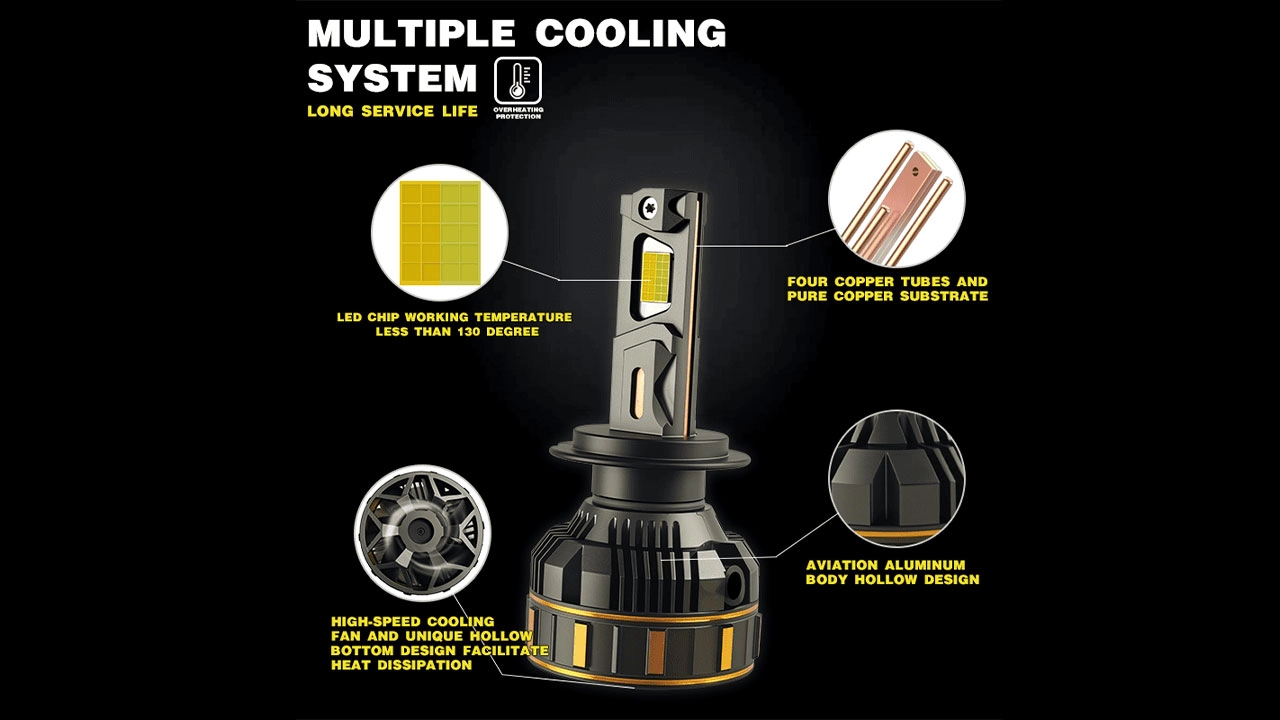
- Heat-sink efficacy: Compact retrofit bulbs inside a headlamp housing have less convective cooling; reflective housings trap heat.
Realistic expectations for hot climates:
- OEM-grade sealed LED modules with integrated heat pipes or high-quality passive cooling: 20,000–40,000 hours
- High-end aftermarket bulbs with robust drivers and proper thermal pathways: 15,000–30,000 hours
- Lower-cost retrofit bulbs with small fans or marginal heat-sinks: 5,000–15,000 hours (fan bearings, driver failure, or thermal throttling common)
Buyer checklist for hot climates:
- Look for LM-80 + TM-21 data or independent lab photometric reports showing L70 projections measured at elevated case temperatures.
- Prefer passive, high‑mass heat sinks or sealed heat-pipe designs over tiny fans unless the fan uses a high-grade sealed bearing rated for >30,000 hours.
- Verify IP67/68 or equivalent sealing to prevent moisture + heat-driven corrosion inside the lamp housing.
Practical tip: If you live in a hot climate and plan frequent stop-and-go driving, choose LED bulbs or OEM modules specifically tested for higher case temperatures and backed by a 3–5 year warranty.
2) What causes early failure in LED headlight bulbs within the first 1,000–5,000 hours, and how can I diagnose it?
Common early-failure modes (0–5,000 hours):
- Driver electronics failure: Poorly designed constant-current drivers, lack of surge protection, or low-quality electrolytic capacitors fail early under automotive voltage transients.
- Cooling-fan bearing failure: Small fans used in many plug-and-play bulbs can stop working after a few thousand hours if bearings are low quality.
- Solder joint fatigue: Thermal cycling from daily engine heat and cold causes solder cracks, leading to intermittent or permanent failures.
- Corrosion and ingress: Poor sealing allows moisture and salts to reach PCB traces or connectors.
- Over-voltage or poor vehicle electrical compatibility: Spikes from alternators or poor wiring can kill drivers.
How to diagnose:
- Symptom analysis: If both bulbs die simultaneously, suspect vehicle electrical spikes or a wiring fault. If one dies, likely a component failure in that bulb.
- Visual checks: With power off, inspect connectors, cooling fins, and the base for moisture, burnt components, or cracked solder joints.
- Swap test: Swap the suspect bulb to the opposite side. If the failure follows the bulb, it’s the bulb; if it stays on the same side, investigate vehicle wiring or grounding.
- Measure input: Use a multimeter to spot voltage spikes and verify proper grounding (look for alternator ripple or voltage >16V under load).
Prevention checklist:
- Use surge-protected drivers and metal-can capacitors rated for automotive temperature ranges.
- Avoid cheap fans; choose passive or sealed, long-life fans (or fanless design) if you need longevity.
- Install a line filter or surge suppressor if your vehicle has voltage instability.
- Ensure proper sealing (IP67/68) and heat path into the lamp housing to prevent hotspot formation.
3) If a quality LED headlight shows reduced brightness after 10,000 hours, is it the LED chips or the driver, and can it be repaired?
Reduced brightness (lumens decline) can originate from multiple components; identifying the root cause requires systematic testing:
Which component is most likely at 10,000 hours?
- LED chips: LEDs slowly lose lumen output over time — L70 at 30–50k hours means decline is expected but partial at 10k hours (typically a few percent depending on Tj history).
- Driver: A failing constant-current driver or worn capacitors can reduce the current to LEDs, causing an abrupt or progressive dimming.
- Thermal throttling: If the thermal interface deteriorates (TIM dries out) or heat sink fouls with dirt, the driver or chips may thermally throttle, appearing dimmer.
Diagnosis steps:
- Measure forward current and voltage at the bulb. A decreasing current indicates driver issues. Stable current but reduced luminous output points to LED lumen depreciation or optical fouling.
- Compare color temperature: Significant color shift toward blue/green often signals LED chip degradation; driver-caused dimming usually doesn't change color notably.
- Inspect thermal path: Check if the heat sink/fan runs at higher temps than before; increased temperatures imply degraded thermal transfer.
Repairability:
- Driver replacement: Many retrofit bulbs have fixed integrated drivers; some higher-end units allow driver module replacement, which can restore brightness.
- Chip replacement: Replacing LED chips is rarely practical for consumers; it’s usually handled at manufacturer repair level or requires replacing the assembly.
- Cost-benefit: For quality bulbs with replaceable drivers and warranty, repair is feasible. For sealed or low-cost units, replacement is usually more economical.
Recommendations: Keep records of operating conditions and request manufacturer photometric re-tests if the product is under warranty. For fleet operations, specify driver-replaceable LED modules to extend service life and reduce total cost of ownership.
4) How does constant on/off cycling (city driving, intermittent use) affect the lifespan of LED headlights compared to continuous highway use?
LEDs are less sensitive to on/off cycling than filaments, but for automotive LED headlight systems the surrounding electronics change the equation.
Effects of cycling:
- LED chips: Solid-state chips themselves tolerate frequent on/off cycles very well (virtually unlimited switching cycles compared to incandescent filaments).
- Drivers and capacitors: Repeated thermal cycling from frequent turn-on causes mechanical fatigue (solder joints) and stress on electrolytic capacitors which shorten life.
- Thermal cycling: Recurrent heating and cooling cycles produce expansion/contraction in solder joints and TIM layers, accelerating mechanical fatigue.
Real-world comparison:
- Highway (continuous) use: Maintains steady operating temperature; if thermal path is good, this can produce longer life for drivers and solder joints.
- City (rapid cycling): More stress from thermal cycling; life of drivers and solder joints may be reduced by 10–40% depending on design quality.
Mitigation strategies:
- Choose bulbs with high-temperature rated MLCCs or solid-state capacitors rather than low-grade electrolytics.
- Prefer high-reliability solder alloys and mechanical reinforcement for solder joints.
- If frequent cycling is expected, select products with automotive-grade driver ICs and proven thermal cycle test results (ISO 16750 or similar).
5) Do aftermarket retrofit LED bulbs achieve OEM-rated 30,000–50,000 hours in real-world conditions, and what features in a product predict actual longevity?
Short answer: Some do, but many do not; achieving OEM-rated lifespans in the real world depends on design and testing.
Key features that predict long real-world life:
- LM-80 & TM-21 data: Look for independent LM-80 results on the LED chips and TM-21 extrapolation to L70. This is the primary photometric test engineers use.
- Integrated thermal design: Heat pipes, large aluminum extrusion heat sinks, or actively cooled sealed architectures that transfer heat away from junctions effectively.
- Automotive-grade driver electronics: Drivers rated for transient protection (ISO 7637-2/ISO 16750-2), wide input voltage range (9–16V typical), and high MTBF components.
- IP67/68 sealing and corrosion-resistant coatings: Prevent moisture ingress and salt corrosion—major causes of early failure in vehicles.
- Replaceable parts and serviceability: Modular designs where drivers or LED boards can be changed extend field service life.
- Independent photometric and environmental testing: Third-party labs (e.g., labs that publish LM-79/LM-80/TS tests) showing L70 projections and vibration, salt-spray, and thermal-cycle results.
Real-world gap reasons:
- Manufacturers may quote LED chip lifetime (50k–100k hours) but not system lifetime; driver or fan often fails first.
- Limited testing duration: A short LM-80 test (e.g., 6,000 hours) extrapolated via TM-21 may give optimistic lifespans; extrapolation limits exist (TM-21 allows projection up to 6× the test time).
Buying guidance:
- Ask sellers for LM-80 & LM-79 test reports, TM-21 extrapolation, and environmental test certificates (vibration, thermal cycling, IP rating).
- Prioritize products with 3–5 year warranties and clear return/repair policies.
6) What warranty and verification standards (e.g., L70, IES LM-80, DOT/ECE) should buyers require to ensure the advertised lifespan of LED headlight bulbs is reliable?
Standards and tests to request from suppliers:
- LM-80 (IES): Measures lumen depreciation of LED packages at set temperatures over thousands of hours. Essential for credible LED life claims.
- TM-21 (IES): Method to extrapolate LM-80 data to projected L70 life. Ask to see TM-21 extrapolation and know the original LM-80 test duration (longer tests give stronger projections).
- LM-79 (IES): Photometric and electrical measurements for the entire LED product; verifies initial lumen output and efficacy.
- IP ratings (IP67/IP68): Confirms ingress protection for dust/water—important for longevity in automotive applications.
- Automotive environmental tests: ISO 16750 series (electrical, thermal, mechanical), ISO 7637-2 (electrical transient immunity), and relevant SAE or manufacturer-specific vibration tests.
- Regulatory compliance: DOT/FMVS108 compliance in North America and ECE R112/R148 or ECE R128 in regions that require type-approval for headlamp performance and beam pattern.
What to demand from vendors:
- LM-80/LM-79 test reports, TM-21 extrapolation, and independent lab validation when possible.
- Clear L70/Lumen maintenance statements and the test conditions used to derive them (case temperature, ambient, test duration).
- A warranty of at least 2–3 years for consumer products; 3–5 years or longer recommended for higher-end or fleet purchases.
- Evidence of environmental testing (thermal cycling, vibration, salt fog) and IP rating.
Reasoning: A credible lifespan claim ties back to LM-80/TM-21 and independent environmental testing. Without those, a manufacturer’s hour number is marketing rather than engineering.
Conclusion: Advantages of quality LED headlight bulbs
Quality LED headlights deliver longer nominal lifespans, higher lumens-per-watt, instant full output (no warm-up), and better photometric stability than halogen or HID alternatives when designed and tested correctly. The real-world lifetime depends on system engineering—robust thermal design, automotive-grade driver electronics, sealed housings, and validated LM-80/TM-21 data. For buyers in extreme climates or fleet operations, insisting on third-party testing, IP ratings, and a multi-year warranty is essential to realize the theoretical 30,000–50,000 hour benefits in practice.
For a quote or to discuss application-specific recommendations and verified test reports, contact us at www.carneonlighting.com or email nick@evitekhid.com.
Recommended for you
Why Your Customers Complain About LED Headlight Flickering (And How Our CANbus Solutions Fix It)
The Ultimate B2B Guide to Plug and Play LED Headlights: 1:1 Design, Specs & CANbus Solutions
LED vs. HID vs. Laser: Which Headlight Technology is Actually the Brightest for 2026?
Evitek Launches Smart Control Headlight—N14 Series, Redefining Driving Lighting Experience
FAQs
After-sale Service
How do you handle product complaints or quality issues?
Can I cancel my order?
Logistics
How long does international shipping take?
Customized Service
Do you support small-batch wholesale orders?
You May Also Like
Get More Resources
If you have any comments or good suggestions, please leave us a message, later our professional staff will contact you as soon as possible.
Start Your Wholesale Order / Request OEM Solutions
Partner directly with the factory for competitive pricing and priority support. Please provide your business details and estimated order volume (MOQ applies) so our sales engineers can tailor the best quote for your market.
Contact us


6th Floor, Building B, Liando U Valley, No. 29, Bishan Street, Huangpu District, Guangzhou, China

© 2026 CARNEON. All Rights Reserved. Privacy Policy | Terms and Conditions | Sitemap

Whatsapp: +8618688487142