


Do LED headlight bulbs fit H4/H7/H11 socket types? | Insights by CARNEON
- 1) Will a plug-and-play H4 LED bulb sit at the same filament height and angle in my reflector housing, and how does misalignment cause glare?
- 2) My ECU gives a bulb-out or CANbus error after installing H11 LED bulbs — can I fix this without cutting wiring?
- 3) Do dual-beam H4 LED conversions need two LED chips or a mechanical shutter for correct low/high operation, and which approach is better?
- 4) How much heat-sink or fan clearance behind the housing is required for fanless H7 LED bulbs to avoid overheating and thermal throttling?
- 5) Will swapping an H7 halogen for an LED change the beam pattern in projector vs reflector housings, and how do I choose the right LED for each?
- 6) Are aftermarket H4/H7/H11 LED bulbs road-legal in the US and EU, and how do I verify DOT/ECE compliance before buying?
- Concluding summary — Advantages of switching to LED headlight bulbs for H4/H7/H11 sockets
When beginners search “Do LED headlight bulbs fit H4/H7/H11 socket types?” they find mixed, shallow answers. This article from Carneon Lighting answers six specific, pain-point-oriented long-tail questions that often lack depth online. It combines practical installation checks, electrical considerations (CANbus/ECU), optical alignment, cooling/thermal management, and compliance (DOT/ECE). Embedded semantic topics include H4 LED compatibility, H7 LED conversion, H11 LED bulb fit, CANbus decoders, DOT approved LED bulbs, beam pattern alignment, heat sink clearance, lumen vs lux, projector vs reflector housings, and LED headlight retrofit.
1) Will a plug-and-play H4 LED bulb sit at the same filament height and angle in my reflector housing, and how does misalignment cause glare?
Short answer: Not always. H4 is a dual-beam base where the halogen filament position is critical. Many “plug-and-play” LED kits use LED chips or filaments that do not match the original filament’s axial and radial position. If the LED light source sits too far forward, back, rotated, or off-center relative to the original filament plane, the reflector or projector optics cannot form the designed beam pattern — producing scatter, hot spots, or blinding glare for oncoming traffic.
Practical checks and solutions:
- Measure filament plane equivalence: Remove the headlamp lens (or use markings) and measure how the LED emitter aligns with where the halogen filament sits. Manufacturers that advertise “filament-position matched” or use linear LED filaments designed to mimic halogen filament geometry are far more likely to yield a correct beam pattern.
- Rotation control: For many H4 LED bulbs the emitter array must be rotationally adjustable so the cut-off shape from the reflector or projector lines up correctly. If rotation isn’t adjustable, glare risk rises.
- Use projector vs reflector guidance: Projector housings are generally more forgiving of LED emitter geometry; reflectors demand precise filament-height and rotation matching.
- If you observe asymmetric scatter or high glare after installation, the emitter is likely misaligned — return or exchange for a model that explicitly states emitter-position matching or uses a mechanical adapter to replicate filament location.
2) My ECU gives a bulb-out or CANbus error after installing H11 LED bulbs — can I fix this without cutting wiring?
Yes — usually without cutting wiring. Modern vehicles monitor bulb current and/or use PWM sensing to detect lamp health. Replacing a halogen with a low-current LED often triggers a “bulb out” message, hyper-flash, or stability warnings.
Fix approaches (ranked by safety and reversibility):
- CANbus decoders / anti-flicker harness: A plug-and-play decoder (also called an LED driver harness or anti-flicker adapter) replicates the halogen electrical signature and suppresses PWM feedback. Choose a decoder engineered for your vehicle’s CAN system (many vendors list vehicle compatibility). This is non-invasive and reversible.
- Load resistors: Resistive loads emulate halogen current draw to stop hyper-flash or errors. They work but dissipate a lot of heat and require careful mounting on metal and proper isolation. They are less elegant and can defeat some CANbus systems that use PWM signatures rather than raw current.
- ECU coding / adaptation: Some vehicles accept a software adaptation (via dealer tools or aftermarket programmers) to disable bulb monitoring. This is vehicle-specific and may be the cleanest long-term fix but requires the right tool and knowledge.
- Best practice: Try a CANbus decoder specifically rated for H11 LED kits for your vehicle before modifying wiring or fitting resistors.
3) Do dual-beam H4 LED conversions need two LED chips or a mechanical shutter for correct low/high operation, and which approach is better?
Dual-beam H4 halogens use two filaments at different axial positions to generate low and high beams. LED conversions handle this in three principal ways:
- Two independent LED arrays (coaxial design): One emitter is dedicated to low beam, the other to high beam. When switching, the driver activates the appropriate array. This mimics the dual-filament idea but requires precise placement so each emitter aligns optically with the reflector.
- Single array with mechanical shutter or movable lens: The LED array remains fixed while a small shutter or actuator changes the beam cut-off for low/high. This can produce a clean cut-off but adds mechanical complexity and potential failure points.
- Bi-LED emitters with optical switching: Some designs use a single emitter paired with optical components to alter beam pattern; effectiveness depends on how well the optics replicate filament displacement.
Which is better? Systems that explicitly mimic the original filament geometry (either by carefully placed dual arrays or a tested mechanical shutter) produce the most reliable beam pattern in reflector housings. For projectors, simpler designs can perform acceptably. Always prefer solutions with photometric testing or third-party beam-pattern validation.
4) How much heat-sink or fan clearance behind the housing is required for fanless H7 LED bulbs to avoid overheating and thermal throttling?
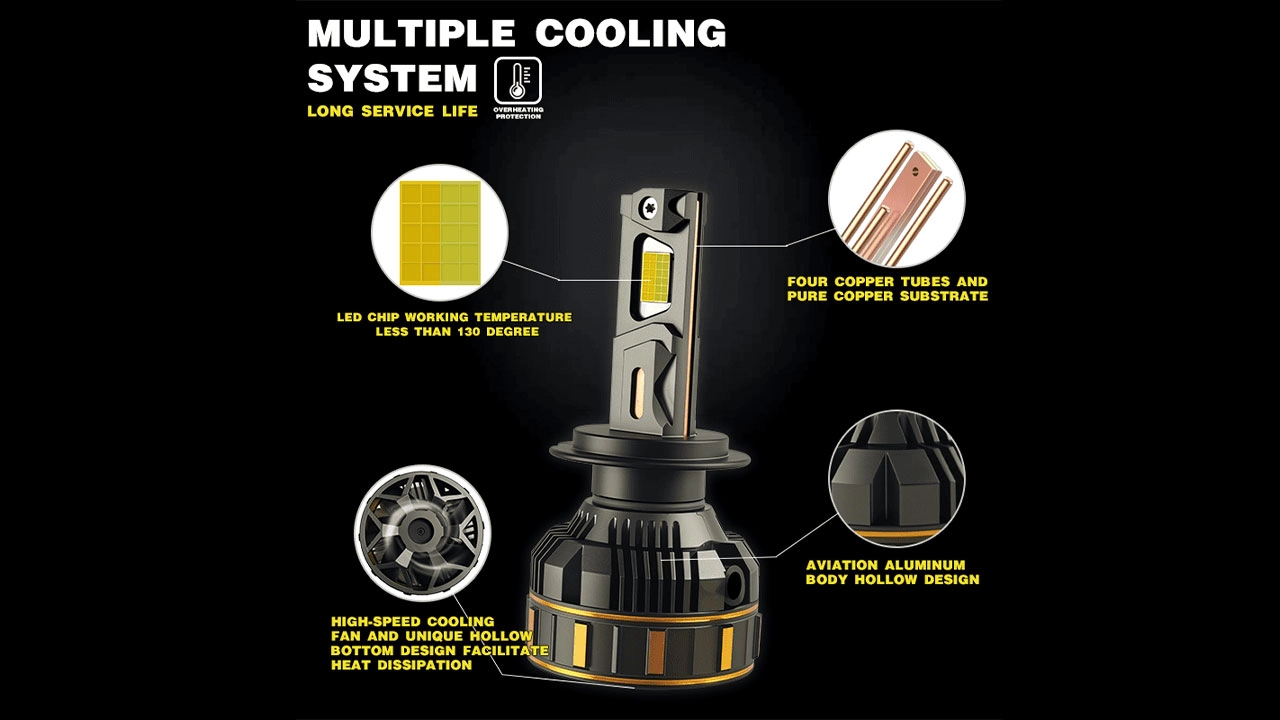
Thermal management is critical. H7 LED conversion kits typically use either active cooling (small fans) or passive cooling (large finned heatsinks). Most manufacturers recommend measuring the available depth behind the bulb socket before purchase; typical recommended clearances are often in the 20–40 mm range for compact passive designs, and 30–60+ mm for larger heatsinks. Fan-cooled solutions often need similar or slightly more space due to the fan housing.
Practical guidance:
- Measure from the bulb flange/retention plate to the inner back cover of the headlamp bucket or vehicle bodywork. Compare that measurement to the LED kit’s specified back clearance. If the heatsink or fan makes contact, you’ll get thermal throttling or premature failure.
- Consider airflow: fan-cooled bulbs need some air exchange and clearance around the fan intake/exhaust. Enclosed factory headlamp housings with little ventilation can reduce fan life.
- Choose passive (heatsink) vs active (fan) based on space and vibration exposure: passive is silent and more durable but bulkier; active can be more compact but adds moving parts and potential noise.
- Thermal throttling symptoms: initially bright output followed by dimming under hard use, or flicker when hot. If you see these after installation, the bulb is overheating or the driver is thermal-limiting output for safety.
5) Will swapping an H7 halogen for an LED change the beam pattern in projector vs reflector housings, and how do I choose the right LED for each?
Yes — the impact differs by housing type.
Reflector housings:
- Reflectors rely heavily on precise filament location and often reproduce halogen cut-offs and shields that assume a filament point source. LED chips that don’t mimic the original filament geometry will scatter light off reflectors and can cause wide, uncontrolled beams or glare. For reflectors, choose LEDs that specifically advertise filament-position matching or come with a vehicle-specific adapter to correctly position emitters.
Projector housings:
- Projectors focus and collimate light, and are generally more forgiving. Many LEDs perform well in projectors because the lens can re-form the beam. However, correct emitter centering and distance from the projector lens still matter for sharp cut-offs.
Choice checklist:
- For reflectors: prioritize emitter-position matched designs and test for a clean cut-off on a wall before finalizing.
- For projectors: prioritize thermal management and stable drivers; optical alignment is important but slightly more forgiving.
- Always inspect the actual beam on a vertical surface at installation (or have it professionally aligned) — don’t rely only on claimed lumen numbers. Lux distribution and a sharp cutoff matter more than claimed lumen counts.
6) Are aftermarket H4/H7/H11 LED bulbs road-legal in the US and EU, and how do I verify DOT/ECE compliance before buying?
Legality varies by market and by product. In the United States, headlamp performance and approval are governed by FMVSS 108 (administered by DOT). In many European markets, ECE regulations such as ECE R112 (and related approvals) apply for headlamp beam performance. A key point: many aftermarket LED conversion bulbs are not certified for road use in their intended retrofit application even if the LED module itself has some certification.
How to verify:
- Look for explicit certification markings and documentation: DOT or FMVSS 108 statements for the US, and an ECE type approval or E-mark for EU countries. Sellers should provide a certificate or a visible marking on the product/manufacturing label.
- Check photometric test reports: Legitimate aftermarket products will provide ISO/IEC-accredited photometric reports showing beam patterns measured in a lab (preferable) or SAE reports. These show lux distribution at set distances rather than just raw lumen claims.
- Beware of claims: A bulb saying “DOT compliant” without verifiable documentation may still be noncompliant when installed as a retrofit. OEM or retrofitted LED headlamps (complete lamp assemblies) often meet the legal bar more reliably than drop-in replacement bulbs in stamped reflectors.
- If you live in a regulated market, check local inspection rules: some regions restrict retrofit LEDs in reflector housings regardless of markings. When in doubt, consult local vehicle inspection authorities or ask for third-party test results from the vendor.
Bottom line: don’t assume every aftermarket H4/H7/H11 LED is legal — verify the certificate and photometry before purchase.
Concluding summary — Advantages of switching to LED headlight bulbs for H4/H7/H11 sockets
When chosen and installed correctly, upgrading H4, H7 or H11 halogen lamps to LED headlight bulbs delivers clear advantages: higher luminous efficacy (more usable light per watt), longer service life, faster turn-on, and lower vehicle electrical load. Proper-fit LED kits can improve nighttime visibility and reduce maintenance intervals. However, to realize these benefits without generating glare, errors, or legal issues you must select a bulb with correct emitter positioning, adequate thermal management, CANbus compatibility if required, and verifiable DOT/ECE or photometric documentation. Measure backspace, verify rotational alignment, and prefer tested products with documented beam-pattern results.
Need help selecting a certified H4/H7/H11 LED kit for your vehicle or want a custom quote? Contact Carneon Lighting at www.carneonlighting.com or email nick@evitekhid.com for an application-specific recommendation and quote.
Recommended for you
Why Your Customers Complain About LED Headlight Flickering (And How Our CANbus Solutions Fix It)
The Ultimate B2B Guide to Plug and Play LED Headlights: 1:1 Design, Specs & CANbus Solutions
LED vs. HID vs. Laser: Which Headlight Technology is Actually the Brightest for 2026?
Evitek Launches Smart Control Headlight—N14 Series, Redefining Driving Lighting Experience
FAQs
Brand
Does CARNEON provide OEM/ODM services?
Yes. CARNEON supports custom LED headlight designs, packaging, branding, and market-specific adaptations.
Are CARNEON headlights suitable for global markets?
Yes. CARNEON products are designed for diverse climates, voltages, and vehicle types, serving markets worldwide.
Customized Service
Do you support small-batch wholesale orders?
Logistics
Can we mix different SKUs in one wholesale order?
You May Also Like
Get More Resources
If you have any comments or good suggestions, please leave us a message, later our professional staff will contact you as soon as possible.
Start Your Wholesale Order / Request OEM Solutions
Partner directly with the factory for competitive pricing and priority support. Please provide your business details and estimated order volume (MOQ applies) so our sales engineers can tailor the best quote for your market.
Contact us


6th Floor, Building B, Liando U Valley, No. 29, Bishan Street, Huangpu District, Guangzhou, China

© 2026 CARNEON. All Rights Reserved. Privacy Policy | Terms and Conditions | Sitemap

Whatsapp: +8618688487142