


how do plug and play led headlights improve night driving? | Insights by CARNEON
- 1. How do plug-and-play LED headlights truly change measured low-beam illumination (lux) and real-world visibility compared to stock halogen projectors?
- 2. Will a plug-and-play LED conversion trigger CANBUS errors, flicker, or bulb-out warnings on modern vehicles — and how do you prevent it?
- 3. Do plug-and-play LED kits increase glare for oncoming drivers, and how can buyers ensure a compliant, non-glare beam pattern?
- 4. How critical is thermal management in plug-and-play LED headlights for maintaining lumen output and lifetime?
- 5. How do color temperature (CCT) and CRI in plug-and-play LEDs affect night target recognition, pedestrian detection, and wet-road visibility?
- 6. What specific electrical, optical and mechanical checks should a buyer perform before purchasing a plug-and-play LED kit to avoid long-term failures and legal issues?
1. How do plug-and-play LED headlights truly change measured low-beam illumination (lux) and real-world visibility compared to stock halogen projectors?
Short answer: a well-engineered plug-and-play LED conversion can significantly raise usable road lux and target contrast, but not all kits do — and lumen marketing numbers are often misleading.
Why this matters: drivers should judge headlight performance by illuminance (lux) at specific distances and by beam uniformity, not by raw lumen claims. Lumens measure total light output in all directions; what matters for night driving is controlled light directed onto the roadway where drivers need it, measured as lux at standardized distances (commonly at 10 m, 25 m and 50 m for comparisons or under local test standards).
How LEDs improve visibility when engineered properly:
- Higher luminous efficacy: LEDs produce more lumens per watt than halogen, so designers can create brighter, more efficient beams without drawing excessive vehicle power.
- Sharper beam control: LED modules paired with correctly designed reflectors or projector optics produce a crisper cutoff and more concentrated hot spot, delivering higher lux on the center of the driving lane and better peripheral fill without wasted scatter.
- Reduced spectral scattering: LEDs with appropriate color temperature and optical control reduce intraocular scatter on wet or reflective surfaces, which enhances target recognition.
Buyer checklist for real-world verification:
- Ask for measured lux plots (or candela curves) at standardized distances or an SAE/ECE test report — not just lumen ratings.
- Confirm the kit provides a well-defined horizontal cutoff line for low beams; look for projector optics or reflector elements tuned to the vehicle housing.
- Prefer products with independent third-party lab measurements or OEM-style beam maps; these are far more reliable than marketing numbers.
Standards note: low-beam performance in the U.S. is governed by FMVSS 108; in many other markets ECE R112 regulates luminous intensity and beam pattern. Reputable kits will state compliance or provide test data aligned to these rules.
2. Will a plug-and-play LED conversion trigger CANBUS errors, flicker, or bulb-out warnings on modern vehicles — and how do you prevent it?
Short answer: yes — if you ignore the vehicle’s electrical system. Many modern cars monitor bulb current and frequency; low-power LEDs can be misidentified as faults. Preventing errors requires addressing both electrical load and signal characteristics.
Why this happens: vehicles use the bulb filament’s resistance and thermal profile as part of fault detection. LEDs draw far less current and have different impedance, so the vehicle’s Body Control Module (BCM) or Lighting Control Module can register a code, turn on a dashboard warning, or engage a default blinking/failure mode.
Technical solutions and best practices:
- CANBUS-compatible drivers: choose LED drivers with built-in CANBUS decoders designed to emulate filament load and respond correctly to PWM dimming. Quality drivers communicate with vehicle modules and maintain the expected electrical signature.
- Inline resistors/anti-flicker harnesses: for systems that don’t accept smart drivers, heavy-duty load resistors or anti-flicker modules tuned to the vehicle can eliminate flicker and warnings. But resistors add heat and waste power — smart drivers are preferable.
- EMI/EMC compliance: poorly filtered LED drivers can inject noise into CAN lines and radios. Use drivers with proven EMI filtering and compliance certificates (CE EMC, FCC where applicable) to avoid interference.
- Vehicle-specific harnesses: many manufacturers (BMW, Mercedes, VW, Audi and some newer Asian makes) use sensitive monitoring. Use vehicle-specific plug-and-play harnesses or harness adapters made for that make/model to reduce risk.
Installation tip: if possible, bench-test the kit on a diagnostic harness or the vehicle before final mounting. A short trial run reveals warnings, errant signals, or thermal issues early.
3. Do plug-and-play LED kits increase glare for oncoming drivers, and how can buyers ensure a compliant, non-glare beam pattern?
Short answer: poorly designed LED retrofit kits can increase glare; good designs reduce glare while improving the driver’s own visibility. Prevention requires correct optical alignment and either projector optics or precise reflector engineering.
Main causes of glare with aftermarket LEDs:
- Incorrect filament-to-LED-axis positioning: halogen filaments are at a specific point; LED emitters must be positioned to match that reference. Off-axis LEDs create scattered or upward light that blinds oncoming drivers.
- Overdriven, untamed output: excessive intensity without a tight cutoff leads to scatter above the horizon line.
- Housing incompatibility: placing a bright LED into a reflector housing designed for halogen often leads to uncontrolled beams.
How to ensure a non-glare, compliant pattern:
- Choose kits engineered for your housing type (projector vs reflector). Projectors with a proper cutoff lens provide the best cutoff and minimal glare.
- Verify DOT (U.S.) or ECE (Europe) compliance or ask for lab beam pattern charts. Compliance demonstrates that the beam has acceptable intensity in zones designated to prevent glare to oncoming traffic.
- Check adjustability: after installation, verify vertical and horizontal aim; even compliant lamps will glare if misaligned. Use a wall test or professional headlight aiming equipment.
- Prefer kits with optical lenses or shields that recreate the halogen filament’s effective source position — not just raw LED chips bolted to a heatsink.
4. How critical is thermal management in plug-and-play LED headlights for maintaining lumen output and lifetime?
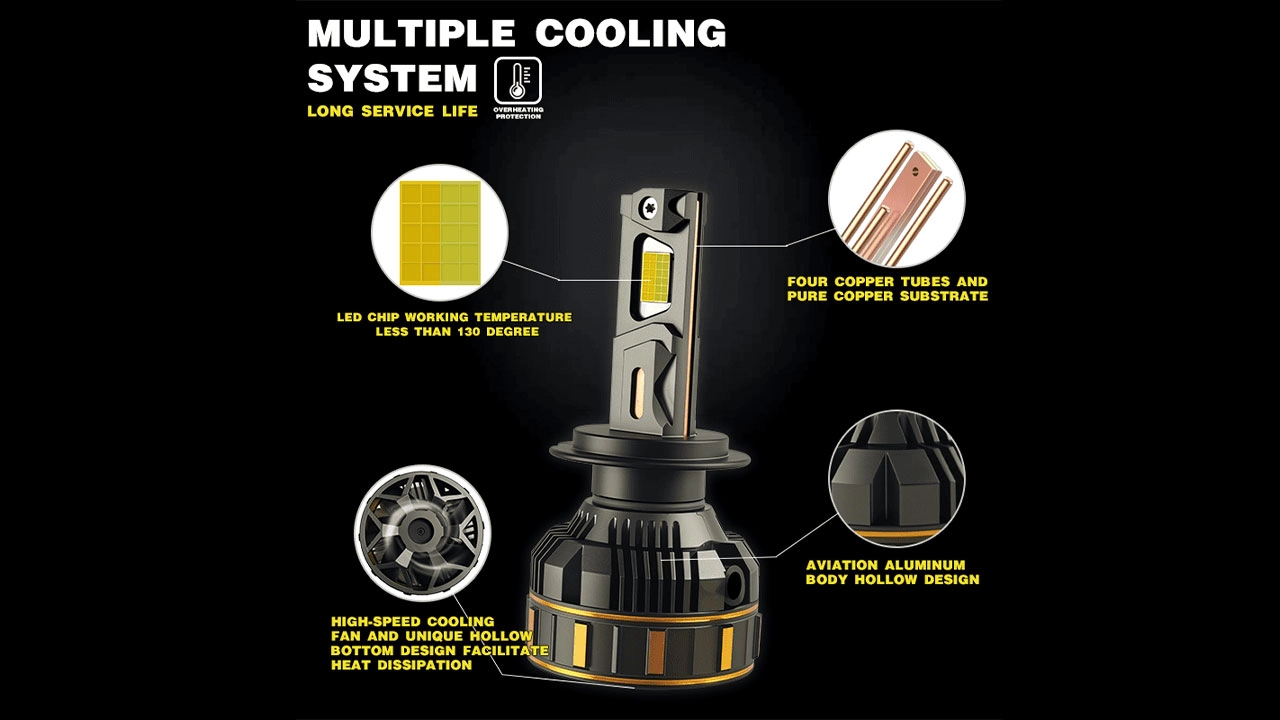
Short answer: thermal design is the single biggest reliability factor. LEDs degrade when operated at elevated junction temperatures; poor cooling quickly reduces lumen output and can flip drivers into thermal shutdown.
Key engineering points:
- Junction temperature drives lumen maintenance: LED light-output falls with increasing temperature (LM-85 and manufacturer thermal curves show lumen depreciation as junction temperature rises). Effective heat dissipation keeps junctions cool and maintains initial lumen output for thousands of hours.
- Cooling methods: passive heatsinks (large aluminum bodies, heat pipes) versus active cooling (small fans). Each has trade-offs. Fans provide better short-term cooling but introduce moving parts that can fail under vibration and dust exposure; passive solutions rely on surface area and conduction and are often more reliable if designed properly.
- Protection from ingress and vibration: sealing (IP67 or IP68 ratings) and robust vibration-tested designs extend life in automotive environments. Moisture and dust impair both optics and heat transfer.
Practical buyer guidance:
- Check published lifetime ratings (expect credible kits to claim 30,000–50,000 hours with thermal graphs to support those claims).
- Ask for thermal imaging or datasheets showing operating junction temperature at 25 °C ambient and at vehicle under-hood temps (which can be considerably higher).
- Avoid cheap fan-cooled “plug-and-play” bulbs without serviceable fans or verified vibration ratings — fans are a common point of failure in low-cost kits.
5. How do color temperature (CCT) and CRI in plug-and-play LEDs affect night target recognition, pedestrian detection, and wet-road visibility?
Short answer: color temperature and Color Rendering Index (CRI) influence contrast, object recognition, and driver comfort. Choosing the right CCT/CRI is a balance between contrast, glare, and perceptual brightness.
Practical effects:
- Color temperature: OEM systems tend to target 4000K–5000K for a balance of contrast and daylight-like color rendering. Lower CCTs (3000K–4000K) penetrate fog and rain better; higher CCTs (>5500K) appear very white/blue and can increase perceived glare and scatter on wet surfaces.
- CRI: higher CRI improves object color and detail perception at night. While absolute CRI values are less emphasized in headlamp specs than in interior lighting, LEDs with poor CRI can make pedestrians, road signs and obstacles harder to distinguish despite high raw lumens.
Recommendation:
- For general driving, choose 4300K–5000K with CRI >70–80 for a good combination of visibility and low scatter; 4300K closely matches halogen color and often yields the least perceived glare.
- For fog-driving needs, supplemental 3000K driving/fog lights perform better in scattering conditions; do not rely on color temperature alone to fix beam pattern issues.
6. What specific electrical, optical and mechanical checks should a buyer perform before purchasing a plug-and-play LED kit to avoid long-term failures and legal issues?
Short answer: use a pre-purchase checklist covering compliance, electrical compatibility, optical fit, thermal durability and installation fitment.
Comprehensive pre-purchase checklist:
- Regulatory compliance: check for DOT/FM VSS 108 or ECE R112 markings and request third-party lab test reports or compliance certificates.
- Measured performance: ask for lumen as well as lux/candela beam plots at standardized distances. Prefer vendors who publish measured beam maps for the vehicle housing if available.
- Electrical compatibility: confirm power draw per bulb, driver voltage tolerance (9–16 V typical for automotive systems), CANBUS compatibility, and EMI/EMC certifications.
- Connector and socket fit: verify physical fit with your vehicle’s stock connector type (H1, H4, H7, 9005, 9006, etc.). Plug-and-play only works if the mechanical mating and bulb-to-reflector axis are correct.
- Thermal and environmental specs: request junction temperature data, IP rating (IP67 or better recommended), vibration test results (automotive spec vibration testing), and fan life if present.
- Warranty and RMA policies: prefer multi-year warranties and clear return/testing procedures. Automotive lighting experiences expose products to harsher conditions than indoor lighting; warranty commitment indicates manufacturer confidence.
- Installation complexity: ensure harness length, harness routing, and mounting clearances fit your vehicle without modifications to housings — or plan for professional retrofitting if required.
Final purchasing tip: when in doubt, contact the manufacturer or an experienced lighting retrofit shop and request vehicle-specific fitment data or a staged demo on your vehicle. A short on-vehicle test is the best final verification.
Concluding summary
When properly engineered and installed, plug-and-play LED headlights improve night driving by delivering higher usable lux on the roadway, better beam control and cutoff, more efficient power use, and longer operating life than halogen bulbs. The benefits depend on optics, CANBUS and EMI compatibility, and thermal management; verify DOT/ECE compliance, ask for measured beam maps and thermal data, and ensure the kit matches your vehicle’s electrical and housing requirements to avoid glare or fault codes. For professional projects, consider projector-based retrofits or OEM-style LED modules for the best compromise between brightness and compliance.
For a tailored plug-and-play LED headlight solution and a quote, contact us at www.carneonlighting.com or email nick@evitekhid.com.
Recommended for you
Why Your Customers Complain About LED Headlight Flickering (And How Our CANbus Solutions Fix It)
The Ultimate B2B Guide to Plug and Play LED Headlights: 1:1 Design, Specs & CANbus Solutions
LED vs. HID vs. Laser: Which Headlight Technology is Actually the Brightest for 2026?
Evitek Launches Smart Control Headlight—N14 Series, Redefining Driving Lighting Experience
FAQs
Customized Service
Do you support small-batch wholesale orders?
Logistics
What payment methods do you accept?
After-sale Service
Can I cancel my order?
Company
How many employees in Evitek?
You May Also Like
Get More Resources
If you have any comments or good suggestions, please leave us a message, later our professional staff will contact you as soon as possible.
Start Your Wholesale Order / Request OEM Solutions
Partner directly with the factory for competitive pricing and priority support. Please provide your business details and estimated order volume (MOQ applies) so our sales engineers can tailor the best quote for your market.
Contact us


6th Floor, Building B, Liando U Valley, No. 29, Bishan Street, Huangpu District, Guangzhou, China

© 2026 CARNEON. All Rights Reserved. Privacy Policy | Terms and Conditions | Sitemap

Whatsapp: +8618688487142