


Can manufacturers customize auto LED headlight designs? | Insights by CARNEON
- 1) Can manufacturers create a custom beam pattern that meets FMVSS/ECE requirements while fitting my unique vehicle housing?
- 2) How do manufacturers ensure thermal management for high-output custom LED headlamp modules in compact housings without premature lumen depreciation?
- 3) What are realistic tooling, MOQ and lead time expectations for bespoke OEM LED headlight designs, especially with adaptive or matrix features?
- 4) How do manufacturers guarantee CAN-bus, ECU integration and adaptive lighting firmware compatibility when customizing headlights for specific vehicle models?
- 5) What certification and type-approval testing will manufacturers typically provide for custom LED headlamps — and who bears homologation costs?
- 6) How can manufacturers customize optics (projector vs reflector vs TIR) to deliver targeted lux at 25m and avoid glare across different markets?
As automotive buyers and specifiers increasingly request bespoke LED solutions, common questions arise about feasibility, compliance and cost. This article answers six deep, practical questions about custom auto LED headlight designs — including optics, thermal strategy, certification, electronics integration, and realistic lead times.
1) Can manufacturers create a custom beam pattern that meets FMVSS/ECE requirements while fitting my unique vehicle housing?
Yes — experienced suppliers can produce a custom beam pattern that is both vehicle-specific and certifiable, but it requires early alignment on regulatory targets, measurement methods and tooling limits.
Key steps and requirements:
- Define target markets up front (e.g., US, EU, Japan). The primary legal frameworks are FMVSS 108 in the United States and ECE type-approval regimes in many other markets. These determine photometric pass/fail criteria and how lux is measured on the test plane.
- Provide the headlamp cavity CAD or a physical sample. The supplier will assess packaging constraints (optical axis location, cut-off height, reflector vs projector clearance) and design optics accordingly.
- Choose the optical approach: projector (lens + cutoff), reflector (precision formed surfaces) or TIR (total internal reflection) optics. Projectors deliver tighter cutoffs and simpler legal compliance for directional low beams; TIR can be space-efficient for compact housings.
- Photometric targets should be specified in lux at a reference distance (commonly 25 m for many standards) and by off-axis points (e.g., 0°, 1°, 3° above/below center). Suppliers will deliver a photometric report from an integrating sphere or goniophotometer during proto and validation phases.
- Expect iterative prototyping: an initial optical prototype is validated on a goniometer; adjustments to reflector curvature, lens aspheric surfaces or LED placement refine the pattern. Each iteration may require new tooling or SLA parts.
Real-world note: achieving a sharp, legal low-beam cutoff in a small, non-standard cavity often forces tradeoffs — e.g., a slightly larger projector module or additional internal baffling to control stray light.
2) How do manufacturers ensure thermal management for high-output custom LED headlamp modules in compact housings without premature lumen depreciation?
Thermal design is one of the most frequent causes of failed custom LED projects. LEDs lose lumen output and life when junction temperature rises; suppliers mitigate this with mechanical, electrical and materials strategies.
Practical engineering controls:
- Set thermal budgets: a common design target is to keep LED junction temperature (Tj) well below manufacturer maximum (often <125°C). Suppliers typically design to maintain Tj margins of 20–30°C under worst-case ambient conditions (e.g., 40°C) and high-beam duty cycles.
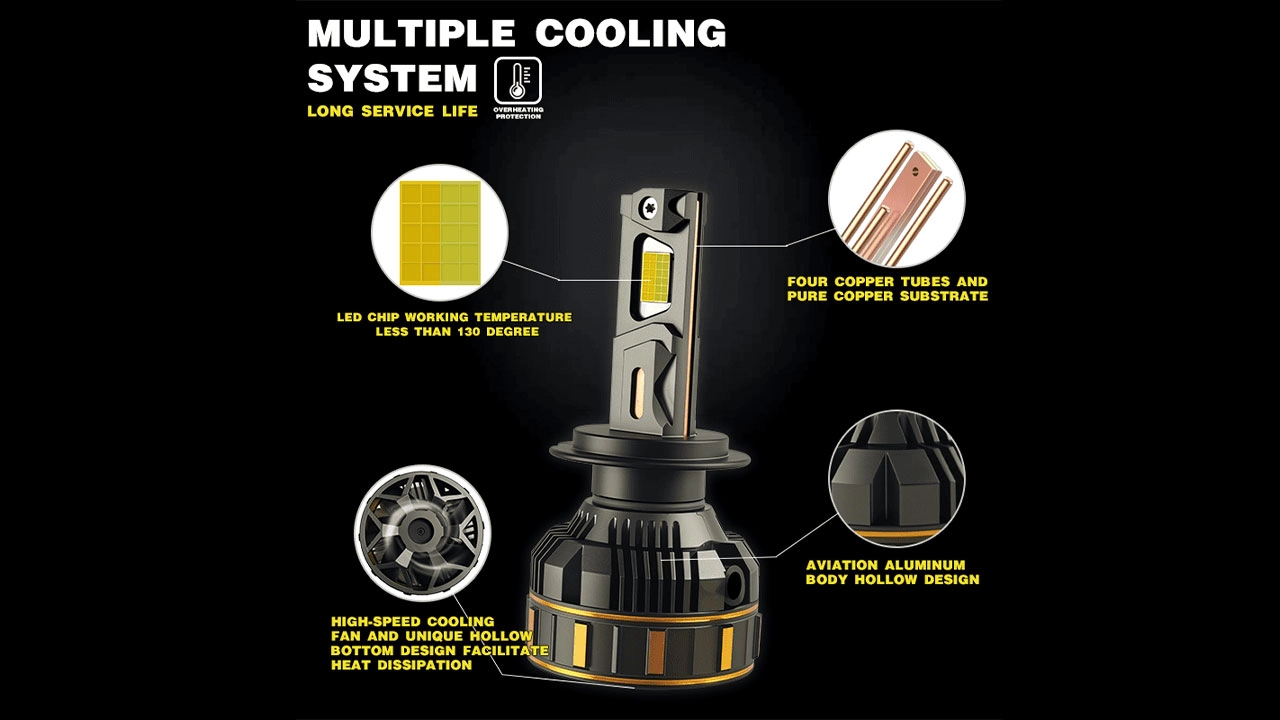
- Choose the right LED package and MCPCB: high-thermal-conductivity MCPCBs (copper base) and efficient LED die (higher efficacy lm/W) reduce heat per lumen.
- Use passive vs active cooling properly: passive extruded/aluminum heat sinks with fins are preferred for long-term reliability. Active cooling (micro-fans or heat pipes) can reduce size but adds moving parts and potential failure modes; active cooling also requires ingress protection and EMI planning.
- Thermal interface materials and housing design: thermal pads, vias, and direct-path housings (metal housing touching MCPCB) improve conduction. Ensure the headlamp housing has ventilation or thermal paths to avoid trapping heat behind the optic.
- Validate with thermal cycling and HTOL testing: run accelerated thermal life tests (e.g., 1000–3000 hours at elevated temperatures), temperature mapping and thermal resistance (Rth) measurements during proto stage.
Buyer checklist: require supplier thermal models, Tj predictions, thermal imaging of prototypes, and long-term lumen maintenance (LM-80/LM-79 style data where applicable). For mission-critical fleets, insist on HTOL validated run-time data and a warranty tied to lumen maintenance.
3) What are realistic tooling, MOQ and lead time expectations for bespoke OEM LED headlight designs, especially with adaptive or matrix features?
Costs and timelines vary widely by complexity. Adaptive matrix headlights (many individually addressable LEDs) multiply electronics, software and optical complexity compared with simple retrofit modules.
Typical ranges and what they cover:
- Prototyping phase: 6–12 weeks. Includes initial optical design (CAD), 3D-printed housings, basic PCB and optics to validate form/fit/function. Matrix systems need camera/ECU emulation earlier.
- Tooling & pilot production: 8–16 weeks. Injection mold tooling for housings and lenses is usually the biggest upfront capital item. Tool costs range from several thousand to >US$50k per tool depending on complexity and cavitation.
- MOQ: 300–2,000 units is a practical buyer expectation for many suppliers when tooling is required; very complex adaptive matrix OEM assemblies often push MOQs higher because of electronics and calibration costs. Some tier-2 suppliers will accept lower MOQs at higher per-unit prices or with shared tooling amortization.
- Mass production lead time: 12–20 weeks after prototype approval, depending on electronics sourcing (LED binning lead times), mold availability, and homologation scheduling.
Cost drivers: number of LEDs and channels (matrix complexity), precision optics, certification tests, and software/ADAS integration. Buyers should budget for tooling amortization, pre-production verification runs and homologation tests in addition to unit price.
4) How do manufacturers guarantee CAN-bus, ECU integration and adaptive lighting firmware compatibility when customizing headlights for specific vehicle models?
Electrical and software integration is a common sticking point. Successful customization requires early vehicle interface definition and system-level testing.
Recommended process and technical controls:
- Define vehicle communication and control interfaces up front: direct PWM, LIN, CAN (classical or CAN FD), or dedicated headlamp bus. Provide the supplier with the vehicle’s electrical architecture, pinouts, wake/sleep states and voltage transient profiles.
- ECU/firmware responsibilities: clarify whether the supplier supplies the headlamp ECU and firmware or only the optical/electrical hardware. If the vehicle OEM wants the headlamp to be controlled by the vehicle’s body ECU, the supplier must provide a proven CAN protocol stack and acceptance tests (signal timing, watchdog, heartbeat).
- Support for ADAS and camera integration: adaptive or matrix LED systems require precise alignment with the vehicle camera and ADAS ECU for glare suppression. Calibration procedures (static and dynamic) must be documented and tested. Expect to perform V&V with the vehicle camera and vehicle ECU on a test bench and in-vehicle road trials.
- EMC/EMI planning: headlamp electronics must meet vehicle EMC requirements. Suppliers should provide conducted and radiated emission test reports and transient immunity test results in line with OEM specifications.
Contract items: include a formal interface control document (ICD), software release milestones, failure mode behavior (what happens on bus loss), and an agreed test matrix. For matrix systems, include acceptance tests for frame rates, latency and pixel-level brightness control.
5) What certification and type-approval testing will manufacturers typically provide for custom LED headlamps — and who bears homologation costs?
Manufacturers can supply pre-compliance and full-certification packages, but responsibility for final homologation often depends on contractual arrangements and whether the supplier is an approved Type-Approval holder.
Common testing and approvals:
- Photometric compliance: tests per FMVSS 108 (US) or ECE testing regimes (Europe and other regions). These are photometric measurements (lux at defined target points and glare limits) performed on a goniophotometer or photometric test bench.
- Environmental & mechanical: IP rating testing (IP67/IP68 common for modern headlights), thermal cycling, vibration (per vehicle standard e.g., ISO 16750 where applicable), and salt spray for corrosion resistance.
- EMC/EMI: conducted and radiated emissions and immunity tests per vehicle electrical specs and regional regulations.
- Functional safety & software: for adaptive systems, functional safety analyses (e.g., ISO 26262 artifact generation) and software validation may be required by OEMs.
Who pays and who holds approvals:
- Small customers: often pay suppliers for a certification package. The supplier usually performs testing and delivers technical files; the customer may be responsible for final submission to regulatory authorities or vehicle-type approval agencies if required.
- OEM customers: often manage homologation centrally and require suppliers to deliver components to a defined specification; the OEM may hold final approval/EC-type approval number.
Buyer tip: contractually require documented test reports (lab names, test dates, measurement methods), IP ratings, and if required, source code escrow or software safety artifacts for matrix systems.
6) How can manufacturers customize optics (projector vs reflector vs TIR) to deliver targeted lux at 25m and avoid glare across different markets?
Choosing optics is a performance vs packaging tradeoff. The correct optical strategy depends on your lux targets, allowed glare envelopes by region, and physical space inside the lamp cavity.
Design guidance and test approach:
- Start with photometric specifications: specify target lux at 25 m on axis and at critical off-axis locations (e.g., 1° above center to control glare). For adaptive systems, define shielding zones where intensity must be reduced when oncoming traffic is detected.
- Projector optics: use a well-designed cutoff shield and aspheric lens to create a sharp horizontal cutoff and controlled hotspot for long-throw beams. Projectors are preferred for meeting strict glare limits in compact designs if space permits.
- Reflector optics: require high-precision reflective surfaces and strict LED placement tolerances. Reflectors can be more cost effective but sensitive to source position error; they are commonly used for broad flood beams or simpler low-beam patterns.
- TIR optics: compact and efficient, TIR combines lens and reflector action in a single molded optic. TIR is effective for packaging-limited applications and can produce very uniform field illumination, but designing a legal asymmetric cutoff can be more complex.
- Verification: run design files in optical ray-tracing software and then validate on a goniophotometer. Iteratively adjust LED positions, reflector profiles or lens freeform surfaces until measured lux at 25 m meets spec while staying under defined glare thresholds.
Practical note: many suppliers provide a pre-approval photometric report that lists measured lux at 25 m and includes the full photometric table that homologization agencies use. Insist on that data rather than raw lumen claims — lux on the test plane is what regulators evaluate.
Concluding summary — advantages of custom auto LED headlight designs
Custom LED headlight designs let OEMs and fleets achieve better vehicle-specific illumination (optimized lux at target distances), improved styling and integrated features (DRL, sequential indicators, adaptive matrix), and alignment with brand identity. When done right — with careful optics selection, robust thermal management, validated ECU/CAN integration and a clear homologation plan — custom LED headlamps improve safety, reduce warranty exposure and provide distinguishable vehicle differentiation.
If you want a custom quote, prototype plan or compliance package for bespoke LED headlight projects, contact us for a quote at www.carneonlighting.com or email nick@evitekhid.com.
Recommended for you
Why Your Customers Complain About LED Headlight Flickering (And How Our CANbus Solutions Fix It)
The Ultimate B2B Guide to Plug and Play LED Headlights: 1:1 Design, Specs & CANbus Solutions
LED vs. HID vs. Laser: Which Headlight Technology is Actually the Brightest for 2026?
Evitek Launches Smart Control Headlight—N14 Series, Redefining Driving Lighting Experience
FAQs
Logistics
Can we mix different SKUs in one wholesale order?
E1
How do you ensure product quality?
Full QC process, factory testing, and international certifications.
Product
Can I get some samples to test first?
Customized Service
Do you provide OEM/ODM service?
You May Also Like
Get More Resources
If you have any comments or good suggestions, please leave us a message, later our professional staff will contact you as soon as possible.
Start Your Wholesale Order / Request OEM Solutions
Partner directly with the factory for competitive pricing and priority support. Please provide your business details and estimated order volume (MOQ applies) so our sales engineers can tailor the best quote for your market.
Contact us


6th Floor, Building B, Liando U Valley, No. 29, Bishan Street, Huangpu District, Guangzhou, China

© 2026 CARNEON. All Rights Reserved. Privacy Policy | Terms and Conditions | Sitemap

Whatsapp: +8618688487142