


How do I choose waterproof/dustproof LED headlight bulbs? | Insights by CARNEON
- 1) How do I verify an LED headlight's IP67 or IP68 rating is genuine and not just marketing copy?
- 2) What sealing and housing features actually prevent moisture ingress around the LED driver and connector on retrofit bulbs?
- 3) How does thermal management affect waterproofing over time—can overheating cause seals to fail?
- 4) Which LED chip/assembly types and lens designs give the best dustproof beam stability for off-road use?
- 5) For marine or salt-air environments, what anti-corrosion and waterproof features should I insist on?
- 6) How can I test installed LED headlights for waterproof/dustproof performance without a lab—what safe field tests work?
Choosing truly waterproof and dustproof LED headlight bulbs requires more than trusting marketing claims. This guide answers six technical, beginner-focused questions that are often underexplained online. Each section explains what to check, why it matters (including standards like IEC 60529 and ASTM B117), and actionable steps you can take before buying or installing bulbs.
1) How do I verify an LED headlight's IP67 or IP68 rating is genuine and not just marketing copy?
Why this matters: IP ratings (IEC 60529) tell you how well the unit resists dust and water. Sellers often list IP67 or IP68 without proof.
How to verify:
- Ask for a third-party test report from accredited labs (SGS, Intertek, TÜV). A legitimate report will show the test method, specimen, date, and pass criteria. Look for mention of IEC 60529, immersion depth and duration (IP67 = immersion to 1 m for 30 minutes; IP68 = continuous immersion with manufacturer-specified depth/time).
- Check for IP69K if high-pressure/high-temperature washdown resistance is required (common for trucks and some marine applications). IP69K testing uses high-pressure steam and is not implied by IP67/68.
- Confirm production controls: ask whether the manufacturer performs batch sampling and maintains a certificate of conformity per lot. Serial numbers and traceable production dates are positive signs.
- Inspect physical construction: genuine IP67/IP68 products have visible O-rings, glued or potted driver housings, and sealed connector boots. Poor finish, open seams, or exposed driver vents indicate likely lower protection.
Red flags: vague claims like “water-resistant” without a standard, no lab report, or IP numbers listed only in marketing images. If they won’t provide documentation, treat the rating as unverified.
2) What sealing and housing features actually prevent moisture ingress around the LED driver and connector on retrofit bulbs?
Why this matters: most moisture ingress starts at joints, cable entry points, or through vent holes—exactly where drivers and connectors are located.
Important design features:
- Potted drivers: the driver (power electronics) should be potting-encapsulated in epoxy or silicone. Potting fills air gaps and limits moisture pathways.
- Sealed connectors: look for IP67/68-rated male/female plugs with silicone boots and a locking collar. Metal threads without gaskets are inadequate.
- Gore vents (breathers): quality products use a waterproof, vapor-permeable membrane (e.g., PTFE) to equalize internal pressure without letting liquid in. This prevents pressure-driven water ingress while avoiding condensation problems.
- Effective gasket materials: EPDM or silicone O-rings with compression seats are standard. Avoid thin foam gaskets that compress flat over time.
- Potted cable exits or molded cable assemblies: molded or over-molded cable exits eliminate the sharp-edge cutouts where water tracks in.
- Corrosion-resistant fasteners and coatings: anodized aluminum (e.g., hard-anodize) or marine-grade coatings and stainless (A2/A4/316) hardware reduce long-term leak risks where fasteners join housings.
What to request from suppliers: cross-section photos or CAD of the seal design, material specs for gaskets, and confirmation the driver is potted or conformal-coated.
3) How does thermal management affect waterproofing over time—can overheating cause seals to fail?
Why this matters: LEDs are sensitive to temperature. Thermal cycling and excessive heat accelerate seal and material degradation, creating new paths for dust and moisture.
Mechanisms of failure:
- Thermal expansion/contraction: repeated heating and cooling cycles change gasket compression and can creep adhesive bonds. Soft silicone gaskets can compress (compression set) and lose sealing force.
- Adhesive ageing: potting compounds and sealants can harden or crack under elevated temperatures, breaking the water barrier.
- Driver overheating: if the driver exceeds rated case temperature (Tc), internal components can outgas or deform, stressing seals and connectors.
Practical checks and specs:
- Check the Tc rating: reputable manufacturers provide Tc (case) max and a recommended maximum ambient temperature. For longevity, select products specifying low thermal resistance and keep Tc under manufacturer limits (many LED drivers specify Tc <85°C; lower is better for lifetime).
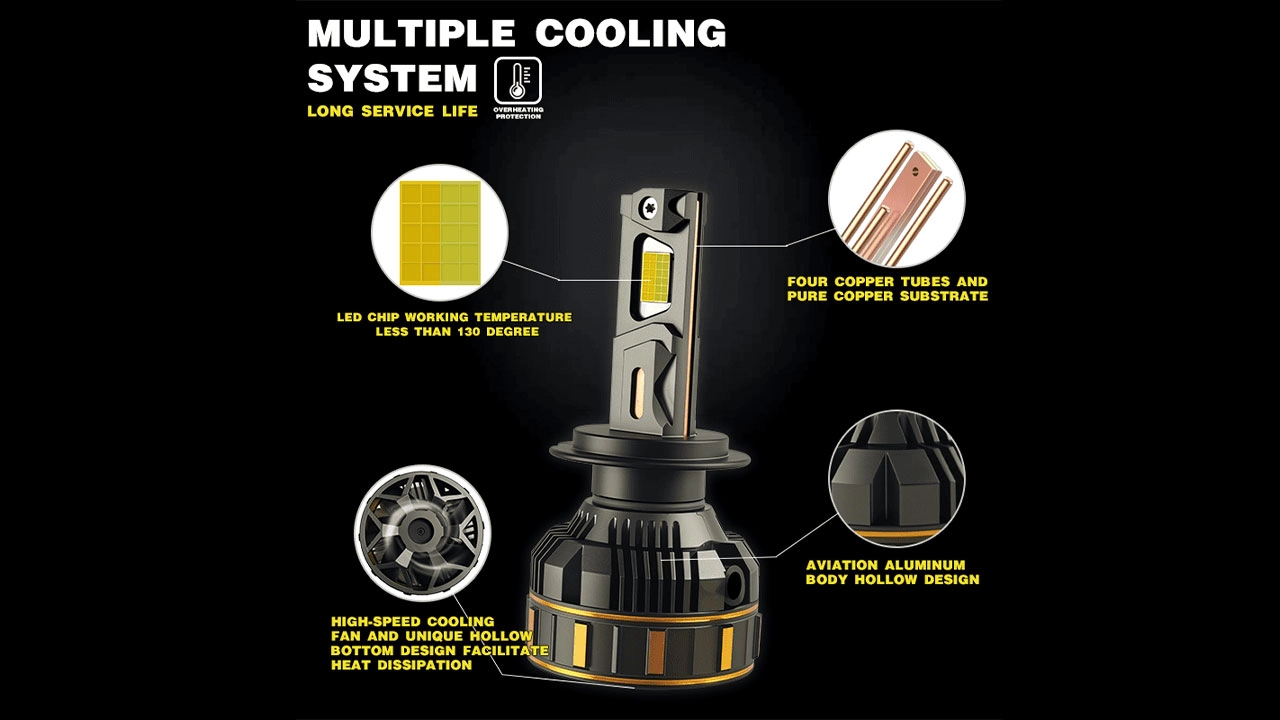
- Thermal path: confirm heat is carried away from the driver and LED emitters through a solid metal heat sink (aluminum, often 6061/6063) with adequate surface area or active cooling (fan or liquid). Fans should themselves be IP-rated or isolated behind the housing.
- Material compatibility: look for adhesives and gaskets rated for automotive thermal cycling (−40°C to +105°C) to reduce compression set and embrittlement risk.
Recommendation: avoid cheap bulbs that use thin stamped housings and expect long life from them in hot climates or continuous high-beam operation.
4) Which LED chip/assembly types and lens designs give the best dustproof beam stability for off-road use?
Why this matters: dust ingress into optics or onto emitters produces scattered light and unstable beam patterns, which defeats the purpose of a regulated cutoff in retrofits.
Chip and assembly guidance:
- COB (chip-on-board) arrays: provide uniform light source across a single emitter area, which helps mimic filament position in projector housings. They can be more easily sealed behind a glass/plastic lens.
- CSP and small SMD packages: offer high lumen density but require precise mounting for stable beam pattern. Multi-SMD arrays create multiple point sources that must be aligned and sealed.
- Projector-style sealed optics: bulbs that place a sealed lens or projector module between the LEDs and the headlamp reflector limit dust ingress into the headlamp optical cavity.
- Glass vs polycarbonate covers: glass is scratch-resistant; polycarbonate is lighter but needs hard coatings (anti-UV, anti-scratch). Ensure UV-stable coatings to avoid crazing that traps dust.
Installation note: when retrofitting into an existing headlamp, preserve the headlamp’s seals. Dust entering the lamp housing from the back (through the bulb aperture) is more common than dust seeping through the front lens.
5) For marine or salt-air environments, what anti-corrosion and waterproof features should I insist on?
Why this matters: salt spray is highly corrosive and can quickly degrade alloys, coatings, and electrical contacts—compromising IP seals.
Key features and tests:
- Materials: specify marine-grade stainless steel (316) fasteners, hard-anodized aluminum housings (MIL-A-8625, Class 3 or equivalent), or thermally conductive polymer housings with proven salt resistance.
- Salt-fog/spray testing: ask for ASTM B117 salt spray test data. While lab conditions are accelerated and not perfectly equivalent to marine environments, passing 500–1,000 hours is a good indicator of corrosion resistance.
- Conformal-coated PCBs and potting: conformal coatings (parylene, silicone, polyurethane) on electronics prevent salt deposition; full potting of the driver is even better.
- Sealed and plated connectors: gold-plated contacts with IP67/68-rated housings reduce galvanic corrosion and maintain conductivity.
Installation tip: use dielectric grease on connectors to exclude salt-laden moisture and inspect fasteners for surface degradation during scheduled maintenance.
6) How can I test installed LED headlights for waterproof/dustproof performance without a lab—what safe field tests work?
Why this matters: installers need quick verification methods that don’t void warranties or damage the product.
Practical field checks (non-destructive / warranty-safe):
- Visual and condensation check: after 24–72 hours of normal use and after a wash, inspect the inside of the lens for any fogging, droplets, or salt residue. Minute condensation immediately after a wash is normal; persistent moisture indicates ingress.
- Connector inspection: disconnect and inspect the mating surfaces—look for corrosion, water, or dirt. Reinstall with dielectric grease on the pins and a snug sealing boot.
- Smoke or incense test for dust pathways: with the headlamp removed or accessible, introduce a faint smoke source outside the sealed areas and look for ingress paths (do this carefully and safely—do not burn inside housing). It's better used to identify open seams than to prove full immersion sealing.
- Moisture indicator stickers: place small humidity indicator cards inside the accessible cavity during installation (if possible). If they change color, the lamp has been exposed to elevated humidity.
- Immersion tests (use caution): for IP67-style checks, some installers carefully submerge the sealed end of the bulb (not the wired connector) in a bucket at 1 m for 30 minutes to try to reproduce the IP67 condition. WARNING: this may void warranty and should be avoided unless manufacturer permits testing. Safer alternative: third-party lab testing.
- Functional check after wash and rough use: run the lights on high and low beams and monitor for flicker, color shift, or power draw change (use a clamp meter). Flicker can indicate intermittent contact due to moisture or corrosion.
When to escalate: persistent condensation, corrosion, or electrical anomalies should prompt a warranty claim or laboratory ingress test—do not rely solely on DIY tests for safety-critical failures.
Concluding summary of advantages: Waterproof and dustproof LED headlight bulbs, when properly specified and installed, deliver reliable lumen output, consistent beam pattern, longer service life, and reduced maintenance—especially in off-road, marine, and harsh-weather environments. Choosing bulbs with verified IP ratings, robust thermal management, sealed optics, and corrosion-resistant materials minimizes failure modes (moisture ingress, optical scatter, and electrical corrosion) and preserves legal-compliant beam performance.
If you’d like a custom product recommendation or a formal quote for IP-rated LED headlight solutions, contact us for a quote at www.carneonlighting.com or email nick@evitekhid.com.
Standards referenced: IEC 60529 (IP codes), ASTM B117 (salt spray). Regulatory notes: ensure any retrofit complies with local vehicle lighting regulations (e.g., FMVSS 108/DOT in the U.S., UNECE type-approval regulations in many regions) before on-road use.
Recommended for you
Why Your Customers Complain About LED Headlight Flickering (And How Our CANbus Solutions Fix It)
The Ultimate B2B Guide to Plug and Play LED Headlights: 1:1 Design, Specs & CANbus Solutions
LED vs. HID vs. Laser: Which Headlight Technology is Actually the Brightest for 2026?
Evitek Launches Smart Control Headlight—N14 Series, Redefining Driving Lighting Experience
FAQs
Brand
What makes CARNEON headlights reliable?
Triple-copper heat conduction system, rigorous testing, stable power output, and real-world vehicle testing ensure reliability.
What is CARNEON?
CARNEON is a performance-driven automotive LED headlight brand, built on over 15 years of manufacturing and R&D experience at Guangzhou Evitek Electronic.
After-sale Service
How do l start working with you?
Customized Service
What is the minimum order quantity for private boxes?
You May Also Like
Get More Resources
If you have any comments or good suggestions, please leave us a message, later our professional staff will contact you as soon as possible.
Start Your Wholesale Order / Request OEM Solutions
Partner directly with the factory for competitive pricing and priority support. Please provide your business details and estimated order volume (MOQ applies) so our sales engineers can tailor the best quote for your market.
Contact us


6th Floor, Building B, Liando U Valley, No. 29, Bishan Street, Huangpu District, Guangzhou, China

© 2026 CARNEON. All Rights Reserved. Privacy Policy | Terms and Conditions | Sitemap

Whatsapp: +8618688487142