


How do I choose waterproof/dustproof LED headlight bulbs? | Insights by CARNEON
- 1) How does an IP rating translate to real-world protection for LED headlight bulbs on motorcycles and off-road vehicles?
- 2) If my LED conversion doesn't seal the OEM bulb base, will a waterproof bulb still prevent condensation inside the headlamp?
- 3) Which sealing methods (silicone gasket, epoxy potting, O-rings, breather vents) actually work long-term in high-heat LED headlight bulbs?
- 4) How do waterproofing measures affect thermal management and LED lifespan?
- 5) What connector and harness specs ensure dustproof/waterproof performance under salt/splash/corrosion conditions?
- 6) How can I verify manufacturer waterproof claims — what tests, datasheets, and field checks should I demand before buying?
1) How does an IP rating translate to real-world protection for LED headlight bulbs on motorcycles and off-road vehicles?
Understanding an IP rating is critical when buying waterproof/dustproof LED headlight bulbs. The two-digit IP code (IEC 60529) communicates dust and water resistance: the first digit (6 is dust-tight) and the second digit (7, 8, 9K describe increasing water protection). For automotive use:
- IP67: Dust-tight (6) and protected against immersion up to 1 m for 30 minutes (7). Suitable for normal road vehicles and many motorcycles where exposure is limited to splashes and occasional puddle immersion. Many automotive LED bulbs marketed as “waterproof” achieve IP67.
- IP68: Dust-tight and protected against continuous immersion beyond 1 m; the exact depth/time is manufacturer-defined. Better for vehicles regularly exposed to deep water or submerged equipment.
- IP69K: Designed for high-pressure, high-temperature washdowns (DIN 40050-9 / ISO 20653). This rating covers close-range high-pressure cleaning (hot water) and is useful for off-road, agricultural, towing, or commercial vehicles that receive power washing.
Key buyer takeaways: specify at least IP67 for street use; choose IP68 or IP69K for motorcycles that ride in heavy spray, off-road vehicles, or equipment cleaned with pressure washers. Note that an IP rating applies to the assembled bulb/driver/connector unit — a high IP rating for the bulb body does not fix a poorly sealed lamp housing or base interface.
2) If my LED conversion doesn't seal the OEM bulb base, will a waterproof bulb still prevent condensation inside the headlamp?
Short answer: No — the bulb alone can't fix a leaking housing interface. Many condensation/fogging problems originate at the lamp housing’s sealing flange or the gaps created by conversion adapters when replacing halogen bulbs with different LED form factors.
Why condensation still happens:
- Pressure and temperature cycles cause humid air to be pulled into the housing through marginal seals. When the housing cools, moisture condenses on optics.
- A bulb with IP68 body but a loose bayonet or incorrect retaining ring can still allow water and dust past the bulb base.
What actually prevents condensation:
- Maintain OEM base fit and sealing: choose LED bulbs with the exact OEM base (H7, H4, 9005/9006, etc.) and compatible retaining rings so the factory rubber gasket remains effective.
- Use headlamp breather/vent membranes (e.g., Gore vents) to equalize pressure without admitting liquid water. Many modern headlamp assemblies include these.
- If conversion requires adapters, use precision-machined adapters and new rubber gaskets designed for LED acceptances. Avoid bulky heat-sink shapes that prevent the cover from seating properly.
Actionable advice: inspect the lamp housing seal after installation (look for pinched gaskets, missing O-rings), run a short water spray test at low pressure, and check for early signs of fogging. If you need an LED that mitigates poor housing sealing, choose a fully sealed assembly with a remote driver and a sealed connector system — but remember this adds cost and may alter fitment.
3) Which sealing methods (silicone gasket, epoxy potting, O-rings, breather vents) actually work long-term in high-heat LED headlight bulbs?
Common sealing techniques and their pros/cons for LED headlight bulbs:
Silicone gaskets / O-rings: Widely used at the bulb base. Silicone remains flexible across wide temperatures (-60°C to +200°C for high-grade silicones) and resists aging. Quality OEM-style gaskets are effective when the bulb geometry allows proper compression. Beware low-cost gaskets that harden over time.
Epoxy potting / overmolding: Provides excellent water/dust sealing for drivers and solder joints. However, potting compounds can trap heat; they reduce the driver’s heat dissipation path and increase junction temperature unless the design offsets it with robust external heat sinks or remote drivers.
Conformal coatings (silicone or acrylic): Thin coatings protect PCBs from moisture and salt spray while adding minimal thermal mass. Good for driver boards but not a substitute for bulk sealing.
Sealed (hermetically) driver enclosures with breather membranes: The best long-term approach is a sealed driver housing with a small hydrophobic/air-permeable vent (e.g., Gore vents) that allows pressure equalization but blocks liquid water. This prevents stress on seals during thermal cycling.
Mechanical sealing with threaded collars and locking rings: Effective if tolerances are correct and corrosion-resistant materials are used.
Recommendation: For harsh climates or salt-exposed vehicles, prioritize LED products that combine a sealed driver enclosure with a silicone base gasket and an appropriate breather membrane. Avoid designs that rely solely on epoxy potting for the main thermal path unless the driver is separated (remote) and the main LED heat sink is exposed to air.
4) How do waterproofing measures affect thermal management and LED lifespan?
Thermal management is the single biggest driver of LED lifespan. Waterproofing approaches can create trade-offs:
Sealing methods increase thermal resistance: Epoxy potting or hermetic sealing can reduce the driver’s ability to reject heat to ambient air. Higher case temperatures accelerate lumen depreciation (LEDs follow LM-80 testing and TM-21 for lifetime projection). Every 10°C increase in junction temperature can meaningfully shorten life and increase color shift.
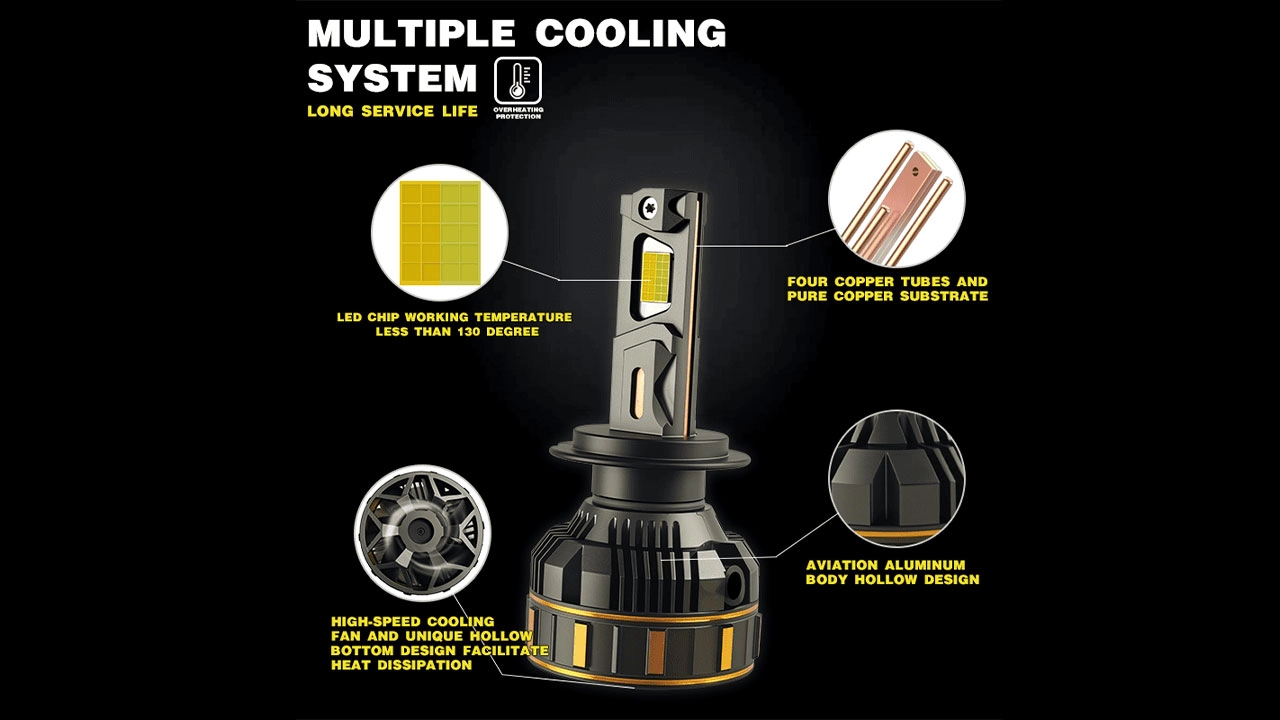
Remote driver architectures: Many high-quality waterproof LED systems place the driver remote (sealed in a separate enclosure) while keeping the LED emitter and heat sink exposed to airflow. This lets you achieve high IP ratings for the driver while still maintaining effective heat dissipation at the LED.
Active vs passive cooling: Compact, sealed bulbs often use active cooling (micro-fans) that need IP-rated protection for ingress and may have shorter lifespans if moisture gets into the fan motor. Passive heat sinks with larger surface area are preferred for long-term durability if they fit the fitment envelope.
Buyer checklist for thermal reliability:
- Request LM-80 test data for the LED chips and TM-21 extrapolations from the manufacturer or look for published lumen maintenance curves.
- Check maximum case/junction temperature ratings and the stated operating temperature range (a good automotive LED should operate reliably from -40°C to at least +85°C or higher).
- Prefer designs that separate the heat-generating LED package from sealed electronics (remote driver) or provide large passive heat sinks; avoid sealed designs that trap heat near LEDs without compensating cooling.
5) What connector and harness specs ensure dustproof/waterproof performance under salt/splash/corrosion conditions?
Connectors and wiring are frequent failure points. Specifications and features to insist on:
- IP-rated connectors: Look for connectors specified to IP67/IP68 (dust-tight and water immersion) or IP69K for pressure wash environments. Deutsch-style or automotive-grade sealed connectors are common.
- Corrosion resistance: Use gold or tin plating on terminals and consider marine-grade compounds for environments with road salt. Stainless fasteners and UV-resistant jacket materials (e.g., cross-linked polyolefin) increase longevity.
- Strain relief & proper routing: The harness should have molded strain relief, correct grommets where wires pass through panels, and secure routing away from hot exhaust components.
- Canbus/ECU compatibility: Many modern vehicles need CAN-bus compatible drivers or an anti-flicker harness with error canceller; if you use an external resistor/decoder, ensure it is in a sealed connector box.
- Dielectric grease: Small amounts of dielectric grease in connectors help prevent water intrusion and corrosion for field maintenance.
Field-proven spec: For heavy-duty use ask for IP68-rated connectors, ASTM B117 salt spray test results for corrosion resistance, and materials data for cable jackets (UV and oil resistance).
6) How can I verify manufacturer waterproof claims — what tests, datasheets, and field checks should I demand before buying?
Marketing claims often exaggerate. Verify waterproof/dustproof performance with objective documentation and field checks:
- IP test reports (IEC 60529): Ask for a copy of the IP test report showing the assembled bulb/driver/connector was tested to the claimed IP level (including test conditions and photos). IP67 should show 1 m immersion for 30 min; IP68 should show the specified depth/time.
- IP69K / DIN 40050-9 test documentation: For products claiming IP69K, request the high-pressure/high-temperature wash test report with nozzle distance and pressure parameters.
- Photometric & thermal reports: Request LM-79 (photometric) and LM-80 (LED chip) test data and TM-21 lifetime extrapolations. These demonstrate lumen output, CCT, CRI, and projected lumen maintenance.
- Corrosion and environmental tests: ASTM B117 salt spray and UV exposure reports show resistance to real-world corrosion.
- Warranty & MTBF: A minimum 2–3 year warranty is common for quality automotive LEDs; commercial/off-road products should offer longer coverage or field service options.
- Field validation: Ask for references or case studies for the same application (motorcycle, off-road truck, marine) and request photos after 12+ months of use.
Practical verification steps post-installation:
- Water spray test at low pressure (simulate road spray) and inspect for ingress.
- Overnight thermal cycling (if possible) to check for condensation.
- Periodic inspection of connectors for corrosion during the first 6 months.
If a manufacturer refuses to supply test reports or detailed photometric/thermal data, treat the waterproof claims as unreliable.
Concluding summary — advantages of waterproof/dustproof LED headlight bulbs
Waterproof/dustproof LED headlight bulbs engineered with proper IP ratings, sealed drivers, good thermal management, and OEM-compatible bases deliver longer life, consistent beam patterns, reduced maintenance, and improved reliability in wet, salty, or dusty conditions. The best solutions pair dust-tight (first digit 6) protection with a water rating appropriate to the vehicle’s use (IP67 for street, IP68/IP69K for off-road/pressure-wash environments). Insist on LM-79/LM-80 data, IP test reports (IEC 60529 / DIN 40050-9), and corrosion testing (ASTM B117) to avoid common failures such as condensation, connector corrosion, and premature lumen loss.
For a tailored recommendation and a quote for IP68/IP69K-rated plug-and-play LED options with sealed drivers, thermal data and photometric reports, contact us: www.carneonlighting.com or nick@evitekhid.com. We provide datasheets, test reports and fitment checks for your vehicle application.
Recommended for you
Why Your Customers Complain About LED Headlight Flickering (And How Our CANbus Solutions Fix It)
The Ultimate B2B Guide to Plug and Play LED Headlights: 1:1 Design, Specs & CANbus Solutions
LED vs. HID vs. Laser: Which Headlight Technology is Actually the Brightest for 2026?
Evitek Launches Smart Control Headlight—N14 Series, Redefining Driving Lighting Experience
FAQs
Logistics
How long does international shipping take?
Can we mix different SKUs in one wholesale order?
Product
Can I get some samples to test first?
E1
What is the MOQ?
Usually 50 sets, depending on the model.
You May Also Like
Get More Resources
If you have any comments or good suggestions, please leave us a message, later our professional staff will contact you as soon as possible.
Start Your Wholesale Order / Request OEM Solutions
Partner directly with the factory for competitive pricing and priority support. Please provide your business details and estimated order volume (MOQ applies) so our sales engineers can tailor the best quote for your market.
Contact us


6th Floor, Building B, Liando U Valley, No. 29, Bishan Street, Huangpu District, Guangzhou, China

© 2026 CARNEON. All Rights Reserved. Privacy Policy | Terms and Conditions | Sitemap

Whatsapp: +8618688487142