


how to choose plug and play led headlight color temperature? | Insights by CARNEON
- 1. How do I pick a plug and play LED headlight color temperature that improves visibility on wet or rainy roads?
- 2. Which plug and play LED color temperature minimizes glare to oncoming drivers while preserving apparent brightness?
- 3. My vehicle has yellow OEM fog lights — what plug and play LED color temperature will keep contrast and avoid color mismatch?
- 4. How can I tell a manufacturer's Kelvin/K color claim isn't just marketing — what tests or documents should I request?
- 5. Will a higher color temperature plug and play LED affect my car's ADAS/camera systems or lane-detection sensors?
- 6. When converting from halogen to plug and play LED, which color temperature preserves the headlamp’s beam pattern and regulatory compliance?
Choosing the right plug and play LED headlight color temperature can dramatically affect night visibility, glare to oncoming drivers, and compatibility with vehicle ADAS sensors. This guide answers six specific, technical questions that beginners (and many installers) frequently find under-explained online. It embeds industry-grade concepts — Kelvin/CCT, spectral power distribution (SPD), CRI, LM-79/LM-80 reports, photometric plots, DOT/ECE compliance, CANbus/OBD compatibility and thermal management — to help you buy correctly and legally.
1. How do I pick a plug and play LED headlight color temperature that improves visibility on wet or rainy roads?
Key factors: correlated color temperature (CCT in Kelvin), spectral power distribution (SPD), and mesopic vision. Human vision under low-light and wet-reflective conditions operates in the mesopic range — a mix of rod and cone sensitivity — where the eye's peak sensitivity shifts toward green-yellow wavelengths (~500–550 nm).
Practical recommendation: for wet or rainy conditions choose a warmer-to-neutral LED in the 3000–4500 K range. Why: warmer color temperatures have reduced blue content in their SPD. Blue photons scatter more in water droplets and on wet pavement due to increased Rayleigh and Mie scattering, which raises veiling luminance and reduces contrast. Lamps around 4300 K (close to factory HID) offer a good balance: they retain white appearance, good color rendering for signage, and reduced scatter versus 6000+ K bulbs.
What to verify when buying: ask the vendor for the SPD chart and LM-79 photometric report (see later). If no SPD or photometry is supplied, treat Kelvin claims skeptically — visual photos in marketing can be misleading due to camera white balance.
2. Which plug and play LED color temperature minimizes glare to oncoming drivers while preserving apparent brightness?
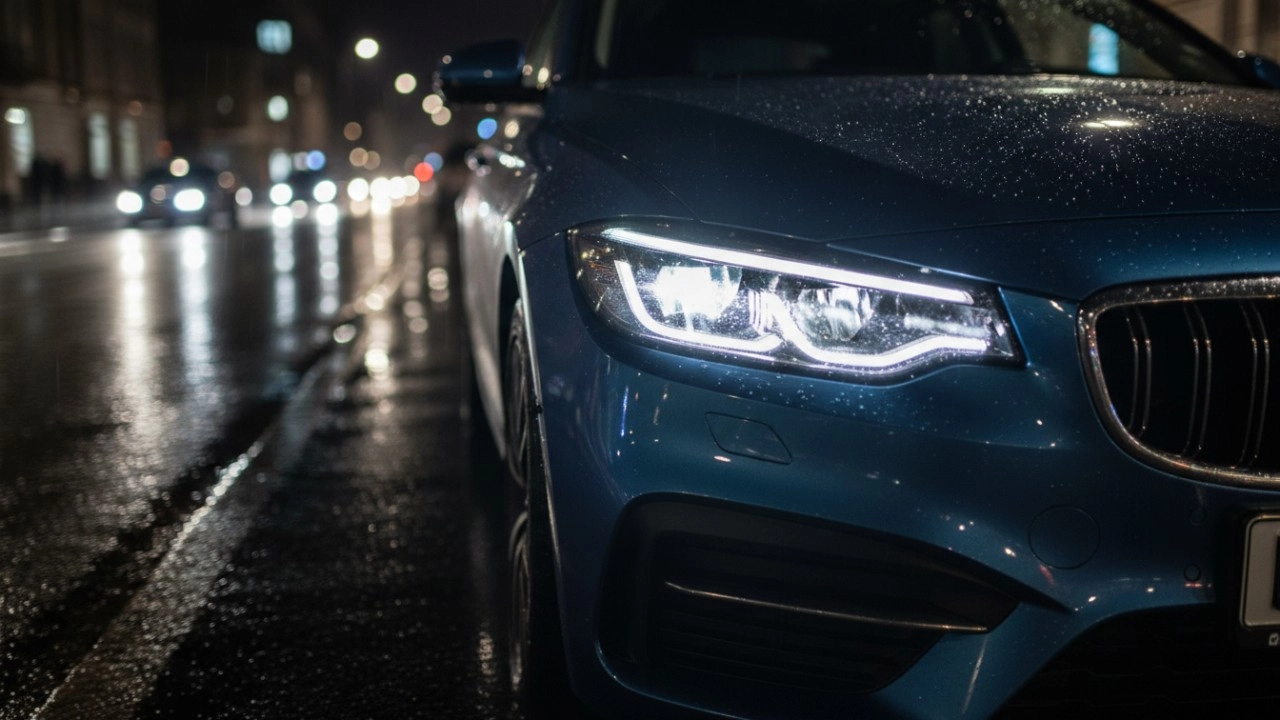
Glare is not only about Kelvin — it's primarily a function of beam pattern (cutoff), aim, candela distribution and blue light content. However, color temperature influences perceived glare: higher Kelvin (≥6000 K) increases short-wave (blue) emission that the eye perceives as harsher and more dazzling, particularly at higher luminance.
Balanced approach: select 4300–5000 K LEDs that have certified photometric beam patterns (sharp cutoff for low beams) and manufacturer-provided candela/lux maps. A properly engineered LED conversion should maintain the original filament bulb's virtual filament position and beam centroid so the reflector/projector optics create the correct cutoff.
Buyer's checks:
- Demand beam pattern photos against a wall at 25 m (or manufacturer lab photometric images).
- Confirm the luminaire has tested candela values and a sharp cutoff per LM-79 photometry or an IES file.
- Prefer LEDs with lower blue peak in the SPD if minimizing glare is a priority.
3. My vehicle has yellow OEM fog lights — what plug and play LED color temperature will keep contrast and avoid color mismatch?
Fog lights are intended to cut through spray and fog at close range. Traditional yellow fog lamps (around 3000 K) reduce forward scatter and improve contrast in particulate conditions. When converting headlights while keeping OEM yellow fogs, aim for a headlight color temperature that complements — typically 4300–5000 K.
Why not match fog lights exactly? If both headlamp and fog lamp are the same warm color at 3000 K, you may lose the color contrast that helps the brain detect pavement edges and signage at longer range. A 4300 K low beam with 3000 K fog provides a visually useful layering: neutral headlight for distance detection, warm fog for close-range contrast. Always ensure your fog lamp conversions are compliant with local regulations.
4. How can I tell a manufacturer's Kelvin/K color claim isn't just marketing — what tests or documents should I request?
Ask for three reliable, standardized artifacts — these are industry-accepted and provide objective verification:
- LM-79 report (ANSI/IES standard): measures total luminous flux (lumens), correlated color temperature (CCT), chromaticity coordinates and candela distribution under standardized conditions.
- LM-80 and TM-21 data: LM-80 measures lumen maintenance of the LED package; TM-21 projects long-term lumen depreciation. These show how output and color hold up over time.
- Spectral Power Distribution (SPD) chart or chromaticity (x,y) plot: shows blue peak and energy distribution. Two LEDs both labeled 6500 K can have different SPDs — one might be very blue-heavy and another more balanced.
Additional useful items: IES photometric file (for beam plots), DOT/ECE homologation documents (if claimed), and real-world beam photos taken with calibrated white balance and exposure metadata. If a seller cannot provide LM-79 or SPD, treat claims of Kelvin and lumen output as marketing figures rather than laboratory-verified data.
5. Will a higher color temperature plug and play LED affect my car's ADAS/camera systems or lane-detection sensors?
Yes — color temperature and SPD can interact with cameras and some ADAS sensors. Many camera-based lane-keeping, pedestrian detection and automatic high-beam systems have image-processing algorithms tuned for typical OEM illumination spectra. Increasing blue content (higher CCT) changes how cameras auto-expose and how algorithms perceive contrast and white balance. Reported effects include false glare detection, altered exposure and occasional reduced detection distances in some systems.
What to do:
- Check your vehicle manual and OEM service notices — some manufacturers explicitly warn against aftermarket bulbs that alter spectral content.
- Prefer neutral CCT ranges (4300–5000 K) and LEDs with SPD similar to OEM LEDs/hid/xenon modules if you have camera-based ADAS.
- Test ADAS after installation in a safe environment: verify lane-keeping, automatic high-beam and pedestrian detection behavior.
Also verify electrical compatibility: CANbus error codes or flicker can cause camera systems to log faults. Use quality plug and play kits with proper decoders or firmware designed for your vehicle to prevent interference.
6. When converting from halogen to plug and play LED, which color temperature preserves the headlamp’s beam pattern and regulatory compliance?
Preserving beam pattern depends on optical alignment of the new light source relative to the reflector/projector’s designed filament position — not the color temperature alone. However, color temperature influences perception of beam edges and reflections.
Steps to ensure correct conversion:
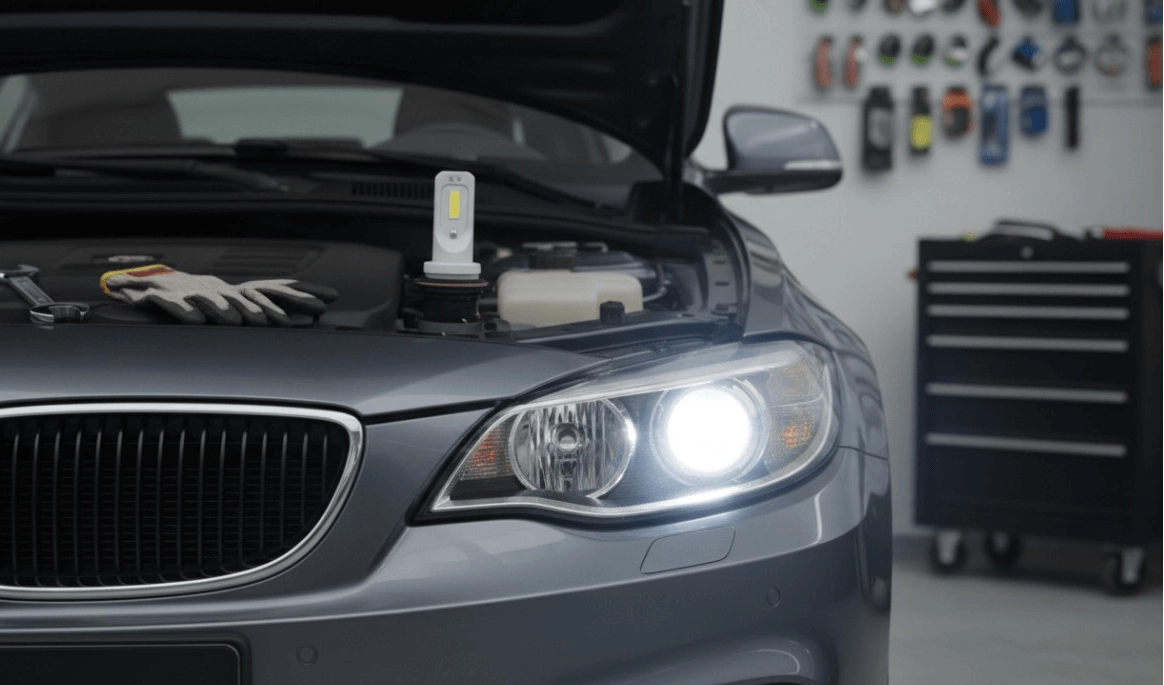
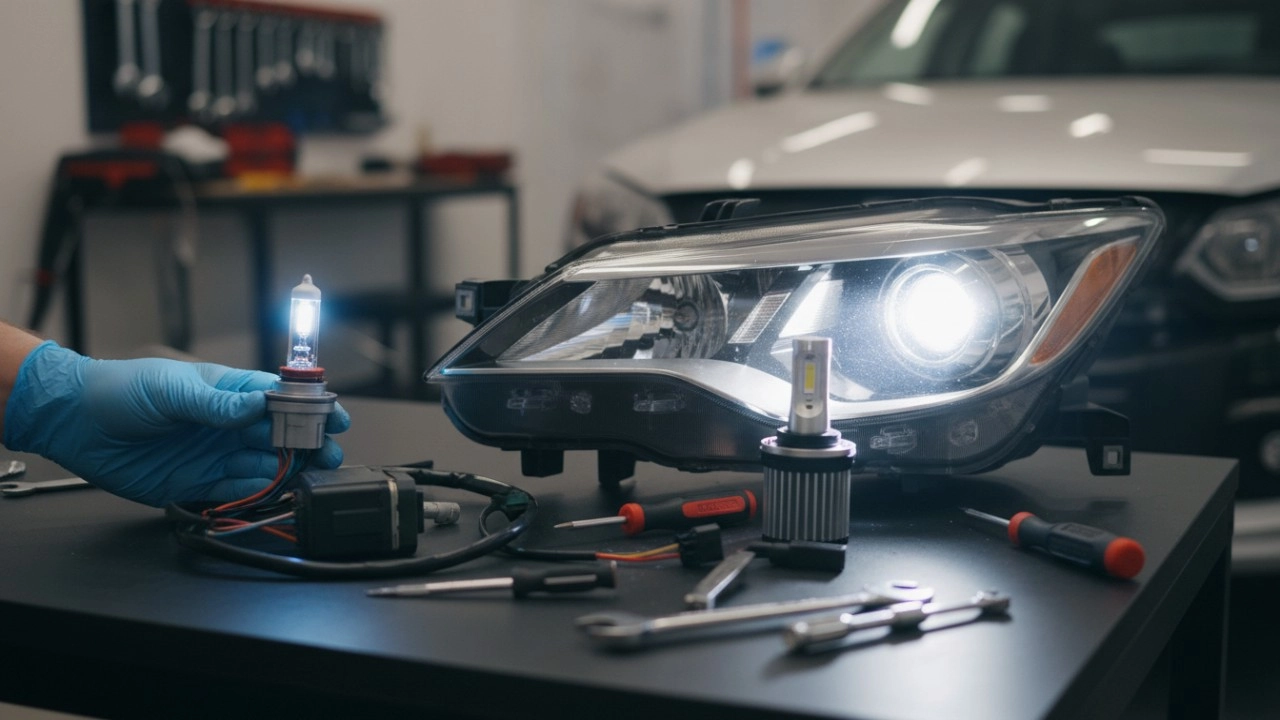
- Choose a plug and play LED that duplicates the filament's virtual position (axial and radial offsets). Manufacturers should show cross-section diagrams of LED emitter placement vs. OEM filament position.
- Request LM-79 photometric plots or IES files for the specific vehicle/reflector combination — these demonstrate candela distribution and whether a sharp cutoff is present.
- For color temperature, 4300–5000 K typically preserves visual balance and stays nearest to many OEM xenon/LED modules, reducing the chance of legal or perceptual issues. Avoid extremes (≥7000 K) which provide no visibility benefit and can increase scatter and nuisance complaints.
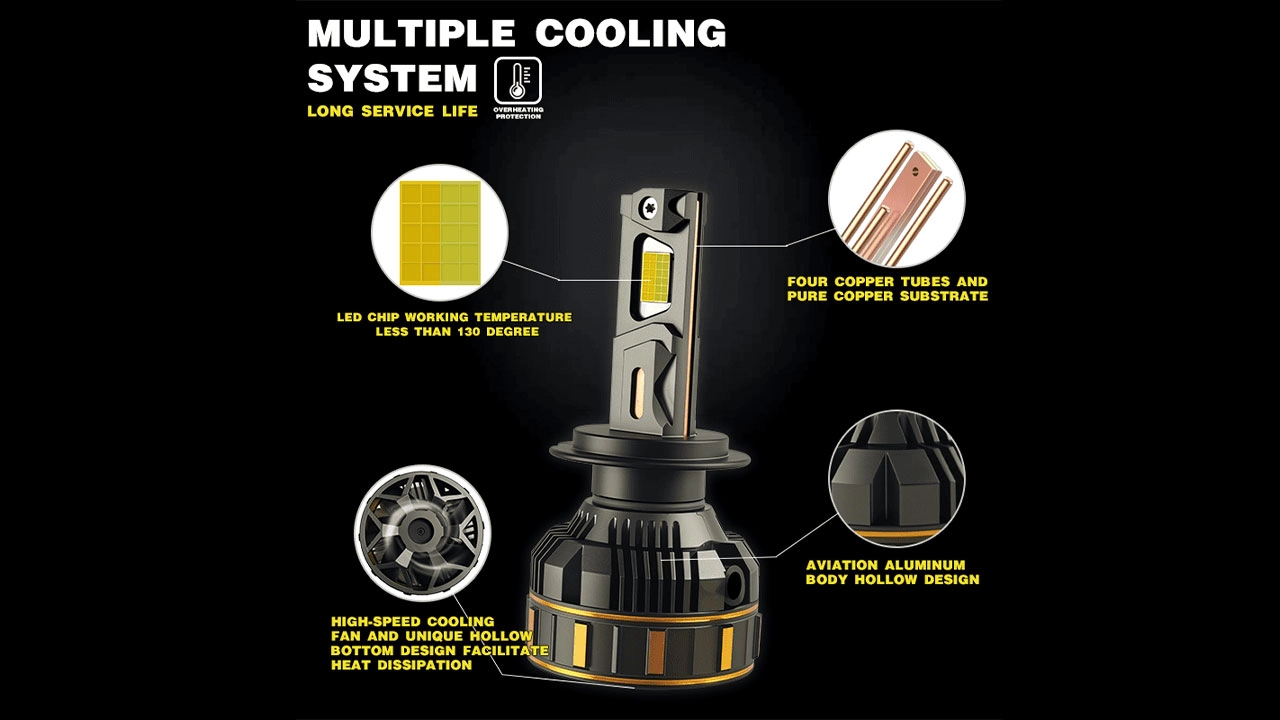
- Confirm IP67/IP68 ingress protection, adequate thermal management (active fan or heat pipe), and that the unit includes proper CANbus resistors or firmware to avoid error codes. Poor thermal designs can shift CCT as temperature changes, altering SPD and causing color drift over time.
Regulatory note: Many jurisdictions require replacement lamps to be type-approved or the entire headlamp assembly to remain compliant (FMVSS 108 in the US, ECE regulations in Europe). Retrofits that change bulb type without proper approval can be illegal; always check local laws and, if possible, choose kits with homologation or provide installation documentation for inspection.
Final checklist for buying plug and play LED headlights: verify LM-79 photometric data and SPD chart; request LM-80/TM-21 lumen maintenance data; confirm emitter placement matches OEM filament center; inspect beam pattern images/IES files; ensure IP67/IP68 rating and robust thermal design; confirm CANbus/OBD compatibility; and choose a CCT aligned to your driving conditions (3000–4300 K for fog/wet bias, 4300–5000 K balanced, avoid >6500 K on public roads).
Choosing the correct plug and play LED headlight color temperature improves night visibility, reduces glare complaints, maintains ADAS reliability and preserves legal compliance while extending LED lifetime when you rely on verified LM-79/LM-80 data and proper optical design.
If you need help selecting a verified plug and play LED kit for a specific vehicle or want lab-verified photometry and SPD documentation, contact us for a quote at www.carneonlighting.com or email nick@evitekhid.com.
Recommended for you
Why Your Customers Complain About LED Headlight Flickering (And How Our CANbus Solutions Fix It)
The Ultimate B2B Guide to Plug and Play LED Headlights: 1:1 Design, Specs & CANbus Solutions
LED vs. HID vs. Laser: Which Headlight Technology is Actually the Brightest for 2026?
Evitek Launches Smart Control Headlight—N14 Series, Redefining Driving Lighting Experience
FAQs
Product
What's the order of the lead time?
After-sale Service
How do l start working with you?
Brand
What is CARNEON?
CARNEON is a performance-driven automotive LED headlight brand, built on over 15 years of manufacturing and R&D experience at Guangzhou Evitek Electronic.
Logistics
Can we mix different SKUs in one wholesale order?
You May Also Like
Get More Resources
If you have any comments or good suggestions, please leave us a message, later our professional staff will contact you as soon as possible.
Start Your Wholesale Order / Request OEM Solutions
Partner directly with the factory for competitive pricing and priority support. Please provide your business details and estimated order volume (MOQ applies) so our sales engineers can tailor the best quote for your market.
Contact us


6th Floor, Building B, Liando U Valley, No. 29, Bishan Street, Huangpu District, Guangzhou, China

© 2026 CARNEON. All Rights Reserved. Privacy Policy | Terms and Conditions | Sitemap

Whatsapp: +8618688487142