


How to choose the best auto LED headlight manufacturer? | Insights by CARNEON
- 1. How can I verify a manufacturer's thermal management claims so headlights don't fade or fail early?
- 2. How do I confirm a supplier’s headlamps are legally compliant for my market (DOT/FMVSS, ECE/type approval) and not just marketed as street legal?
- 3. When I can’t physically test many samples, what beam-pattern and photometric data should I demand to avoid poor cut-off and glare?
- 4. Are “50,000 hours” lifetime claims believable — what tests and certificates prove real lumen-life performance?
- 5. How can I be sure headlights will be CANbus-compatible and won’t trigger ECU errors, flicker, or lamp-out alerts?
- 6. What remote factory audit, quality control and supply-chain evidence should I request before placing a large order?
1. How can I verify a manufacturer's thermal management claims so headlights don't fade or fail early?
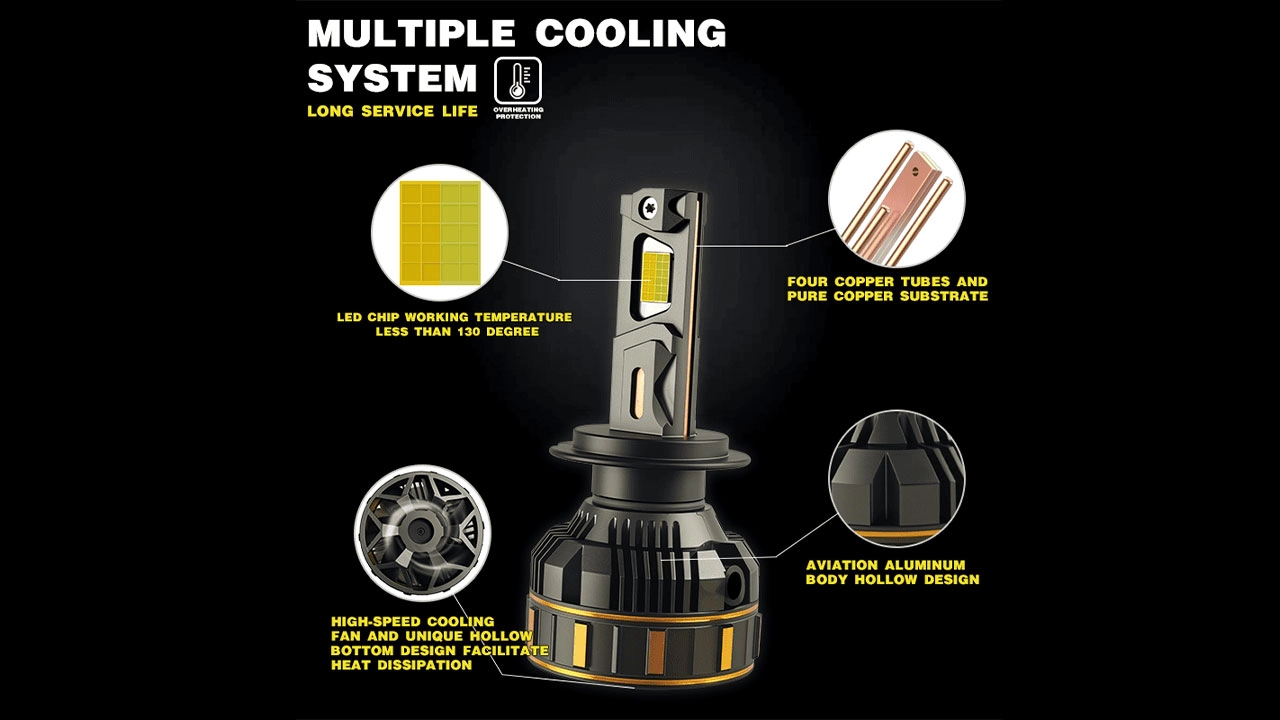
Thermal management is the single biggest real-world failure cause for auto LED headlights. Don’t accept vague claims such as “good heat dissipation.” Ask for specific, measurable evidence:
- Tc and Tj data: Request measured case temperature (Tc) at the manufacturer’s defined Tc point and junction temperature (Tj) under the target drive current and ambient (usually 25°C). A legitimate auto LED headlight supplier will provide laboratory thermal chamber reports showing steady-state Tc and Tj vs time.
- Thermal resistance (°C/W): Ask for ratings of the LED module and driver (junction-to-case and case-to-ambient). Lower °C/W numbers mean better heat transfer; compare like-for-like across suppliers.
- Measured lumen vs time at specified ambient: Thermal stress causes lumen depreciation. Demand photometric runs that show lumens at T=0, 1, 500, 1,000 hours at rated current (LM-79 style testing for luminaires helps here).
- Cooling strategy and MTBF: Clarify whether the unit is passive (die-cast aluminum heat sink) or active (fan). If active, request fan MTBF (in hours) and dust ingress protection details; fans add moving-part failure vectors. If passive, ask for material specs and thermal interface material (TIM) details.
- Real-world operating range: A credible LED headlight manufacturer will publish operating temperature range (e.g., -40°C to +85°C) and show thermal derating curves so you know expected lumen output across ambient temperatures.
What to require from the supplier: thermal chamber graphs, thermal images, thermal resistance calculations, a description of cooling materials (e.g., extrusion vs die-cast aluminum), and any thermal simulation (CFD) files if available. These documents let you compare thermal performance quantitatively rather than trusting marketing claims.
2. How do I confirm a supplier’s headlamps are legally compliant for my market (DOT/FMVSS, ECE/type approval) and not just marketed as street legal?
Regulatory compliance matters for saleability and liability. The relevant frameworks are different by region (FMVSS/Federal Motor Vehicle Safety Standards and DOT in the U.S.; ECE/UNECE type approvals in Europe and many export markets; local approvals in other countries).
Checklist to verify compliance:
- Official certification documents: Ask for Certificates of Conformity and homologation documents — not marketing copy. For U.S. sales require FMVSS 108 / DOT acceptance documentation or an explicit statement that the product is not for on-road use. For EU sales ask for ECE type approval documentation or an E-mark where appropriate.
- Test reports: Request third-party lab reports (an accredited lab such as TÜV, DEKRA, or equivalent) covering photometry and beam pattern compliance. Raw photometric data (IES / LDT files) should match the claims in the certificate.
- Photometric and alignment evidence: Confirm that beam patterns meet the region’s cutoff and glare limits; suppliers should provide candela distribution plots, lux @ distance, and pass/fail comparisons against regulatory limits.
- Markings and traceability: Legitimate automotive components usually carry regulatory marks (DOT, E-mark) plus traceable serial numbers or batch codes. Ask for labeling photos and traceability workflow.
If the supplier can’t produce verifiable certificates and independent lab reports, treat claims of “street legal” as marketing language only. For fleets or OEMs, require certificates in your PO terms.
3. When I can’t physically test many samples, what beam-pattern and photometric data should I demand to avoid poor cut-off and glare?
Beam quality is what pedestrians, regulators and drivers notice first. Request the following technical deliverables from any LED headlight manufacturer or LED headlight supplier:
- IES/LDT files: These files are standard photometric outputs used in lighting design. They let you import the headlamp into photometric software and simulate lux at distance and beam distribution. Never accept only JPEG beam photos.
- Candela distribution plots and lux maps: Require candela vs angle curves and lux measurements at standardized distances (e.g., lux at 10m, 25m). Compare against your target requirements and regulations.
- Cutoff line verification: For projector-style or reflector lamps, request a vertical/horizontal cutoff measurement showing where the beam transitions — this is critical to ensure low glare. Manufacturers should provide measured cutoff coordinates and a side-by-side metric comparison with legal limits.
- SAE/ECE compliance tests: Ask for the test protocol used (e.g., LM-79 photometric testing or the regional photometric standard). Independent lab reports that include pass/fail data are preferred.
- On-vehicle sample test protocol: If you can take a sample, define a test protocol for the supplier: install on a test vehicle, align to manufacturer spec, and measure lux at defined points. If remote, ask the supplier to deliver a video of the test rig showing meter readings and raw data files.
These artifacts allow you to verify beam pattern numerically even if you can’t test every unit on-road. Avoid suppliers who only show staged photos without underlying photometric files.
4. Are “50,000 hours” lifetime claims believable — what tests and certificates prove real lumen-life performance?
“50,000 hours” is a common marketing figure but it must be backed by proper testing methodology. The industry uses IES standards to validate LED lumen maintenance:
- LM-80 (LED package/chip testing): This measures lumen maintenance of the LED source over a minimum of 6,000 hours at specified drive currents and temperatures. Ask the manufacturer for LM-80 reports from the LED chipmaker (e.g., Nichia, Lumileds, Osram) or for in-house LM-80-like data when they qualify modules.
- TM-21 (extrapolation method): TM-21 takes LM-80 data and extrapolates lumen maintenance (L70, L90) beyond the tested period. Proper L70 estimates should be derived from LM-80 using TM-21 rules; ask to see the TM-21 extrapolation and the base LM-80 dataset.
- LM-79 (photometric and electrical testing of luminaires): LM-79 reports measure total lumens and efficacy of a full luminaire; this confirms that the final headlamp assembly meets photometric claims at time zero.
- Real-world aging and burn-in: Ask for accelerated aging/burn-in data and photometric results at intervals (e.g., 0, 500, 1,000, 2,000 hours) performed on complete assemblies under rated drive conditions and temperature. A robust supplier will report lumen maintenance (L70/L80) for the complete headlamp, not only the chip.
How to interpret: If a manufacturer claims 50,000 hours but can only show raw chip LM-80 at low current and no TM-21 extrapolation for the full luminaire, view the claim skeptically. For automotive applications request complete-luminaire data and documented extrapolation methodology.
5. How can I be sure headlights will be CANbus-compatible and won’t trigger ECU errors, flicker, or lamp-out alerts?
Modern vehicles use sensitive ECUs that detect lamp status through current sensing and PWM dimming. To ensure compatibility:
- CANbus/ECU compatibility list: Ask the manufacturer for a documented compatibility matrix showing models (or ECUs) tested and the test results. Vendors that have worked with Tier-1 OEMs will often have extensive compatibility lists.
- Driver functionality: Get the LED driver spec sheet showing constant-current operation, PWM dimming frequency range, soft-start behavior, and protections (over-voltage, over-temperature, reverse polarity). A proper driver reduces flicker and avoids tripping lamp-out circuits.
- Anti-flicker and load emulation: For vehicles that rely on filament bulb current signatures, the supplier should provide either a CANbus-friendly driver that mimics bulb characteristics or external load equalizers. Verify whether anti-flicker electronics are integrated or sold separately.
- EMC and EMI testing: In-vehicle electronics require EMI/EMC compliance. Ask for CISPR 25 (or regional equivalent) EMI reports and conducted/radiated emission measurements. Poor EMI can cause flicker and interfere with vehicle electronics.
- On-vehicle verification protocol: Insist on an on-vehicle test plan covering startup, idle, PWM dimming, emergency flashes, and cold-start conditions to ensure the headlight does not generate ECU fault codes or flicker across the vehicle’s operational range.
If the supplier can’t provide driver-level specs, EMC tests, and a compatibility matrix (or refuses on-road test results), budget for a compatibility verification run before full purchase.
6. What remote factory audit, quality control and supply-chain evidence should I request before placing a large order?
Remote audits and supplier documentation reduce risk from counterfeit components, inconsistent solder quality, or poor QC practices. For a professional evaluation:
- Certifications: Request copies of ISO 9001 and IATF 16949 (automotive quality management) certifications. These speak to process control and continuous improvement.
- Factory audit reports: Ask for third-party audit reports from agencies such as SGS, Bureau Veritas, or Intertek. These reports typically cover capacity, traceability, equipment, and labor practices.
- BOM and component traceability: Require a bill of materials with manufacturer part numbers for key components (LED chips — e.g., Cree/Lumileds/Osram/Samsung/Nichia, drivers, capacitors). Ask how the supplier prevents counterfeit components and whether they perform incoming inspection or X-ray/BGA checks for critical parts.
- Process controls and QA testing: Verify the supplier’s in-line and end-of-line tests (optical inspection, automated visual inspection, burn-in duration, functional test, vibration/shock tests). Typical automotive tests include vibration (ISO 16750 series), salt spray for corrosion resistance (ASTM B117), and thermal cycling. Ask for sampling plans and failure rates.
- Traceable batch IDs and warranty handling: Ensure product batches are serial-traceable and that the supplier documents returns and life-failure analysis. An SLA for response time, RMA process and replacement lead times should be included in your contract.
- Capacity and lead times: Confirm manufacturing capacity, MOQ, and planned lead times. Request a production ramp-up plan if you will scale volumes.
A supplier that openly provides these documents and supports remote video audits of the production line demonstrates higher transparency and lower risk than one that does not.
Concluding summary — Advantages of choosing the right auto LED headlight manufacturer
Choosing a manufacturer that provides verifiable thermal data, LM-79/LM-80/TM-21 test reports, third-party regulatory certificates (DOT/ECE), complete beam photometry (IES/LDT), CANbus/EMC test evidence, and supply-chain traceability drastically reduces warranty cost, field failures and regulatory liability. The right supplier minimizes returns, simplifies homologation for new markets, accelerates time-to-market for OEMs and ensures fleet safety and uptime for commercial customers.
To get a technical quote, test documentation or schedule a remote factory audit, contact us at www.carneonlighting.com or email nick@evitekhid.com.
Recommended for you
Why Your Customers Complain About LED Headlight Flickering (And How Our CANbus Solutions Fix It)
The Ultimate B2B Guide to Plug and Play LED Headlights: 1:1 Design, Specs & CANbus Solutions
LED vs. HID vs. Laser: Which Headlight Technology is Actually the Brightest for 2026?
Evitek Launches Smart Control Headlight—N14 Series, Redefining Driving Lighting Experience
FAQs
After-sale Service
How do you handle product complaints or quality issues?
Brand
Where are CARNEON products manufactured?
All CARNEON products are produced in our Dongguan factory, with full in-house assembly, testing, and quality control.
What makes CARNEON headlights reliable?
Triple-copper heat conduction system, rigorous testing, stable power output, and real-world vehicle testing ensure reliability.
E1
Do you offer samples?
Yes, paid samples or refundable samples are available.
You May Also Like
Get More Resources
If you have any comments or good suggestions, please leave us a message, later our professional staff will contact you as soon as possible.
Start Your Wholesale Order / Request OEM Solutions
Partner directly with the factory for competitive pricing and priority support. Please provide your business details and estimated order volume (MOQ applies) so our sales engineers can tailor the best quote for your market.
Contact us


6th Floor, Building B, Liando U Valley, No. 29, Bishan Street, Huangpu District, Guangzhou, China

© 2026 CARNEON. All Rights Reserved. Privacy Policy | Terms and Conditions | Sitemap

Whatsapp: +8618688487142