


what are the best plug and play led headlights for trucks and suvs? | Insights by CARNEON
- 1) Which plug-and-play LED bulbs give the best true beam pattern and cutoff in halogen housings for trucks and SUVs without creating glare?
- 2) How do I choose a CANbus-compatible plug-and-play LED for my 2018–2023 Ford F-150 to avoid dashboard errors and hyper-flashing?
- 3) Can I install plug-and-play LED headlights in OEM projector vs reflector housings on SUVs (example: Jeep Grand Cherokee) without rewiring, and which bulbs fit physically?
- 4) What are realistic lumen, power, and thermal limits for plug-and-play LED bulbs used in heavy-duty trucks running 12+ hours a day, and which designs handle long duty cycles?
- 5) Which plug-and-play LED conversion kits meet DOT/SAE and ECE regulations for on-road use in the US and EU, and how can I verify compliance?
- 6) How do I prevent flicker, radio interference, and CANbus error codes when installing plug-and-play LEDs in diesel trucks with aftermarket alternators or high-output charging systems?
1) Which plug-and-play LED bulbs give the best true beam pattern and cutoff in halogen housings for trucks and SUVs without creating glare?
A precise beam pattern is the single biggest real-world concern when converting halogen housings to plug-and-play LED headlights. Unlike projector housings designed for LEDs, many truck and SUV halogen reflectors rely on a filament position and round light source. Good plug-and-play LED bulbs that reproduce a filament-sized emitter footprint and correct optical height produce the correct hotspot and cutoff; poor designs create scatter and oncoming glare.
What to check and why:
- Emitter footprint and chip placement: Look for bulbs that position their LED emitters to match the original filament plane (often called 1:1 filament mapping). This controls hotspot location and reduces glare. Most reputable LED manufacturers advertise filament-mapped or filament-replica designs.
- Beam testing results: Choose bulbs with measured candela plots or wall-projection photos (high/low beam) in a halogen housing. Many brands publish projection photos—compare them to an OEM halogen’s projection to confirm a tight hotspot and clearly defined cutoff.
- Proven product families: As of 2024, brands frequently recommended by installers and fleet users for good beam pattern in retrofit halogen housings include Philips X-tremeUltinon LED (well-known for OEM-grade optics), Hikari Ultra LED series (filament-mapped designs), and higher-end Alla/Truck-Lite complete LED replacements for OEM housings. These are types to evaluate for trucks and SUVs where halogen reflectors are retained.
- Avoid cheap multi-chip, 360-degree designs for halogen housings: They often create scattered light and significant glare.
Practical test steps before purchase:
- Verify exact bulb code for your truck/SUV (H4, H13, 9005/HB3, 9006/HB4, H11, etc.).
- Ask the seller for wall projection images in the same housing type as your vehicle or ask for a local installer's comparison photos.
- If possible, buy from a supplier with a good return policy and documented photos from installs in similar vehicles.
2) How do I choose a CANbus-compatible plug-and-play LED for my 2018–2023 Ford F-150 to avoid dashboard errors and hyper-flashing?
Problem summary: Modern trucks like the F-150 use body control modules that expect a certain electrical load and bulb characteristics. Plug-and-play LED bulbs can trigger low-voltage warnings, bulb-out messages, or hyper-flash on turn signals if the vehicle detects lower current draw or altered line characteristics.
What to look for in a CANbus plug-and-play solution:
- True CANbus compatibility (not just marketed as CANbus with no details). Genuine solutions include built-in decoders or electronics designed to sit inline with the vehicle’s diagnostic expectations.
- Integrated resistors vs. active CAN decoders: Many LED headlight and turn-signal bulbs use internal decoders rather than external resistors. Internal decoders are cleaner and preserve plug-and-play wiring without splicing.
- EMI/EMC filtering: Trucks with sensitive multiplexed networks can register noise from poorly designed LED drivers. Choose bulbs with documented EMI suppression and CE/FCC-class filtering.
- Manufacturer fit guides: Reputable manufacturers list vehicle models and years tested; for Ford F-150s, check explicit compatibility notes about Adaptive Lighting, daytime running light circuits, and BULB-X configurations.
Recommended approach for F-150 owners:
- Identify the exact socket and control (some F-150 trims use module-controlled DRLs or PWM dimming; those require drivers that support PWM).
- If the vehicle uses PWM dimming on headlight lines, choose bulbs explicitly labeled PWM-compatible.
- If issues persist after installing CANbus-labeled bulbs, the clean fix is an inline OEM-grade load equalizer (resistor) or a vehicle-specific CANbus harness made for that model. Many installers recommend vehicle-tested kits from Philips/Hikari or OE supplier Truck-Lite for minimal troubleshooting.
Bottom line: For a 2018–2023 F-150, use bulbs explicitly tested on that model, with PWM/CANbus-capable drivers and EMI filtering. If in doubt, opt for a kit sold with a vehicle-specific harness or buy from an installer who guarantees error-free operation.
3) Can I install plug-and-play LED headlights in OEM projector vs reflector housings on SUVs (example: Jeep Grand Cherokee) without rewiring, and which bulbs fit physically?
Key distinction—projector vs reflector:
- Projector housings (very common in higher trims) have focused optics and generally accept LED conversions better—they reproduce good cutoff and are often a straightforward plug-and-play swap if the bulb type matches.
- Reflector housings are more sensitive to emitter position; only filament-mapped LED bulbs that mimic a filament’s light source usually give acceptable results.
Fitment checklist:
- Confirm bulb code: Check the service manual or the existing bulb (H11, H4, 9005, 9006, H13, etc.). A plug-and-play replacement must match that same bulb code to mate with the stock connector and retain mechanical alignment.
- Clearance and cooling: Verify the LED’s heatsink or fan fits within the headlamp bucket. Some LED bulbs have larger heat sinks or small fans; if the OEM headlamp cavity is tight (many SUVs have limited rear access), you need a low-profile or remote-driver design.
- Dust cap and sealing: Stock dust caps or rubber boots must be replaceable or modified without breaking. Many LED bulbs are designed with removable boots or remote drivers to preserve sealing.
Practical tips for Jeep Grand Cherokee and similar SUVs:
- For projector-equipped Grand Cherokees, most plug-and-play LED bulbs in the correct bulb code will maintain beam quality—select a high-quality branded bulb.
- For reflector housings (older trims), choose filament-mapped LED bulbs and check projection photos from the same reflector type.
- If physical interference occurs, consider a remote-driver kit (the driver sits elsewhere in the cavity, connected by a short cable) or an OE-style full LED headlamp assembly (Truck-Lite and OEM replacements) to retain fitment and sealing.
Conclusion: Yes, you can often install plug-and-play LEDs without rewiring if you match the exact bulb code and confirm heatsink clearance. For limited cavity space, choose low-profile or remote-driver plug-and-play kits.
4) What are realistic lumen, power, and thermal limits for plug-and-play LED bulbs used in heavy-duty trucks running 12+ hours a day, and which designs handle long duty cycles?
Reality check on specs:
- Advertised lumen numbers vary and are sometimes measured differently by manufacturers (some report raw LED chip lumen output rather than usable lumens from the headlamp). Expect realistic usable lumen output per bulb in solid plug-and-play conversions to fall between roughly 2,000 and 6,000 lumens per bulb depending on quality and optical efficiency.
- Power draw: Typical modern plug-and-play LED headlight bulbs draw between 20W and 40W per bulb for high-quality designs. Higher wattage can mean more heat to manage and requires better thermal systems.
Thermal management and duty cycles:
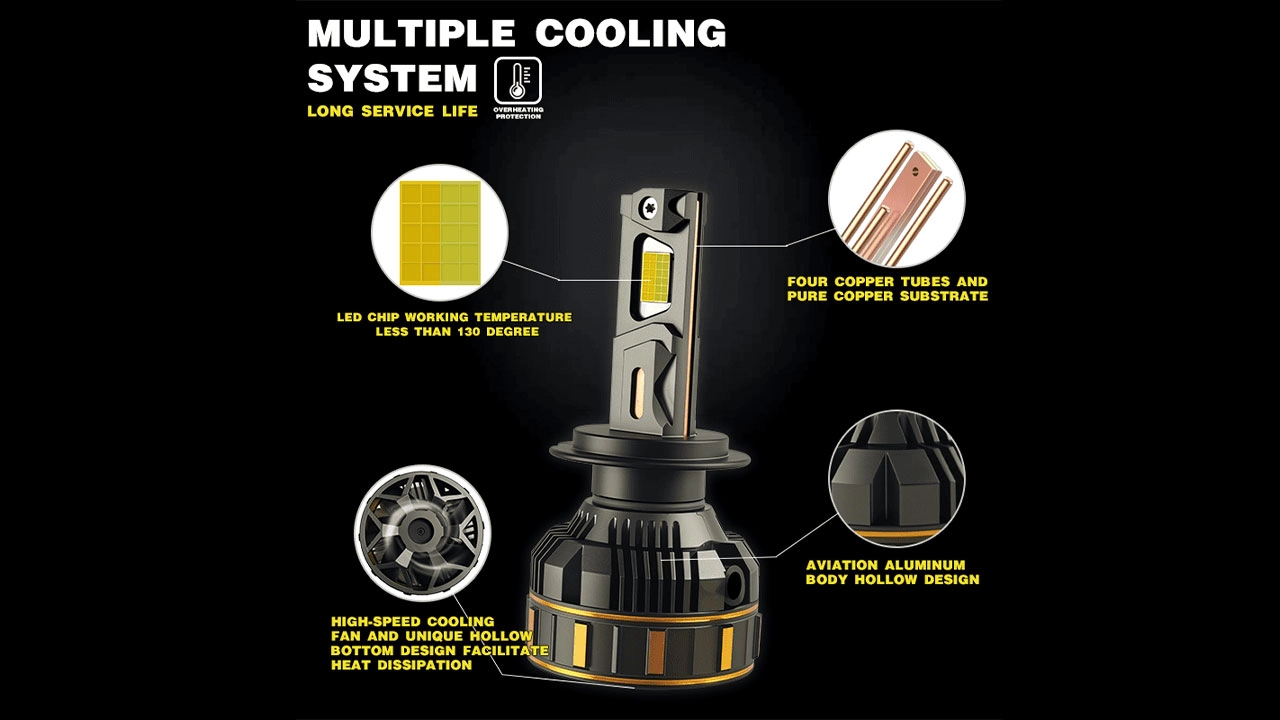
- Thermal design is the reliability limiter for long-running duty cycles. Fan-cooled designs can deliver high lumen output but may be vulnerable to dust/water and fan failures; passive (heatsink + thermal pad) designs are more robust in dusty, off-road conditions common for trucks.
- Look for bulbs rated for continuous operation at elevated ambient temperatures (e.g., spec sheets that state performance at 85°C or continuous run ratings). OEM-grade full LED assemblies (Truck-Lite, OEM replacements) generally have better thermal engineering for long duty cycles than small plug-in bulbs.
- IP rating and vibration resistance: For heavy-duty use, check IP67/IP69K ratings and MIL-STD vibration tests if available—these indicate the product is suitable for trucks running long hours and in harsh environments.
Which designs to favor:
- Passive-cooled, high-efficiency LED bulbs with remote drivers are preferred for 12+ hour daily operation: no fan to fail, larger surface area for heat sinking, and robust sealing.
- Where high sustained lumen output is needed (work trucks, towing at night), consider vehicle-specific OEM LED headlamp assemblies or heavy-duty branded conversion kits listed for commercial usage—these target thermal longevity.
5) Which plug-and-play LED conversion kits meet DOT/SAE and ECE regulations for on-road use in the US and EU, and how can I verify compliance?
Regulations matter: Using non-compliant lamps can result in tickets, failed inspections, or unsafe glare. The two primary regulatory regimes are DOT/SAE in the United States and ECE (ECE R112, R7, etc.) in much of Europe. Some LED retrofit kits are sold as street-legal and some are intended for off-road use only.
How to verify compliance:
- DOT/SAE marking: In the U.S., compliant lamps should have DOT or SAE markings on the housing or official packaging. Note that DOT marking on bulbs does not automatically mean a halogen reflector conversion is compliant—DOT requires proper beam pattern in the housing type.
- ECE approval: In the EU, look for ECE R112 (headlamp) approval marks (an 'E' in a circle with a number) on the product or packaging. ECE has strict beam and luminous intensity standards.
- Manufacturer test data: Request photometric reports, candela plots, or homologation certificates from the seller or manufacturer. Reputable manufacturers will provide these documents.
- Vehicle-specific retrofit guidance: Some manufacturers design vehicle-specific plug-and-play replacements that are homologated for the vehicle (OE-style replacements). Those are the safest option for legal compliance.
Common pitfalls:
- Many universal LED bulbs are sold as DOT-compliant but were not tested in a halogen reflector housing—this can still produce illegal glare despite markings.
- Aftermarket bulbs claiming compliance without test reports should be treated skeptically.
Best practice: Prefer full headlamp assemblies from OEM suppliers (Truck-Lite, OE replacements) or LED conversion kits with documented photometric tests for your housing type and regulatory markings. If in doubt, ask the vendor for test data and check local regulations.
6) How do I prevent flicker, radio interference, and CANbus error codes when installing plug-and-play LEDs in diesel trucks with aftermarket alternators or high-output charging systems?
Why diesel trucks are different: Aftermarket alternators, high-output charging systems, or auxiliary electrical accessories common on diesel trucks can create electrical noise, voltage spikes, and non-standard waveforms. Cheap LED drivers react poorly to these conditions and produce flicker, radio frequency interference (RFI), or trigger vehicle network errors.
Solutions and checks:
- Choose bulbs with robust surge protection and wide input voltage range: Good LED drivers are rated to handle 9–16V or higher transient spikes with TVS diodes and surge suppression.
- EMI/RFI filtering: Look for drivers that state EMI or RFI suppression and compliance with relevant EMC standards. This reduces radio interference with CBs and audio systems.
- PWM compatibility: Alternators and controllers sometimes use PWM charging or dimming on headlamp lines. Select bulbs explicitly compatible with PWM signals and variable voltage control.
- Use OEM-grade decoders/harnesses: An inline harness or CANbus decoder designed for noisy electrical environments will dramatically reduce flicker and errors. Heavy-duty kits intended for fleet trucks or off-road vehicles are engineered for these conditions.
- Proper grounding and wiring practice: Ensure tight, clean grounds and, if using add-on decoders or resistors, mount them away from heat, keep wiring neat, and follow recommended grounding points on the chassis to avoid ground loops.
If problems persist:
- Add an in-line voltage stabilizer or surge suppressor module rated for automotive use.
- Consult an experienced installer familiar with diesel truck electrical systems—this is often faster and less risky than trial-and-error.
Conclusion
Plug-and-play LED headlights offer clear advantages for trucks and SUVs: improved lumen-per-watt efficiency, cooler white color temperatures (better visual contrast), longer rated life, and lower maintenance. However, success depends on matching the correct bulb code, choosing filament-mapped emitters for reflector housings, confirming CANbus/PWM compatibility for modern vehicles, and selecting robust thermal and EMI designs for heavy-duty duty cycles. For legal on-road use, prioritize kits and assemblies with documented DOT/SAE or ECE approvals and published photometric data.
If you’d like tailored, vehicle-specific recommendations or a quotation for a tested plug-and-play solution for your truck or SUV, contact us for a quote. Visit www.carneonlighting.com or email nick@evitekhid.com.
Recommended for you
Why Your Customers Complain About LED Headlight Flickering (And How Our CANbus Solutions Fix It)
The Ultimate B2B Guide to Plug and Play LED Headlights: 1:1 Design, Specs & CANbus Solutions
LED vs. HID vs. Laser: Which Headlight Technology is Actually the Brightest for 2026?
Evitek Launches Smart Control Headlight—N14 Series, Redefining Driving Lighting Experience
FAQs
Brand
What makes CARNEON headlights reliable?
Triple-copper heat conduction system, rigorous testing, stable power output, and real-world vehicle testing ensure reliability.
After-sale Service
How do you handle product complaints or quality issues?
Company
When is Evitek founded?
Customized Service
What products can be customized?
You May Also Like
Get More Resources
If you have any comments or good suggestions, please leave us a message, later our professional staff will contact you as soon as possible.
Start Your Wholesale Order / Request OEM Solutions
Partner directly with the factory for competitive pricing and priority support. Please provide your business details and estimated order volume (MOQ applies) so our sales engineers can tailor the best quote for your market.
Contact us


6th Floor, Building B, Liando U Valley, No. 29, Bishan Street, Huangpu District, Guangzhou, China

© 2026 CARNEON. All Rights Reserved. Privacy Policy | Terms and Conditions | Sitemap

Whatsapp: +8618688487142