


what are the best plug and play led headlights for cars? | Insights by CARNEON
- 1) Which plug-and-play LED bulbs reliably produce a correct beam cut-off in reflector (non-projector) housings without creating glare?
- 2) How do I prevent CANbus errors and flicker when installing plug-and-play LED headlights on modern cars (BMW, Mercedes, VW, Audi)?
- 3) Will a plug-and-play LED conversion overheat or damage sealed halogen housings and plastic lenses?
- 4) How can I verify DOT/ECE legal compliance so my plug-and-play LED headlights won’t get me fined or fail inspection?
- 5) What is the real-world lifespan and lumen depreciation I should expect from plug-and-play LED headlight bulbs?
- 6) What color temperature and measured brightness give the best night visibility without increased glare or reduced contrast?
1) Which plug-and-play LED bulbs reliably produce a correct beam cut-off in reflector (non-projector) housings without creating glare?
A common pain point: many plug-and-play LED conversion bulbs are sold as fit-and-forget, yet when placed into reflector-style housings (designed for a filament light source) they scatter light and produce scatter/glare for oncoming drivers. The technical reason is emitter position and beam control. Reflector housings rely on the filament's precise filament geometry and position relative to the reflector focal point. If an LED emitter is not matched to that geometry, the reflector can’t form the correct beam pattern and cut-off.
How to solve this in practice:
- Choose LED bulbs marketed specifically as reflector safe or designed for your socket type (H4/H7/H1 etc.) that publish emitter-to-base dimensions and show photometric beam pattern images. Good plug-and-play LED kits will supply beam photos taken in standard headlight test setups.
- Prefer bulbs with a single compact emitter array or linear emitter that mimics filament location rather than wide, multi-directional LED boards. Proper OEM-style emitter placement produces a sharper cut-off.
- Test before trusting: ask the seller for on-vehicle beam pattern photos taken inside a garage or against a test wall at 7–10 m. Check for a defined horizontal cut-off and minimal scatter outside the beam.
- If you already have glare after install, options are: install projector-style retrofit housings, switch to bulbs designed specifically for reflector housings, or revert to halogen. Avoid DIY aim tweaks that raise the beam to mask scatter — that simply increases glare.
Keywords embedded: plug-and-play LED headlight kits, beam pattern, reflector housings, H4 H7 LED replacement.
2) How do I prevent CANbus errors and flicker when installing plug-and-play LED headlights on modern cars (BMW, Mercedes, VW, Audi)?
Why errors happen: modern vehicles use CANbus body control modules that monitor bulb load (current draw) and lamp diagnostics. LED bulbs draw far less current than halogen filaments and can trigger low-voltage warnings, flicker, or bulb-out messages.
Steps to ensure a clean, flicker-free install:
- Buy CANbus-compatible LED bulbs or kits that explicitly state compatibility with your vehicle make and model. These have driver electronics or built-in decoders designed to mimic resistive load and proper signaling.
- If the kit is not fully compatible, use a dedicated load equalizer or anti-flicker harness. A high-quality harness adds the correct electrical load and stabilizes voltage to stop flicker and instrument cluster errors.
- For cars with sensitive optical or DRL systems, some installations require an OEM-style LED driver or coding via dealer-level software to disable lamp monitoring. This is vehicle-specific and should be performed by a qualified technician.
- Avoid cheap CANbus claims without a stated warranty. Look for sellers offering vehicle-specific fitment guides and a return policy.
Keywords embedded: CANbus-compatible LED bulbs, anti-flicker, LED conversion bulbs, OBD codes.
3) Will a plug-and-play LED conversion overheat or damage sealed halogen housings and plastic lenses?
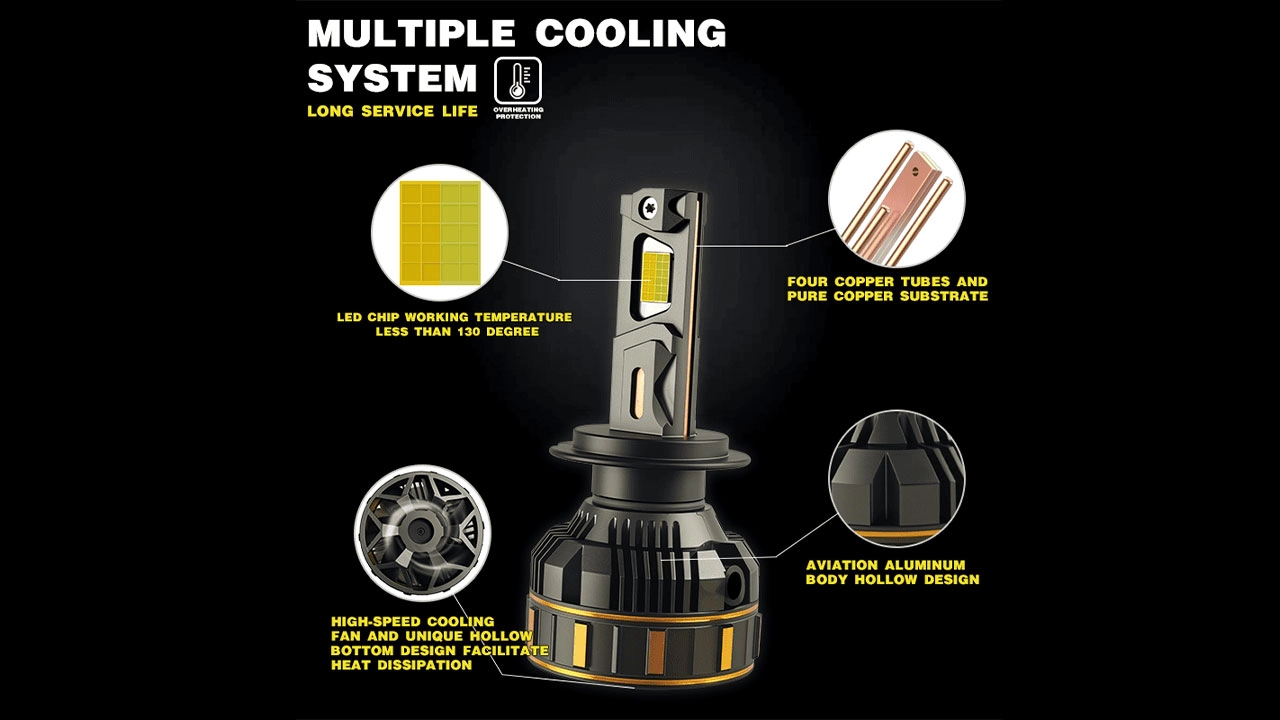
The problem: halogen systems were designed for filament heat radiating forward; many LED bulbs concentrate heat at the base electronics and require effective heat sinking or active cooling. In sealed housings with little airflow, heat can build up and shorten bulb life or deform nearby plastic.
What to check and how to prevent issues:
- Cooling method matters. There are two mainstream designs: active (fan-cooled) and passive (large heatsink, sometimes with heat pipe). For sealed housings or tight spaces, low-profile passive designs or heat-pipe solutions reduce the risk of fan failure and can perform better long-term.
- Verify IP (ingress protection) and thermal specs. Manufacturers should publish operating temperature ranges and IP ratings (e.g., IP67-style water/dust protection). If a product lacks these, treat claims cautiously.
- Watch for heat-related failure modes: melted dust caps, brittle wiring insulation, or connector deformation. Inspect under-hood clearances before final install.
- If your housings are sealed with rubber dust-caps, ensure the LED package can seal correctly; some fans/heatsinks require modification that compromises seal and invites moisture.
- Practical precaution: after initial installation, monitor headlight area temperature during a 15–30 minute night drive (careful touch test or IR thermometer). If surfaces near the bulb become uncomfortably hot, consult a fitter or use an alternative bulb designed for sealed halogen housings.
Keywords embedded: thermal management, heat sink, fan-cooled LED bulbs, sealed housings.
4) How can I verify DOT/ECE legal compliance so my plug-and-play LED headlights won’t get me fined or fail inspection?
Many online listings use vague phrases such as street legal in some areas — legality depends on regional standards and specific approvals. Buyers must check certification marks and model-level approvals rather than trusting generic claims.
Checklist before purchase:
- Look for clear markings: in the U.S., DOT or SAE markings on the lamp or packaging indicate compliance with federal lighting standards. In many European countries, an E-mark (circle with an E and number) indicates UNECE approval; for LED-specific approvals, look for the manufacturer’s declared regulation references.
- Request photometric test reports or certification documents from the vendor. Legitimate suppliers can provide test reports or approval numbers.
- Verify model-specific fitment: some LED bulbs are legal in projectors but not legal in reflectors, and vice versa. An LED bulb with the right approvals in one housing may be illegal in another.
- Check local regulations or DMV guidance: states and countries can differ on aftermarket light approvals. When in doubt, consult local vehicle inspection authorities or a qualified installer.
Keywords embedded: DOT-approved LED headlights, ECE approval, street-legal LED headlight kits, photometric data.
5) What is the real-world lifespan and lumen depreciation I should expect from plug-and-play LED headlight bulbs?
Manufacturer lifespans often claim tens of thousands of hours (commonly 20,000–50,000 hours). Real-world lifespan depends on thermal management, electrical stability, vibration, and moisture ingress.
Realistic expectations and maintenance tips:
- Expect significant factors to reduce life: high under-hood temperatures, frequent short trips (which cycle thermal stresses), poor sealing, and voltage spikes. LEDs degrade more from heat than from nominal on-hours.
- Lumen depreciation: LEDs lose brightness over time (described as L70 when luminous output falls to 70% of rated). High-quality headlight LEDs can maintain useful output for many thousands of hours, but inferior kits with poor cooling can drop noticeably in <2–3 years under real driving conditions.
- Replace in pairs: even if one bulb appears OK, replace both to maintain matched beam color and intensity.
- Warranty: choose vendors offering multi-year warranties and documented support. A real warranty backed by a business with clear return policies is a strong E-E-A-T signal.
Keywords embedded: lumen depreciation, L70, lifespan, warranty.
6) What color temperature and measured brightness give the best night visibility without increased glare or reduced contrast?
Manufacturers often highlight high Kelvin temperatures (6000–6500K) because they look bright and white, but this is not always optimal for human vision and may increase glare and scattering, especially in wet conditions.
Guidance for practical selection:
- Color temperature (CCT): 4000K–5000K tends to provide the best compromise between visibility and low glare. 3000K offers superior penetration in fog and rain (more yellow), while 6000–6500K looks crisp but scatters more in precipitation and can increase driver eye strain.
- Brightness vs. useful light: total lumen claims are often marketing figures. What matters for road visibility is lux at the pavement and the candela distribution (how much light is projected where you need it). Ask vendors for photometric charts or measured lux-at-distance data.
- Avoid relying solely on lumen numbers. Seek demonstrable measurements (beam charts or third-party tests) that show a concentrated hot spot with a controlled cutoff and useful throw distance.
- Match to driving style and environment: rural drivers who need long-throw illumination prioritize candela/throw; urban drivers may prioritize uniform flood and low glare.
Keywords embedded: color temperature, CCT, candela distribution, lux, low-glare LED headlights.
Concluding summary:
Well-chosen plug-and-play LED headlights can deliver clearer color, improved efficiency, and longer service life compared with halogens, but the benefits depend on correct optical design, proven thermal management, vehicle-specific CANbus compatibility, and documented legal approvals. Focus on model-specific fitment, independent beam photos or photometric data, explicit CANbus support or harnesses, and robust IP/thermal specifications. When these elements align, plug-and-play LED conversion offers significant advantages in performance and maintenance.
For a tailored recommendation and a quote for CANbus-compatible, DOT-approved plug-and-play LED headlight kits for your vehicle, contact us at www.carneonlighting.com or email nick@evitekhid.com.
Recommended for you
Why Your Customers Complain About LED Headlight Flickering (And How Our CANbus Solutions Fix It)
The Ultimate B2B Guide to Plug and Play LED Headlights: 1:1 Design, Specs & CANbus Solutions
LED vs. HID vs. Laser: Which Headlight Technology is Actually the Brightest for 2026?
Evitek Launches Smart Control Headlight—N14 Series, Redefining Driving Lighting Experience
FAQs
Logistics
How long does it take to send out?
Customized Service
What is the minimum order quantity for private boxes?
Do you support small-batch wholesale orders?
Brand
What products does CARNEON offer?
High-quality LED headlight bulbs with stable output from 25W to 75W, designed for real-road performance and durability.
You May Also Like
Get More Resources
If you have any comments or good suggestions, please leave us a message, later our professional staff will contact you as soon as possible.
Start Your Wholesale Order / Request OEM Solutions
Partner directly with the factory for competitive pricing and priority support. Please provide your business details and estimated order volume (MOQ applies) so our sales engineers can tailor the best quote for your market.
Contact us


6th Floor, Building B, Liando U Valley, No. 29, Bishan Street, Huangpu District, Guangzhou, China

© 2026 CARNEON. All Rights Reserved. Privacy Policy | Terms and Conditions | Sitemap

Whatsapp: +8618688487142